i Short answer
Beyond the trading platform itself, most active South African traders rely on an economic calendar, dedicated charting tools, and a trade journal.
The trade journal is a deceptively simple tool that's frequently among the most genuinely valuable.
📋 ON THIS PAGE
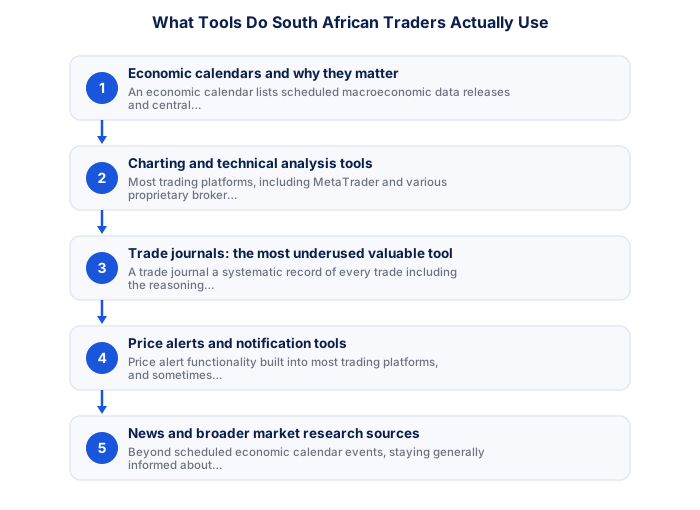
1. Economic calendars and why they matter specifically
An economic calendar lists scheduled macroeconomic data releases and central bank announcements (SARB rate decisions, US Federal Reserve announcements, major employment and inflation data releases) along with their scheduled timing and a general indication of expected market impact. For South African traders specifically, watching both local releases (SARB decisions, South African inflation and growth data) and major global releases (particularly US data, given its broad influence on global forex markets including USD/ZAR) is genuinely useful for anticipating periods of likely elevated volatility.
Many traders use economic calendars to either avoid opening new positions immediately before high-impact scheduled releases (given the elevated risk of sharp, unpredictable price movement around these events) or, alternatively, to plan strategies designed to capitalise on the volatility these releases tend to generate, either approach benefits from simply knowing in advance when these events are scheduled, which an economic calendar provides clearly and reliably.
2. Charting and technical analysis tools
Most trading platforms, including MetaTrader and various proprietary broker platforms, include reasonably capable built-in charting tools covering multiple timeframes and a range of standard technical indicators. Some traders supplement these with dedicated third-party charting platforms offering additional analytical features, more extensive indicator libraries, or particular visual styles and customisation options some traders specifically prefer over their broker's built-in charting.
See also: What Is a Good Framework for Analysing USD/ZAR?
See also: How Do I Manage Trading Notification Volume?
See also: What Is a Multi-Broker Monitoring Tool?
See also: How Do Sovereign Credit Rating Reviews Affect the Rand?
See also: How Do Political Events Affect Markets?
See also: How Do I Open a Trading Account as a South African?
See also: What Does the Term Lot Size Mean in Forex Trading?
See also: How Does Emigration Affect My South African Trading Accou
See also: How Does Load Shedding Affect My Trading Day?
See also: What Are Common SA Trading Scams and How Do I Spot Them?
See also: How Does Trading the VIX or Volatility Index Products Wor
See also: How Do I Read an Economic Calendar in South African Time?
Whether built into the trading platform or used as a separate dedicated tool, the specific charting software matters less than developing genuine skill in reading and interpreting whatever charts you're using consistently, switching between different charting tools frequently, chasing marginal feature differences, often costs more in lost familiarity and consistency than it gains in any specific additional feature.
- SARB economic calendar checked for the week
- Next Eskom load shedding schedule reviewed
- GNU stability news reviewed
- Stats SA data releases noted
- Credit agency review dates checked
- US/global events that move EM risk noted
- Full charting and analysis
- Best for trade entry
- Multi-monitor support
- More order types available
- Monitor and manage on the go
- Load shedding backup use
- Push price alerts
- Limited charting tools
3. Trade journals: the most underused valuable tool
A trade journal, a systematic record of every trade including the reasoning for entry, the specific strategy rule being applied, the outcome, and reflective notes on what went well or poorly, is widely cited by experienced traders as one of the single most valuable tools for genuine skill development, despite being far simpler and less technically sophisticated than charting software or automated trading systems.
This can be as simple as a spreadsheet or dedicated note-taking app, and doesn't require any specialised trading-specific software, though some traders do use purpose-built trade journaling tools that integrate directly with their trading platform's history export functionality. What matters more than the specific tool used is the consistency and honesty of the practice, reviewing your own documented trades regularly and honestly, looking for genuine patterns in what's working and what isn't, rather than simply logging trades without ever revisiting and analysing them.
| Event | Frequency | ZAR impact | Source |
|---|---|---|---|
| SARB MPC | 6x per year | High | resbank.co.za |
| Budget Speech | Annual (February) | Very high | treasury.gov.za |
| Credit reviews | Annual each agency | Very high | Agency sites |
| Stats SA CPI | Monthly | Medium | statssa.gov.za |
| Eskom stage | As needed | Low-medium | eskomsepush.com |
- SA context provides genuine informational edge
- ZAR pairs accessible via FSCA brokers in ZAR accounts
- Rand volatility creates larger intraday ranges
- 6 SARB meetings/year create regular macro setups
- Higher geopolitical risk than G10 pairs
- Load shedding creates unique operational disruptions
- SA rand liquidity thinner than major G10 pairs
- SA-specific news requires constant local monitoring
4. Price alerts and notification tools
Price alert functionality, built into most trading platforms, and sometimes supplemented by dedicated third-party alert services, lets traders set specific price levels that trigger a notification (often via mobile push notification, SMS, or email) without requiring continuous, active chart-watching throughout the day. This is particularly valuable for traders balancing trading with other commitments like full-time work, since it allows monitoring for specific, predefined conditions without needing constant manual attention.
Setting alerts at key technical levels identified during your structured analysis sessions, rather than constantly adjusting alerts reactively throughout the day, supports a disciplined, time-bounded trading routine particularly suited to traders with limited available daily time for active monitoring.
5. News and broader market research sources
Beyond scheduled economic calendar events, staying generally informed about broader financial news and market developments, through reputable financial news sources, broker-provided market commentary and analysis, or other research resources, helps build the broader contextual understanding that informs trading decisions beyond pure technical chart analysis alone, particularly for instruments like USD/ZAR or gold where macro developments play a significant role in price movement.
Being selective and critical about news sources matters here, favouring established, reputable financial news outlets over less reliable social media commentary or unverified "trading guru" content, particularly given how much low-quality or actively misleading trading-related content circulates on social media platforms specifically targeting inexperienced traders with promises of easy profits.
6. Avoiding the common trap of tool overload
A common pattern among newer traders is accumulating an excessive number of tools, indicators, and information sources, under the mistaken belief that more inputs automatically produce better trading decisions. In practice, this often produces the opposite effect: information overload, analysis paralysis, and difficulty maintaining the kind of disciplined, consistent strategy execution that genuinely drives good trading outcomes, since too many competing inputs and signals can make it harder, not easier, to apply a clear, consistent decision-making process.
A more effective approach for most traders involves deliberately limiting the core toolset to a small number of well-understood, consistently applied tools, a chosen charting setup, a specific economic calendar habit, and a disciplined trade journal, rather than constantly adding new indicators, signal services, or information sources in pursuit of some marginal additional edge that rarely materialises in practice and often actively undermines the consistency that good trading requires.
Read the agreement on what occurs if a loss exceeds the deposit. negative balance protection is offered by some providers and withheld by others.
Most South African traders use MT4 or MT5 as their trading platform and TradingView for charting. Forex Factory or Investing.com for economic calendars and a free position size calculator round out the core toolkit.
★ Why It Matters
Something worth testing specifically: track for two weeks which of your current tools you actually open and use versus which ones you installed once and rarely touch again, most traders accumulate considerably more tools over time than they're still using.
✕ Common mistakes
- Accumulating tools over time without periodically reviewing actual usage. Most traders end up using far fewer tools than they've installed.
- Assuming more tools automatically means more thorough analysis. A smaller, genuinely used set tends to serve decision-making better than a sprawling collection.
- Underestimating the trading journal's practical value relative to flashier tools. This deceptively simple tool is frequently among the most valuable.
- Not testing whether a new tool actually improves results before adopting it permanently. A trial period with measurable comparison clarifies genuine value.
Key Takeaways
- Beyond the trading platform itself, most South African traders use economic calendars, charting software, and trade journals. Here's what's actually useful.
- Beyond the trading platform itself, most active South African traders rely on an economic calendar, dedicated charting tools, and a trade journal.
- The trade journal is a deceptively simple tool that's frequently among the most genuinely valuable.
- Economic calendars and why they matter specifically.
- Charting and technical analysis tools.
Site owners can offer several of these tools directly to their readers through the free trading widget library, which covers calculators, live rates and an economic calendar.
Frequently asked follow-up questions
Do I need to pay for premium trading tools to succeed?
Not necessarily, many genuinely effective tools (built-in platform charting, basic economic calendars, simple trade journal spreadsheets) are free; premium tools can offer convenience or additional features but aren't a prerequisite for sound trading practice.
Is social media a reliable source for trading signals or tips?
Generally not recommended as a primary source, given the substantial volume of low-quality, misleading, or outright fraudulent trading content circulating on social media specifically targeting inexperienced traders.
How often should I review my trade journal?
Many traders find a regular weekly review rhythm useful for spotting patterns, though the specific frequency matters less than maintaining genuine consistency and honesty in the review process itself.
