What this page covers
South Africa does not tax a capital gain at a separate rate. A portion of the gain is included in taxable income and taxed at your marginal rate, which is why the effective rate depends on what else you earn.
★ What changed this year
Nothing changed for 2026/27. The inclusion rate has been 40% for individuals since 2016/17 and the annual exclusion has been R50,000 since 2016/17. The effective maximum moved from 16.4% to 18.0% in 2017/18 because the top marginal rate rose to 45%, not because the CGT rules themselves changed.
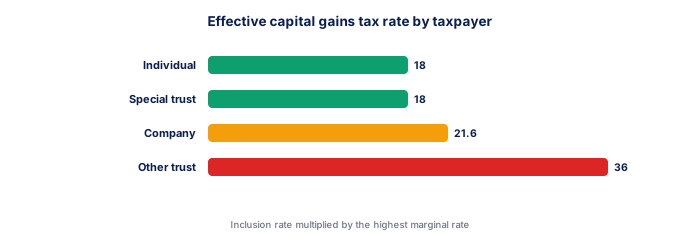
| Taxpayer | Inclusion rate | Highest marginal rate | Effective CGT rate |
|---|---|---|---|
| Individual | 40% | 45% | 18% |
| Special trust | 40% | 45% | 18% |
| Company | 80% | 27% | 21.6% |
| Other trust | 80% | 45% | 36% |
| Exclusion | Amount | Applies to |
|---|---|---|
| Annual exclusion | R50,000 | Individuals and special trusts, each year |
| Exclusion in the year of death | R440,000 | Replaces the annual exclusion |
| Primary residence | R3,000,000 of the gain | One residence, mainly used as a home |
| Small business assets | R2,700,000 lifetime | Owner aged 55 or older, or on ill health |
| Personal use assets | Full gain | Assets not held for investment |
| Year | Individual inclusion | Company inclusion | Annual exclusion |
|---|---|---|---|
| 2026/27 | 40% | 80% | R50,000 |
| 2025/26 | 40% | 80% | R40,000 |
| 2024/25 | 40% | 80% | R40,000 |
| 2016/17, when last raised | 40% | 80% | R50,000 |
| Gain | Included in income | At 26% marginal | At 36% marginal | At 45% marginal |
|---|---|---|---|---|
| R100,000 | R24,000 | R6,240 | R8,640 | R10,800 |
| R250,000 | R84,000 | R21,840 | R30,240 | R37,800 |
| R500,000 | R184,000 | R47,840 | R66,240 | R82,800 |
| R1,000,000 | R384,000 | R99,840 | R138,240 | R172,800 |
| Year | Individual inclusion | Company inclusion | Annual exclusion | Maximum effective, individual |
|---|---|---|---|---|
| 2026/27 | 40% | 80% | R50,000 | 18.0% |
| 2025/26 | 40% | 80% | R40,000 | 18.0% |
| 2024/25 | 40% | 80% | R40,000 | 18.0% |
| 2023/24 | 40% | 80% | R40,000 | 18.0% |
| 2022/23 | 40% | 80% | R40,000 | 18.0% |
| 2021/22 | 40% | 80% | R40,000 | 18.0% |
| 2020/21 | 40% | 80% | R40,000 | 18.0% |
| 2019/20 | 40% | 80% | R40,000 | 18.0% |
| 2018/19 | 40% | 80% | R40,000 | 18.0% |
| 2017/18 | 40% | 80% | R40,000 | 18.0% |
| 2016/17 | 40% | 80% | R40,000 | 16.4% |
| 2015/16 | 33.3% | 66.6% | R30,000 | 13.7% |
| 2012/13 | 33.3% | 66.6% | R30,000 | 13.3% |
| 2011/12 | 25% | 50% | R20,000 | 10.0% |

Download this data
Every table on this page as a spreadsheet, with the source and the date it was checked in the header rows.
⬇ Download CSVHow these figures work
A capital gain is not taxed at its own rate in South Africa. A portion of it, the inclusion rate, is added to taxable income and taxed at whatever your marginal rate turns out to be. The effective rate quoted in the table is the maximum: inclusion rate multiplied by the highest marginal rate.
The gain itself is proceeds less base cost. Base cost includes what you paid plus the costs of acquiring and disposing, so brokerage, securities transfer tax and transfer costs all reduce the gain. The annual exclusion is then applied to the net figure for the year, after losses have been set off against gains.
★ A worked example
An individual sells a JSE share portfolio for R620,000 that cost R400,000, having paid R6,200 in brokerage and securities transfer tax across the two transactions.
The gain is R620,000 less R400,000 less R6,200, which is R213,800. Subtract the annual exclusion of R50,000 and R163,800 remains. At the 40% inclusion rate, R65,520 is added to taxable income.
If that income falls in the 36% bracket, the tax on the gain is R23,587, an effective rate of 11.0% on the original gain rather than the 18% maximum.
✕ Common mistakes
- Applying the effective rate to the gain directly. The 18% figure is a ceiling that only applies at the top marginal rate. Most disposals are taxed at well below it.
- Forgetting to add transaction costs to base cost. Brokerage, securities transfer tax and Strate fees all reduce the gain. Leaving them out overstates the tax.
- Using the annual exclusion per disposal. It applies once a year to the net gain, not to each sale.
- Assuming a loss reduces other income. A capital loss offsets capital gains, this year or in a later year. It does not reduce salary or trading income.
Notes on reading these figures
- The annual exclusion applies to the net gain for the year, after losses. A loss carried forward reduces a later gain rather than other income.
- Whether a share disposal is capital or revenue is the question that decides which set of rules applies. Holding a JSE share for at least three years creates a statutory presumption that the disposal is capital.
- Foreign assets are included at the rand value on the date of each transaction, so the exchange rate movement between purchase and sale forms part of the gain.
To put these figures to work, the Capital Gains Tax Calculator runs the arithmetic on your own numbers, and Securities Transfer Tax Calculator covers the same ground in ordinary language. SARS Income Tax Tables and Completing the ITR12 go into the detail this table only summarises.
Terms used on this page
Put this table on your own site
The table below can sit on your own page and stays current without you editing anything.
- Preview the embeddable table as it will appear on your site
Add the code below to your own site. The table it renders is served from here, so it never goes stale.
<iframe src="https://www.tradeanswers.co.za/embed/ref-capital-gains-tax-rates-and-exclusions.html" width="100%" height="620" style="border:0" title="Capital Gains Tax Rates and Exclusions"></iframe>Free to use with attribution. The link back to this page is built into the embed.
Frequently asked questions
Is my share sale capital or revenue?
It depends on intention and pattern. Frequent short-term trading points to revenue; holding for growth points to capital. Holding a JSE share for at least three years creates a statutory presumption that the disposal is capital.
Does the annual exclusion apply to every asset?
It applies to the net gain for the year across all assets, not per asset. The primary residence and small business exclusions are separate and apply on top.
How is a foreign asset treated?
Proceeds and base cost are both converted to rand at the rate on each transaction date, so the exchange rate movement between purchase and sale forms part of the gain.
What happens to a capital loss?
It is set off against capital gains in the same year. Anything left carries forward indefinitely against future gains.
Do I pay CGT inside a tax-free savings account?
No. Gains inside the wrapper are exempt, which is what makes it the first place to hold growth assets.
Does CGT apply to CFDs?
Rarely. A CFD position is almost always revenue in nature given how it is used, so the profit is taxed at the full marginal rate rather than through the CGT rules.