i Short answer
Lot size refers to the standardised unit of trade volume in forex trading, with standard, mini, and micro lots representing progressively smaller increments.
📋 ON THIS PAGE
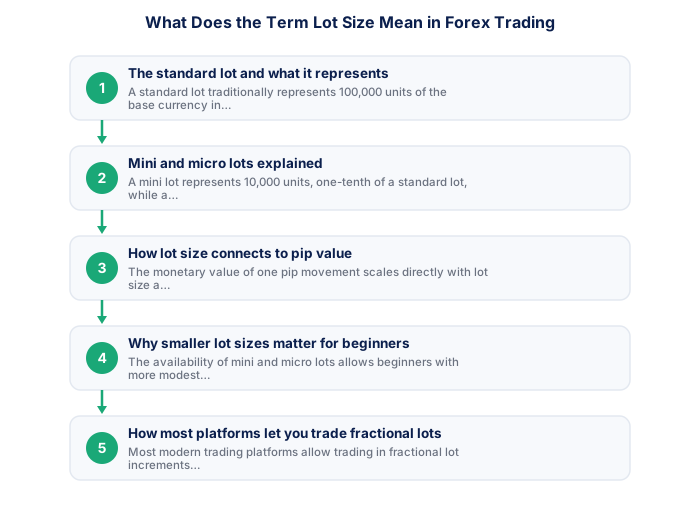
1. The standard lot and what it represents
A standard lot traditionally represents 100,000 units of the base currency in a forex trade, serving as the original, foundational unit size around which forex trading volume conventions developed, though most retail traders today trade considerably smaller sizes than this full standard lot.
It's worth pausing on the sheer scale this represents for a moment, a single standard lot commits you to controlling 100,000 units of currency, which is precisely why leverage, discussed elsewhere on this site, becomes essential for most retail traders to access this instrument size at all.
| Lot Type | Units |
|---|---|
| Standard | 100,000 |
| Mini | 10,000 |
| Micro | 1,000 |
2. Mini and micro lots explained
A mini lot represents 10,000 units, one-tenth of a standard lot, while a micro lot represents 1,000 units, one-hundredth of a standard lot, these smaller increments allow retail traders to size positions more precisely and with considerably less capital than a full standard lot would require.
It's worth appreciating why these smaller increments developed specifically for retail trading, standard lots alone would put trading genuinely out of reach for most individual traders with modest starting capital, mini and micro lots specifically democratised access to forex trading at meaningful, sustainable position sizes.
- P = Position size in lots
- R = ZAR amount at risk (1-2% of account)
- S = Stop distance in pips from entry
- V = Pip value per lot for this instrument
Set account risk %
Define maximum capital at risk per trade, typically 1-2%.
Measure stop distance
Find your stop-loss level on the chart before calculating size.
Calculate pip value
Use the instrument-specific pip value for your lot size.
Compute position size
Position size = (ZAR at risk) / (stop pips x pip value).
Confirm free margin
Ensure required margin fits within your available free margin.
3. How lot size connects to pip value
The monetary value of one pip movement scales directly with lot size. A standard lot's pip value is ten times a mini lot's, and one hundred times a micro lot's, making this relationship directly relevant to broader position sizing calculations.
It's worth internalising this proportional relationship as a genuine mental shortcut, once you know a standard lot's approximate pip value for a given pair, halving or quartering that figure for mini and micro lots respectively becomes an almost automatic calculation.
| Account | Risk % | Max loss (ZAR) | At 1:30 leverage | Notional position |
|---|---|---|---|---|
| R50,000 | 1% | R500 | 1:30 | R15,000 |
| R50,000 | 2% | R1,000 | 1:30 | R30,000 |
| R50,000 | 5% | R2,500 | 1:30 | R75,000 |
| R100,000 | 1% | R1,000 | 1:30 | R30,000 |
- Access larger positions with less capital
- Amplifies returns on winning trades
- Short-selling available without share borrowing
- Losses amplified equally, 10x leverage, 10x loss
- Overnight financing reduces long-term returns
- Margin calls can force closure at worst moments
4. Why smaller lot sizes matter for beginners specifically
The availability of mini and micro lots allows beginners with more modest starting capital, to maintain appropriately small position sizes relative to their account, rather than being forced into oversized standard-lot positions.
It's worth resisting any temptation to trade larger lot sizes purely to feel like a more 'serious' trader, the size of your positions should be driven entirely by your calculated risk tolerance, discussed throughout this site, not by any sense that bigger positions signal greater trading competence.
5. How most platforms let you trade fractional lots
Most modern trading platforms allow trading in fractional lot increments beyond just standard, mini, and micro categories, providing even finer position sizing control, than these traditional fixed categories alone would allow.
It's worth actually testing your specific platform's minimum lot increment before you need it for a genuine trade, confirming this detail in advance, perhaps on a demo account, means you already know exactly what precision is available when a real, calculated position size requires it.
- Confirm account equity
- Calculate 1-2% risk in ZAR
- Identify stop-loss level from chart
- Measure stop distance in pips
- Look up pip value for instrument
- Compute position size
- Verify required margin fits free margin
6. Connecting this to your own position sizing calculation
Understanding lot size and its direct relationship to pip value provides the foundational vocabulary needed to actually perform and understand that broader calculation correctly when determining your own appropriate trade size.
Position sizing is the single most controllable variable in a trading system, and beginners consistently underweight it relative to entry and exit methodology. A strategy with a modest edge but disciplined position sizing will outperform a high-quality strategy with poor position sizing over any meaningful sample of trades. The core principle is that position size should be determined by the account risk tolerance and the stop-loss distance on the specific trade, not by a fixed lot count. This means position size varies from trade to trade depending on the chart structure of each setup. South African traders should incorporate a position sizing calculation into their pre-trade checklist as a non-negotiable step, completed before order entry on every trade without exception, regardless of how confident they feel about the particular setup.
A standard lot of 100,000 units carries a much higher pip value than a mini lot of 10,000 or a micro lot of 1,000. Choosing an appropriate lot size is how position sizing stays proportional to account capital.
★ Why It Matters
Worth doing as a specific exercise: calculate your exact position size in lots for your actual risk tolerance before opening your platform, rather than defaulting to round numbers like 0.1 lots, the lot size that matches your genuine risk rule is often an oddly specific decimal, not a clean round figure.
✕ Common mistakes
- Assuming lot size definitions are identical across all instrument types. The exact meaning can differ between forex pairs, indices, and commodities.
- Not verifying lot size assumptions when trading an unfamiliar instrument for the first time. A wrong assumption here directly affects your real risk exposure.
- Confusing lot size with leverage when sizing a position. These are related but distinct concepts in the sizing calculation.
Key Takeaways
- Lot size refers to the standardised unit of trade volume, with standard, mini, and micro lots representing progressively smaller position size increments.
- Lot size refers to the standardised unit of trade volume in forex trading, with standard, mini, and micro lots representing progressively smaller increments.
- The standard lot and what it represents.
- Mini and micro lots explained.
- How lot size connects to pip value.
Frequently asked follow-up questions
Can I trade less than a micro lot if my account is very small?
Some brokers do offer even smaller fractional sizing below a standard micro lot; checking your specific broker's minimum trade size confirms what's available for your particular account.
Does lot size terminology apply to instruments beyond forex pairs?
Similar volume-unit concepts apply across various instruments, though specific terminology and unit sizes can vary by instrument category.
Is trading a full standard lot common among retail traders?
This is less common for typical retail accounts given the capital this requires, with most retail trading occurring at mini, micro, or fractional sizes instead.
Does my broker's platform automatically calculate the correct lot size for my risk tolerance?
Many platforms include position size calculators, that translate your risk percentage and stop-loss distance into the appropriate corresponding lot size automatically.
Can lot size affect the spread I'm charged on a trade?
Generally the spread itself is typically quoted independently of lot size, though your total cost in monetary terms naturally scales with however large a position you actually trade.
