i Short answer
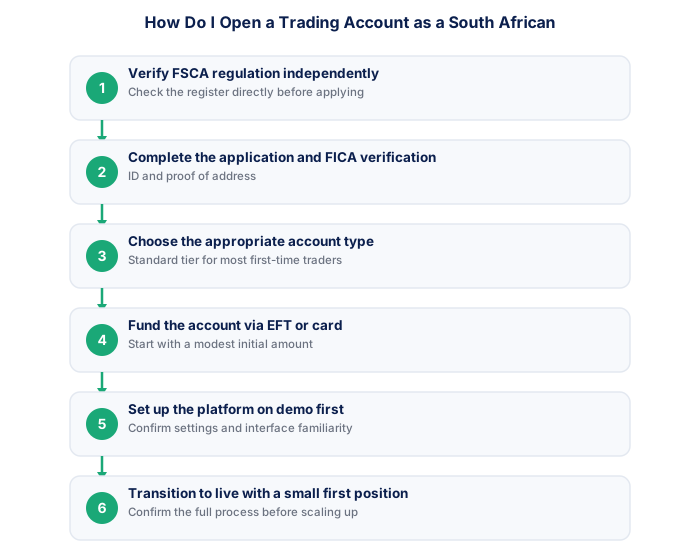
Opening a South African trading account involves choosing an FSCA-regulated broker, completing FICA identity and address verification, funding the account through a supported deposit method, and typically starting on a demo account before transitioning to live trading.
The FICA verification step is usually the main time factor, generally same-day to a few business days depending on the broker and document quality, with the rest of the process often completable in under an hour.
📋 ON THIS PAGE
1. Choosing a broker before you start the application
Confirm FSCA regulation directly on the FSCA's public register before applying anywhere, checking that the exact company name and FSP number match what the broker itself displays. This single step significantly reduces the risk of ending up with an unregulated or misrepresented entity.
Beyond regulation, compare the specific account types offered, minimum deposit requirements, available platforms, and whether the broker supports Rand-denominated accounts, since this affects both convenience and currency conversion costs on every deposit and withdrawal.
2. The application and FICA verification process
The initial application typically requires basic personal details, contact information, and some employment or income information, completed through an online form directly on the broker's website. FICA verification then requires a clear copy of your South African ID or passport, and a recent proof of address, typically a utility bill or bank statement under three months old.
Photographing documents in good lighting against a plain background, ensuring all four corners and all text are clearly legible, reduces the chance of a rejected submission requiring resubmission, which is the most common cause of delay beyond the broker's own processing time.
- SARB economic calendar checked for the week
- Next Eskom load shedding schedule reviewed
- GNU stability news reviewed
- Stats SA data releases noted
- Credit agency review dates checked
- US/global events that move EM risk noted
Choose FSCA-regulated broker
Verify the FSP number is current at fsca.co.za.
Submit FICA documents
SA ID, proof of address within 3 months, bank account proof.
Fund via EFT
Make the initial deposit from your SA bank account in ZAR.
Open demo account first
Practice on demo before activating your live account.
Start with minimum capital
Begin with an amount you can afford to lose while learning.
3. Understanding the account types on offer
Most brokers offer multiple account tiers, commonly distinguished by minimum deposit, spread and commission structure, and sometimes maximum available leverage. A standard or basic account tier is generally the appropriate starting point for a first-time trader, rather than a higher tier requiring a larger minimum deposit.
Some brokers also offer a swap-free account option for traders who prefer to avoid overnight financing charges; consider this at account opening if it's relevant to you, since it is not always something you can switch into after account opening without additional steps.
| Event | Frequency | ZAR impact | Source |
|---|---|---|---|
| SARB MPC | 6x per year | High | resbank.co.za |
| Budget Speech | Annual (February) | Very high | treasury.gov.za |
| Credit reviews | Annual each agency | Very high | Agency sites |
| Stats SA CPI | Monthly | Medium | statssa.gov.za |
| Eskom stage | As needed | Low-medium | eskomsepush.com |
- SA context provides genuine informational edge
- ZAR pairs accessible via FSCA brokers in ZAR accounts
- Rand volatility creates larger intraday ranges
- 6 SARB meetings/year create regular macro setups
- Higher geopolitical risk than G10 pairs
- Load shedding creates unique operational disruptions
- SA rand liquidity thinner than major G10 pairs
- SA-specific news requires constant local monitoring
4. Funding your account for the first time
South African traders typically fund accounts through local EFT, which is usually the lowest-cost and most straightforward method, generally reflecting same day depending on your bank and the broker's processing cutoff times. Card deposits are often instant but occasionally carry a small processing fee depending on the broker.
Starting with a modest initial deposit, rather than your full intended trading capital, is a reasonable approach for a first-time account, letting you confirm the funding process, platform access, and withdrawal process actually work smoothly before committing your full amount.
5. Setting up the platform and starting on demo
Most brokers provide access to MetaTrader 4 or 5, or a proprietary platform, available as desktop, web, and mobile versions. Downloading and familiarising yourself with the platform on a demo account, even briefly, before your first live trade helps regardless of your prior trading experience, since each broker's specific interface has small differences worth knowing in advance.
Confirming your account's specific leverage setting, base currency, and any applied bonus terms during this demo period, rather than assuming default settings, avoids surprises once you transition to live trading.
6. The transition from demo to your first live trade
There is no fixed required demo period before going live, but confirming you are comfortable with order placement, stop-loss setting, and basic navigation on the specific platform, not just the general concept of trading, is a reasonable practical bar before your first live position.
Starting your first live trades with a deliberately small position size, smaller than your eventual intended size, lets you confirm the full live-trading process, execution, statements, and eventually a test withdrawal, behaves as expected before scaling up.
★ Why It Matters
Worth requesting your broker's FICA document requirements in writing before you start gathering documents, since acceptable proof-of-address formats occasionally vary slightly between brokers, and confirming this upfront avoids a preventable resubmission delay.
✕ Common mistakes
- Skipping independent FSCA verification before applying. Confirming the broker's regulation status directly avoids relying solely on their own claims.
- Submitting blurry or partially cropped FICA documents. Poor quality submissions are the most common cause of avoidable verification delay.
- Depositing your full intended capital on the very first funding attempt. A smaller initial deposit lets you confirm the process works smoothly first.
- Going live without any demo familiarity with that specific broker's platform. Each platform has interface differences worth knowing before real capital is on the line.
How long does account verification take at most South African brokers?
Most FSCA-regulated brokers complete identity verification within one to three business days when all required documents are submitted correctly. Electronic document submission often accelerates the process.
Key Takeaways
- Opening a South African trading account involves choosing an FSCA-regulated broker, completing FICA identity and address verification, funding the account through a supported deposit method, and typically starting on a demo account before transitioning to live trading.
- Choosing a broker before you start the application.
- The application and FICA verification process.
- Understanding the account types on offer.
- Funding your account for the first time.
Frequently asked follow-up questions
How long does the full account opening process typically take?
The application itself often takes under an hour; FICA verification is the main variable, typically same-day to a few business days depending on the broker and document quality.
Can I open more than one trading account with different brokers?
Yes, there is no restriction on holding accounts with multiple FSCA-regulated brokers simultaneously, and FICA verification must be completed separately with each.
Do I need a minimum amount of trading experience to open an account?
No, most brokers do not require prior experience to open an account, though completing a genuine demo period first is widely recommended regardless of the account opening requirements themselves.
