What this page covers
A dividend paid by a South African company carries 20% withholding tax, deducted before the money reaches you. A dividend from a foreign company is withheld at that country's rate, then taxed again here, with relief depending on the treaty.
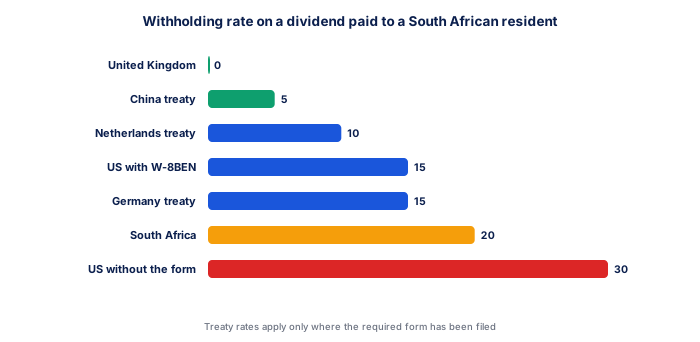
★ What changed this year
Nothing changed for 2026/27. The 20% rate has applied since February 2017. The structural change was in 2012, when dividends tax replaced secondary tax on companies and the burden moved from the company to the shareholder, which is why a dividend statement from before 2012 looks different.
| Recipient | Rate | Note |
|---|---|---|
| South African individual | 20% | Withheld at source, no further tax due |
| Tax-free savings account | 0% | Exempt inside the wrapper |
| Retirement fund | 0% | Exempt |
| South African company | 0% | Exempt between resident companies |
| REIT distribution | Taxed as income | Not subject to DWT for residents |
| Source country | Statutory rate | Treaty rate with South Africa |
|---|---|---|
| United States | 30% | 15% with a valid W-8BEN |
| United Kingdom | 0% | 0% |
| Germany | 26.375% | 15% |
| Netherlands | 15% | 5% or 10%, depending on holding |
| Australia | 30% | 15% |
| China | 10% | 5% |
| From | Rate | Note |
|---|---|---|
| 22 February 2017 | 20% | The current rate |
| 1 April 2012 | 15% | Dividends tax replaced secondary tax on companies |
| Before April 2012 | 10% STC | Levied on the company, not the shareholder |
| Source | Withheld | Net to you |
|---|---|---|
| South African company | R2,000 | R8,000 |
| South African company, inside a TFSA | R0 | R10,000 |
| United States, with W-8BEN | R1,500 | R8,500 |
| United States, without it | R3,000 | R7,000 |
| United Kingdom | R0 | R10,000 before SA tax |
| From | Mechanism | Rate | Who paid it |
|---|---|---|---|
| 22 February 2017 | Dividends tax | 20% | The shareholder, withheld at source |
| 1 April 2012 | Dividends tax | 15% | The shareholder, withheld at source |
| 1 October 2007 | Secondary tax on companies | 10% | The company, on net dividends |
| Before October 2007 | Secondary tax on companies | 12.5% | The company |

Download this data
Every table on this page as a spreadsheet, with the source and the date it was checked in the header rows.
⬇ Download CSVHow these figures work
Dividends tax is a withholding tax, which means the company or the regulated intermediary deducts it before you see the money. You do not declare and pay it separately, and it does not depend on your marginal rate.
A foreign dividend works differently. It is included in South African taxable income, with a partial exemption that leaves an effective rate of around 20% for most individuals. Tax already withheld in the source country is credited against that, which is why a lower treaty rate leaves more in your hand rather than simply moving the tax elsewhere.
★ A worked example
A South African resident holds a United States share paying a USD 1,000 dividend, at an exchange rate of R18.50.
Without a W-8BEN, the United States withholds 30%, so USD 300 is deducted and USD 700 arrives, which is R12,950. With a valid W-8BEN the treaty rate of 15% applies, USD 150 is withheld and USD 850 arrives, which is R15,725.
In both cases the gross dividend is declared here and the foreign tax is credited, but the form is worth R2,775 on this single dividend.
✕ Common mistakes
- Not filing the W-8BEN. It takes minutes at account opening and halves United States withholding from 30% to 15%. It expires after three years and has to be renewed.
- Assuming the broker applies the treaty rate automatically. Some do, some do not. Check what was actually withheld on the dividend statement rather than assuming.
- Treating a REIT distribution as a dividend. South African REIT distributions are taxed as ordinary income at your marginal rate, not at the flat 20%.
- Forgetting foreign dividends are declared here. The foreign withholding is not the end of it. The dividend is included in South African taxable income with a credit for tax already paid.
Notes on reading these figures
- A foreign dividend is included in South African taxable income, with an exemption that leaves an effective rate of 20% for most individuals. Foreign tax already withheld is credited against that, so the treaty rate matters directly.
- The W-8BEN form is what reduces United States withholding from 30% to 15%. Most South African brokers collect it at account opening and renew it every three years.
- Treaty rates change. Check the specific treaty before relying on a rate for a large position, and confirm what your broker actually withholds, which is not always the treaty rate.
To put these figures to work, the Dividend Withholding Tax Calculator runs the arithmetic on your own numbers, and Dividend Yield Calculator covers the same ground in ordinary language. SARS Income Tax Tables and How REITs are taxed go into the detail this table only summarises.
Terms used on this page
Put this table on your own site
The table below can sit on your own page and stays current without you editing anything.
- Preview the embeddable table as it will appear on your site
Add the code below to your own site. The table it renders is served from here, so it never goes stale.
<iframe src="https://www.tradeanswers.co.za/embed/ref-dividend-withholding-tax-by-country.html" width="100%" height="620" style="border:0" title="Dividend Withholding Tax by Country"></iframe>Free to use with attribution. The link back to this page is built into the embed.
Frequently asked questions
Who deducts the 20% on a South African dividend?
The company or the regulated intermediary, usually your broker. It reaches you net, and nothing further is due.
What is a W-8BEN?
A United States tax form declaring that you are not a United States person and claiming the treaty rate. Without it, withholding is 30% rather than 15%.
Are dividends exempt inside a TFSA?
South African dividends are, entirely. Foreign dividends still suffer withholding in the source country, which cannot be reclaimed through the wrapper.
Can I reclaim foreign withholding tax?
Not usually as a refund. It is credited against the South African tax on the same dividend, which achieves a similar result up to the South African rate.
Does the treaty rate apply automatically?
Only where the required form has been filed and accepted. Otherwise the statutory rate applies and the difference is generally not recoverable.
What about dividends from a dual listed company?
It depends where the company is tax resident, not where the share is listed. A company resident in South Africa pays South African dividends tax even on shares bought abroad.