What this page covers
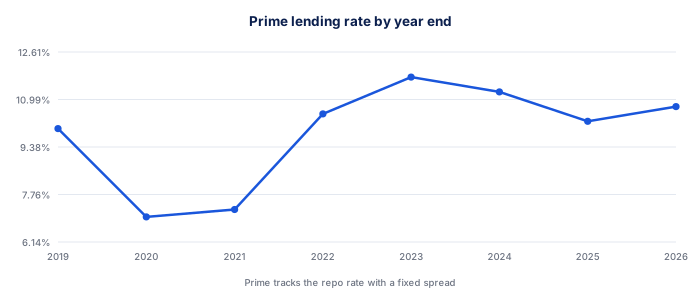
Prime is not set by the Reserve Bank. It is the rate commercial banks quote to their lowest risk borrowers, and it has sat at the repo rate plus 3.5 percentage points for years, which makes it move mechanically with every MPC decision.
★ What changed this year
Prime moved from 10.25% to 10.75% during 2026, tracking the two repo increases. On a R1 million bond over twenty years that is roughly R340 a month, or about R82,000 over the remaining term. The 3.5 percentage point spread over the repo rate did not change, as it has not for more than two decades.
| Effective from | Repo | Prime | Spread |
|---|---|---|---|
| 24 September 2026 | 7.25% | 10.75% | 3.50 |
| 29 May 2026 | 7.00% | 10.50% | 3.50 |
| 20 November 2025 | 6.75% | 10.25% | 3.50 |
| 31 July 2025 | 7.00% | 10.50% | 3.50 |
| 29 May 2025 | 7.25% | 10.75% | 3.50 |
| 30 January 2025 | 7.50% | 11.00% | 3.50 |
| July 2020, cycle low | 3.50% | 7.00% | 3.50 |
| May 2023, cycle high | 8.25% | 11.75% | 3.50 |
| Product | Typical pricing |
|---|---|
| Home loan | Prime, or prime less a margin for a strong applicant |
| Vehicle finance | Prime plus 1 to 3 percentage points |
| Personal loan | Prime plus a wide margin, capped by the NCA |
| Credit card | Capped by the National Credit Act formula |
| Margin lending | Set by the broker, often referenced to prime |
| Date | Repo | Prime | What it marked |
|---|---|---|---|
| September 2026 | 7.25% | 10.75% | Current level |
| November 2025 | 6.75% | 10.25% | Cycle low of the cutting phase |
| May 2023 | 8.25% | 11.75% | Peak of the hiking cycle |
| July 2020 | 3.50% | 7.00% | Record low |
| January 2016 | 6.75% | 10.25% | Mid-cycle for comparison |
| Loan | At 10.25% | At 10.75% | At 11.75% |
|---|---|---|---|
| R750,000 | R7,370 | R7,620 | R8,130 |
| R1,000,000 | R9,820 | R10,160 | R10,840 |
| R1,500,000 | R14,730 | R15,240 | R16,260 |
| R2,000,000 | R19,640 | R20,320 | R21,680 |
| Year | Prime | Repo | Spread | Monthly cost of R1m over 20 years |
|---|---|---|---|---|
| 2026 | 10.75% | 7.25% | 3.50 | R10,160 |
| 2025 | 10.25% | 6.75% | 3.50 | R9,820 |
| 2024 | 11.25% | 7.75% | 3.50 | R10,500 |
| 2023 | 11.75% | 8.25% | 3.50 | R10,840 |
| 2022 | 10.50% | 7.00% | 3.50 | R9,980 |
| 2021 | 7.25% | 3.75% | 3.50 | R7,900 |
| 2020 | 7.00% | 3.50% | 3.50 | R7,750 |
| 2019 | 10.00% | 6.50% | 3.50 | R9,650 |
| 2018 | 10.25% | 6.75% | 3.50 | R9,820 |
| 2017 | 10.25% | 6.75% | 3.50 | R9,820 |
| 2016 | 10.50% | 7.00% | 3.50 | R9,980 |
| 2015 | 9.75% | 6.25% | 3.50 | R9,490 |
| 2014 | 9.25% | 5.75% | 3.50 | R9,170 |
| 2013 | 8.50% | 5.00% | 3.50 | R8,680 |
| 2012 | 8.50% | 5.00% | 3.50 | R8,680 |
| 2011 | 9.00% | 5.50% | 3.50 | R9,000 |
| 2010 | 9.00% | 5.50% | 3.50 | R9,000 |
| 2009 | 10.50% | 7.00% | 3.50 | R9,980 |
| 2008 | 15.50% | 12.00% | 3.50 | R13,540 |
| 2007 | 14.50% | 11.00% | 3.50 | R12,800 |
| 2006 | 12.50% | 9.00% | 3.50 | R11,360 |
| 2005 | 10.50% | 7.00% | 3.50 | R9,980 |
| 2004 | 11.00% | 7.50% | 3.50 | R10,320 |
| 2003 | 11.50% | 8.00% | 3.50 | R10,670 |
| 2002 | 17.00% | 13.50% | 3.50 | R14,690 |
| 2001 | 13.00% | 9.50% | 3.50 | R11,720 |
| 2000 | 14.50% | 12.00% | 3.50 | R12,800 |

Download this data
Every table on this page as a spreadsheet, with the source and the date it was checked in the header rows.
⬇ Download CSVHow these figures work
Prime is a commercial benchmark, not a policy rate. Banks quote it as the rate for their lowest risk borrowers and price everything else relative to it: prime less a margin for a strong home loan applicant, prime plus several points for unsecured credit.
Because the spread over the repo rate has been stable at 3.5 percentage points for years, prime moves mechanically with every MPC decision. The National Credit Act also caps what may be charged using a formula built on the repo rate, so the legal maximum moves too.
★ A worked example
A R1.2 million home loan at prime over twenty years.
At prime of 10.25%, the instalment is roughly R11,800 a month. After two 25 basis point increases take prime to 10.75%, the same loan costs roughly R12,200, an increase of about R400 a month.
Over the remaining term that is close to R96,000 in additional interest, from a change of half a percentage point. This is the transmission mechanism the MPC is relying on when it raises rates to cool demand.
✕ Common mistakes
- Assuming a fixed rate is always safer. A fixed rate is priced with the bank's own view of the cycle built in. It removes uncertainty, at a cost.
- Comparing quoted rates without the margin. Prime less 1% and prime plus 1% differ by two percentage points, which over twenty years is an enormous sum.
- Expecting the change at the next statement. A rate change reaches an existing variable loan on the effective date. The instalment changes that month.
- Treating prime as the Reserve Bank's rate. It is set by commercial banks. The Reserve Bank sets the repo rate, and prime follows by convention rather than by rule.
Notes on reading these figures
- The spread of 3.5 points is a convention, not a rule. Banks could change it, and have in the distant past, but it has been stable for long enough to treat as fixed for planning.
- The National Credit Act caps what a lender may charge using a formula based on the repo rate, which is why the maximum on a credit agreement moves with MPC decisions too.
- A rate change reaches an existing variable rate loan on the effective date, not at the next statement. The instalment changes from that month.
To put these figures to work, the SARB Repo Rate History runs the arithmetic on your own numbers, and SARB MPC Meeting Calendar covers the same ground in ordinary language. Debt Payoff Calculator and How the repo rate differs from prime go into the detail this table only summarises.
Terms used on this page
Put this table on your own site
The table below can sit on your own page and stays current without you editing anything.
- Preview the embeddable table as it will appear on your site
To put the live table on your own page, paste this where you want it to appear. It stays current without you editing anything.
<iframe src="https://www.tradeanswers.co.za/embed/ref-prime-lending-rate-history.html" width="100%" height="620" style="border:0" title="Prime Lending Rate History"></iframe>Free to use with attribution. The link back to this page is built into the embed.
Frequently asked questions
Who sets prime?
Commercial banks, individually. In practice they move together, and the spread over the repo rate has been 3.5 percentage points for years.
Can the spread change?
In principle yes, and it has in the distant past. It has been stable long enough to treat as fixed for planning, but it is a convention, not a rule.
What is prime used for?
Home loans, vehicle finance, personal credit and overdrafts are all priced relative to it, as are many margin facilities.
Does the National Credit Act cap interest?
Yes, using a formula based on the repo rate, which is why the legal maximum on a credit agreement moves with MPC decisions.
How quickly does a rate change reach my loan?
On the effective date announced by the bank, which is usually within days of the MPC decision. The instalment changes from that month.
Should I fix my rate when rates are rising?
The bank prices a fixed rate with its own expectation already included. Fixing buys certainty rather than a lower expected cost.