i Short answer
It depends entirely on your chosen trading style: anywhere from roughly 10 minutes a day for end-of-day swing trading to 6+ hours for active day trading.
Most realistic part-time approaches compatible with a full-time job typically require 30 to 60 minutes daily.
📋 ON THIS PAGE
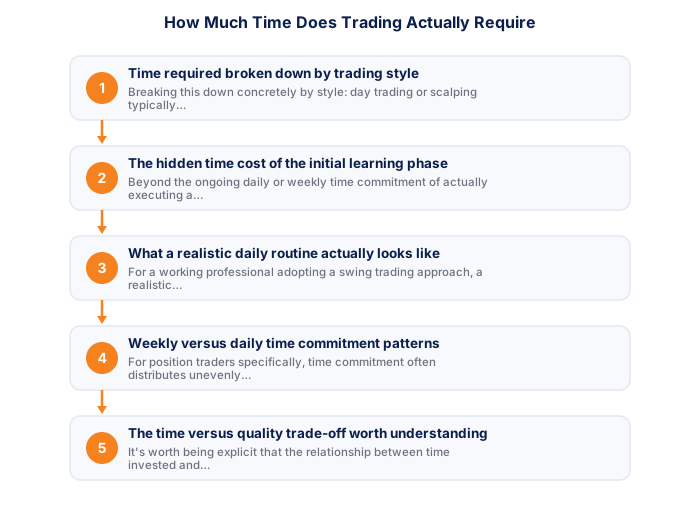
1. Time required broken down by trading style
Breaking this down concretely by style: day trading or scalping typically requires four to six or more hours of close attention during active market sessions, since these styles depend on entering and exiting positions within minutes to hours based on short-term price movement, making this style fundamentally incompatible with most full-time work schedules. Swing trading, by contrast, typically requires only 30 to 60 minutes daily for analysis and order management, since positions are held for days to weeks rather than requiring constant monitoring.
Position trading reduces this further still, often requiring just a few hours per week rather than daily attention, given the considerably longer typical holding periods involved. End-of-day analysis approaches can be the lightest of all in daily time terms, sometimes requiring just 15 to 30 minutes after market close to review charts and place orders for the following session.
It's worth matching this breakdown against your own honest time audit, discussed elsewhere on this site regarding fitting trading into a busy schedule, before committing to any specific style, since the right choice depends entirely on which of these time commitments genuinely fits your actual, available hours.
3. What a realistic daily routine actually looks like
For a working professional adopting a swing trading approach, a realistic daily routine might involve a brief 10-15 minute check before work to review overnight developments and adjust any pending orders if needed, followed by a more substantial 20-30 minute review in the evening to conduct fuller analysis and place new orders or adjust existing positions based on the day's price action. This totals roughly 30-45 minutes of focused daily attention, fitting comfortably around standard working hours.
For an end-of-day-only approach, the routine might simplify further to a single focused 15-30 minute session each evening, reviewing the day's closing price action across watched instruments and placing any new orders or pending instructions for the following session, a lighter daily routine still, suited to traders wanting minimal daily time commitment while maintaining regular, disciplined market engagement.
4. Weekly versus daily time commitment patterns
For position traders specifically, time commitment often distributes unevenly across the week rather than requiring consistent daily attention, perhaps a more substantial dedicated review session of an hour or more once or twice a week, covering broader trend analysis and position adjustment decisions, with minimal or no attention required on the remaining days unless a specific alert or significant market development warrants an unscheduled check-in.
This weekly-rather-than-daily distribution pattern can suit traders whose schedules don't allow for reliable daily availability, but who can consistently set aside a dedicated block of time on a specific day or days each week, recognising this flexibility in how time commitment can be structured, rather than assuming all trading styles require strict daily attention, opens up viable approaches for a wider range of personal schedule constraints.
| Item | Detail |
|---|---|
| Regulator | FSCA, fsca.co.za |
| Exchange control | SARB, resbank.co.za |
| Tax authority | SARS, sars.gov.za |
| JSE hours | 09:00-17:00 SAST Mon-Fri |
| Best forex session | 15:00-17:00 SAST |
| CGT annual exclusion | R50,000 (individuals) |
5. The time versus quality trade-off worth understanding
It's worth being explicit that the relationship between time invested and trading success isn't simply linear, spending more hours doesn't automatically or proportionally translate into better trading results, particularly if that additional time is spent on excessive, low-value chart-watching rather than genuinely productive analysis, strategy refinement, or disciplined execution of a well-tested approach.
Many experienced traders specifically caution against the common beginner tendency to equate more screen time with more diligence or better outcomes, noting that focused, high-quality analysis within a defined, limited time window often produces better decision-making than unfocused, excessive chart-watching throughout the day, which can sometimes lead to overtrading or impulsive decisions driven by minor, ultimately irrelevant short-term price fluctuations.
It's worth reflecting honestly on whether your own screen time genuinely translates into better decisions, or whether it sometimes tips into the kind of excessive, anxiety-driven checking discussed elsewhere on this site, more hours spent trading isn't automatically more productive hours.
6. How time requirements often shift as you progress
Many traders find their time requirements shift somewhat as they gain experience: the initial learning phase often requires more total time investment (research, demo practice, strategy development) than the eventual steady-state time commitment of executing a refined, well-understood strategy, since experienced execution of a familiar approach tends to become more efficient than the exploratory, trial-and-error process of initial learning.
This means newer traders shouldn't necessarily assume their current time investment during the learning phase represents the permanent, ongoing time commitment their eventual trading approach will require, budgeting for a more time-intensive initial period, with the expectation that efficiency improves as genuine experience and strategy refinement accumulate, sets a more accurate long-term expectation.
In South African time (SAST, which is GMT+2 year-round), the London session typically opens around 09:00-10:00 and the New York session around 15:00-16:00, so the overlap between roughly 15:00 and 17:00 SAST tends to bring the highest liquidity and volatility for major forex pairs.
Day trading realistically demands 15-20 hours per week including screens, review, and research. Swing trading fits a more manageable schedule at 5-8 hours per week.
★ Why It Matters
Something worth tracking honestly for two weeks: time yourself doing every trading-related task, not just chart time, including reading news, journaling, and researching, most traders underestimate their genuine total time commitment by a significant margin once everything is actually counted.
✕ Common mistakes
- Counting only chart time, not journaling and research. Total genuine time commitment is usually higher than traders initially estimate.
- Choosing a trading style that doesn't match your real available hours. Mismatch here is one of the more common, avoidable sources of frustration.
- Underestimating review time's contribution to actual skill development. Time spent reviewing often matters more than additional screen time.
- Not tracking actual time spent for a representative period. Most traders are surprised by the gap between estimated and measured time.
Key Takeaways
- Anywhere from 10 minutes a day for swing trading to 6+ hours for day trading. Learn the realistic time commitment by trading style.
- It depends entirely on your chosen trading style: anywhere from roughly 10 minutes a day for end-of-day swing trading to 6+ hours for active day trading.
- Most realistic part-time approaches compatible with a full-time job typically require 30 to 60 minutes daily.
- Time required broken down by trading style.
- The hidden time cost of the initial learning phase.
Frequently asked follow-up questions
Can I switch trading styles if my available time changes?
Yes, many traders adjust their style, for example, moving from swing trading to position trading, if their available time decreases due to changing work or personal commitments, since these styles are flexible choices rather than fixed, unchangeable approaches.
Does less time committed mean lower potential trading results?
Not necessarily in a direct, linear way, disciplined, well-structured trading within a lower time commitment can outperform less disciplined trading with more time invested, since execution quality and strategy soundness matter more than raw hours spent.
How do I know if I'm spending too much time watching charts?
If chart-watching is leading to impulsive trades not aligned with your defined strategy, or is noticeably affecting your focus on other responsibilities like work, this is a reasonable signal to scale back to a more structured, time-bounded routine.
