i Short answer
FSCA-regulated brokers must publish the percentage of retail clients who lose money trading CFDs, and that figure typically sits between 70% and 80%.
Common reasons include undercapitalised accounts, excessive leverage, absent risk management, and emotionally driven decisions like revenge trading.
📋 ON THIS PAGE
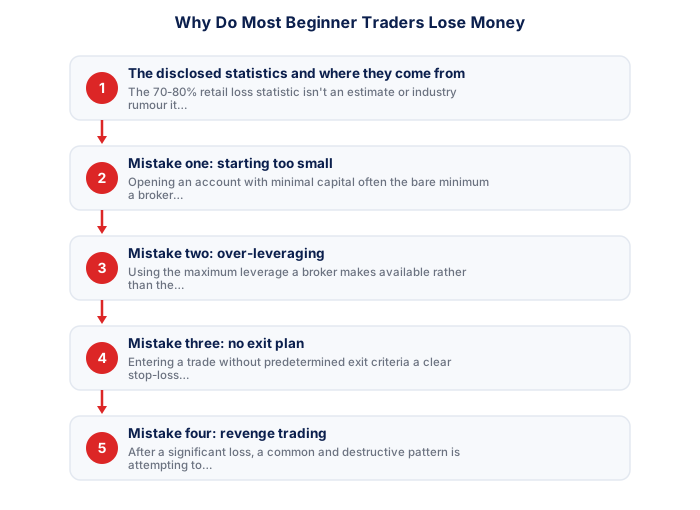
1. The disclosed statistics and where they come from
The 70-80% retail loss statistic isn't an estimate or industry rumour, it comes directly from mandatory regulatory disclosures that FSCA-regulated CFD providers (and equivalent regulated brokers in other major jurisdictions like the UK and EU) are required to publish, typically calculated over a trailing twelve-month period across their actual retail client base. This requirement exists specifically so prospective clients can't reasonably claim they weren't clearly warned about the realistic statistical odds before depositing money.
note that this statistic reflects CFD trading , a leveraged, short-term-oriented product category, rather than all forms of financial market participation. Long-term, unleveraged equity investing, for comparison, has historically produced positive average outcomes for patient investors over sufficiently long time horizons, which is a meaningfully different risk and return profile from leveraged CFD speculation.
See also: What Is Prescribed Assets Policy in SA?
See also: Realised vs Unrealised Losses: Key Differences
See also: What Is a Heat Map Tool and How Do Traders Use It?
See also: How Can SA Investors Use Forex to Hedge Rand Risk?
See also: How Do I Open a Trading Account as a South African?
See also: How Do I Evaluate Trading Podcasts and Audio Content?
See also: The JSE All Share Index vs the Top 40
See also: What Does the Term Lot Size Mean in Forex Trading?
See also: How Does Emigration Affect My South African Trading Accou
See also: How Do I Build a Personal Trading Curriculum for Myself?
See also: Am I Ready to Start Trading? A Practical Checklist
The gap between these two figures is largely explained by discipline, not market conditions. Traders who consistently apply small, fixed risk percentages sit meaningfully outside the majority who don't.
2. Mistake one: starting too small
Opening an account with minimal capital, often the bare minimum a broker allows, sets up a structural problem before a single trade is even placed: there isn't enough capital cushion to absorb a normal, expected losing streak without the account being effectively wiped out. Even a strategy with a genuine long-run statistical edge will produce losing trades, sometimes in clusters, and an undercapitalised account simply doesn't survive long enough to let that edge play out across a representative sample of trades.
This creates a particularly cruel dynamic for beginners: they're simultaneously trying to learn (which requires making mistakes and learning from them) while operating with so little capital cushion that mistakes end the learning process prematurely, before genuine lessons can be absorbed and applied to future decisions.
- 100+ demo trades completed with consistent rules
- Positive expectancy over full demo sample
- Every demo trade documented in journal
- Written trading plan: entry, exit, position sizing
- FSCA-regulated broker chosen and FSP verified
- Starting capital is genuinely disposable
- Backup connectivity tested
Open a demo
Choose an FSCA-regulated broker. Start with R50,000-R100,000 virtual capital.
Write trading rules
Define entry criteria, stop-loss method, and position sizing in writing.
Trade 2-3 months
Complete at least 50-100 trades across varied market conditions.
Journal everything
Record rationale, emotion, and outcome for every trade.
Evaluate objectively
Move to live only when consistent rule-following meets your benchmark.
3. Mistake two: over-leveraging
Using the maximum leverage a broker makes available, rather than the leverage that's actually appropriate given the trader's account size, strategy, and risk tolerance, is one of the most consistently cited factors behind rapid account losses. High leverage doesn't improve a trading strategy's underlying odds of success; it simply amplifies the magnitude of both gains and losses on each trade, which means it also amplifies the speed at which an account can be depleted when trades go wrong.
Many experienced, consistently successful traders deliberately use considerably less leverage than the maximum available to them, specifically because they understand that maximising leverage maximises risk of ruin (the statistical probability of losing the entire account) far more than it maximises long-run expected returns, especially for any strategy that doesn't have an extremely high win rate.
4. Mistake three: no exit plan
Entering a trade without predetermined exit criteria, a clear stop-loss level defining the maximum acceptable loss, and ideally a profit target or exit rule defining when to take gains, leaves critical decisions to be made in the heat of the moment, when emotional pressure (fear as a position moves into loss, or greed and overconfidence as it moves into profit) is at its highest and rational decision-making is hardest to maintain.
Traders without exit plans commonly exhibit two related, damaging patterns: holding losing positions far longer than any sound strategy would dictate, hoping for a reversal that may never come (sometimes called "hope trading"), and exiting winning positions too early out of fear of losing unrealised gains, which can mean a strategy's occasional large wins, often what makes an edge-based approach profitable overall, never get the chance to fully play out.
5. Mistake four: revenge trading
After a significant loss, a common and destructive pattern is attempting to immediately recover that loss through a new, often larger and more impulsive trade, sometimes called revenge trading. This behaviour typically abandons whatever risk management rules the trader normally follows, since the emotional drive to "win back" the loss overrides disciplined decision-making, frequently compounding the original loss with an even larger one.
Recognising the emotional state that precedes revenge trading, frustration, urgency, a feeling of needing to "fix" the situation immediately, and having a predetermined rule (such as stepping away from the platform entirely for a set period after a loss beyond a certain size) is one of the most practically useful disciplines a trader can build specifically to interrupt this pattern before it compounds losses further.
6. What separates the minority who succeed
Traders who consistently fall into the profitable minority tend to share several observable habits: they risk a small, fixed percentage of capital per trade (commonly 1-2%) with discipline that doesn't waver based on recent results; they follow a tested strategy with clear rules rather than making ad hoc decisions; they maintain sufficient capitalisation to weather normal losing streaks without the account being threatened; and they treat individual losing trades as an expected, unremarkable cost of doing business rather than a personal failure requiring an emotional response.
None of these habits are secret or complicated in concept, they're widely documented and discussed throughout legitimate trading education resources. What separates the minority who actually apply them consistently from the majority who don't is largely a matter of discipline and emotional regulation under real pressure, which is considerably harder to sustain in practice than it is to understand intellectually.
Better outcomes follow from consistent risk management and realistic timelines.
Most beginner traders lose because of absent risk management, unrealistic expectations about income and timelines, ad hoc learning approaches, and trading without predetermined rules. Each of these has a specific, addressable fix.
★ Why It Matters
Worth checking specifically in your own case if you're newer to trading, which of the commonly cited failure causes, undercapitalisation, excessive leverage, absent risk management, or emotional decisions, applies most directly to your own current situation, the general statistic matters less than identifying your own specific risk factor honestly.
✕ Common mistakes
- Trading without ever checking your account against the typical undercapitalisation pattern. This is one of the most common, identifiable contributing factors.
- Running leverage levels disconnected from your actual risk tolerance and capital. This combination is frequently cited among the most damaging patterns.
- Not addressing emotionally-driven decisions despite recognising the pattern in yourself. Awareness alone doesn't change behaviour without deliberate, structured countermeasures.
7. What the loss statistic actually measures
The disclosed figure that 70% to 80% of retail accounts lose money is often quoted as though it described skilled attempts. It does not. It covers everyone who opened an account in the period, including people who deposited without a plan, traded for a fortnight and stopped, which is a meaningful share of the sample. Read precisely, it says most people who try this lose money, not that the activity is impossible.
The more useful signal is what the losing group has in common, and the pattern is strikingly consistent: positions sized against available margin rather than a stop distance, no stop-loss at all, and a rand income target that forces oversizing on a small account. That last one does the most damage, because wanting R10,000 a month from a R20,000 account requires 50% monthly returns, which requires risking 10% per trade, which makes a normal losing streak fatal. What traders actually earn works through that arithmetic in full.
Key Takeaways
- Industry disclosures show 70-80% of retail CFD accounts lose money. Learn the four most common mistakes and what separates the profitable minority.
- FSCA-regulated brokers must publish the percentage of retail clients who lose money trading CFDs, and that figure typically sits between 70% and 80%.
- Common reasons include undercapitalised accounts, excessive leverage, absent risk management, and emotionally driven decisions like revenge trading.
- The disclosed statistics and where they come from.
- Mistake one: starting too small.
Frequently asked follow-up questions
Does the 70-80% loss statistic apply to all financial trading, or just CFDs?
This specific statistic is tied to CFD and similarly leveraged retail products; longer-term, unleveraged investing has a different historical risk and return profile.
If most traders lose money, is it even worth trying?
Some traders do succeed consistently, and the documented behaviours separating them from the majority (proper capitalisation, disciplined risk management, tested strategy) are learnable, though they require genuine sustained effort and emotional discipline.
Can a demo account help avoid these specific mistakes?
A demo account can help you practise applying risk management rules and testing a strategy without financial pressure, though it doesn't fully replicate the emotional dynamics (like revenge trading) that often only emerge once real money is at stake.
Is undercapitalisation really as big a factor as poor strategy?
Often yes, even a reasonably sound strategy can fail simply because the account is too small to absorb normal statistical variance, forcing premature exits or oversized positions purely due to capital constraints rather than analytical error.
How long does it typically take before a new trader stops making these common mistakes?
This varies considerably, but most experienced traders and educators suggest it takes many months of consistent, honest practice before these foundational habits genuinely become second nature rather than something requiring constant conscious effort.
