i Short answer
A multi-broker monitoring tool consolidates account information across several separate brokers into one unified view.
This is useful for traders maintaining multiple broker relationships who want a single combined overview.
📋 ON THIS PAGE
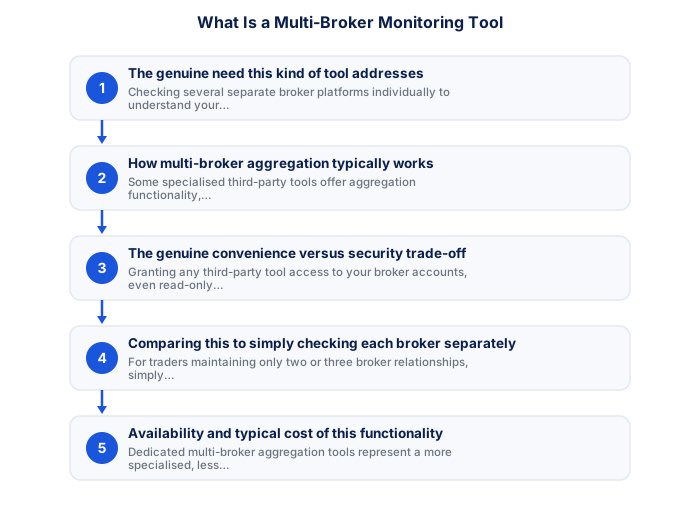
1. The genuine need this kind of tool addresses
When you maintain accounts at multiple brokers simultaneously, whether for strategy separation, currency denomination reasons, or to access instruments only available at specific providers, checking each platform separately to understand your combined position and performance becomes genuinely time-consuming. A multi-broker monitoring tool aggregates this view, showing your total exposure and equity across all accounts in a single interface.
The need is proportional to the number of brokers involved. Two brokers checked separately adds minimal overhead. Four or five brokers across different platforms, each with their own login sequence and dashboard layout, represents a meaningful administrative drain that accumulates over time.
Beyond convenience, the consolidated view enables risk oversight that separate platform monitoring doesn't provide. Understanding your total directional exposure across all accounts, whether you're net long or short a particular currency or asset across your combined positions, requires aggregating data that's distributed across separate systems.
2. How multi-broker aggregation typically works
Multi-broker aggregation tools typically connect to each broker account through read-only API access, a credential that allows the tool to retrieve account and position data without having the ability to place or modify orders. This read-only constraint is an important security feature that limits the damage a compromised aggregation tool could cause.
Some trading platforms and portfolio management tools offer this functionality natively. Third-party applications focused on this specific use case are also available, typically as subscription services. The breadth of broker integrations varies considerably, a tool that supports your specific brokers is more useful than one with broader theoretical coverage.
- Search FSP name or number at fsca.co.za
- Confirm licence is current and not suspended
- Check scope covers forex and CFD activity
- Confirm client funds in segregated accounts
- Read FSCA enforcement actions history
- Test customer support before depositing
- Client funds legally segregated
- FSCA complaints process available
- SA consumer protections apply
- ZAR account, no FX conversion costs
- Some offshore brokers offer wider instruments
- Regulatory overhead passed on in spreads
- Stricter position limits for retail clients
- FICA verification required before trading
- Client funds segregated
- Formal FSCA complaints process
- SA consumer protections apply
- ZAR account available
- Fund safety not guaranteed
- Overseas disputes only
- SA law does not apply
- Currency conversion costs
The data typically available through these integrations includes account balances, open positions with current mark-to-market values, realised P&L history, and sometimes margin utilisation. The completeness of the data depends on what each broker's API exposes and what the aggregation tool has built support for.
3. The genuine convenience versus security trade-off
Granting any third-party tool access to your broker accounts, even read-only, introduces considerations worth understanding clearly. The tool sees your balance, positions, and history. If the tool's own security is compromised, that information is exposed. If the tool's business fails, the access credentials it holds need revoking.
The security consideration is more significant for some traders than others. A trader managing a modest account at two brokers faces less risk from this trade-off than one managing substantial capital across multiple accounts. Evaluating the security posture and business stability of any tool you grant broker access to is part of responsible use.
The practical minimum is ensuring that any API credentials you provide genuinely carry only read-only permissions, verifying this in your broker's API settings rather than relying on the tool's description of what it requests. Most brokers allow you to generate and revoke API credentials independently, which means you can limit access and remove it if anything concerns you.
4. Comparing this to simply checking each broker separately
For traders with only two or three broker relationships, checking each platform separately remains the simpler and more security-conscious approach. The incremental convenience of aggregation needs to justify the additional tool, subscription cost, and API access complexity it introduces.
The break-even point in convenience varies by individual, but the calculation is straightforward: how many minutes per week do you spend across separate platform logins and dashboard reviews, and does the cost and setup overhead of an aggregation tool justify reducing that time? For most traders with two or three accounts, the answer is probably no; for traders with five or more, the answer starts shifting.
| Protection | FSCA Regulated | Offshore Unregulated |
|---|---|---|
| Client fund segregation | ✓ Required | Varies by broker |
| SA complaints process | ✓ Available | ✗ Not available |
| SA consumer law applies | ✓ Yes | ✗ No |
| ZAR account available | ✓ Typically | Often USD/EUR only |
There's also a case for separate platform checking even with many accounts: each broker's own interface provides context that an aggregation dashboard may not, including platform-specific alerts, broker communications, and the full detail of your position management tools. A consolidated view supplements platform-level monitoring rather than replacing it.
5. Availability and typical cost of this functionality
Dedicated multi-broker aggregation tools exist in a relatively specialised corner of the trading software market. Options range from free tools with limited broker integrations to subscription services with broader coverage and additional analytics. The South African market is less well-served than the US or European markets in terms of locally-focused tools, though most global options support FSCA-regulated brokers that offer API access.
Before committing to a subscription, verifying your specific brokers are supported through the tool's integration list, and testing that the integration actually works correctly with a trial account, prevents discovering incompatibilities after payment.
The market for these tools evolves, and brokers periodically add or remove API access depending on their technical priorities. A tool that works today with a specific broker may stop working if that broker changes their API, worth factoring into whether a subscription for this category of tool represents reliable ongoing value.
6. A simpler manual alternative worth considering
A simple personal spreadsheet updated regularly, covering balance, open exposure, and realised P&L for each broker, provides a consolidated view without any third-party access. The update is manual and takes a few minutes, but it requires no API credentials, no subscription, and carries no third-party security risk.
Most brokers provide real-time balance and position data on their dashboard landing page, which can be read at a glance. A weekly spreadsheet update covering these figures from each broker takes five to ten minutes and produces a running record of your combined position that's searchable and archivable independently of any external tool.
For traders who value the consolidated view primarily for aggregate risk oversight rather than real-time monitoring, this manual approach meets the core need at minimal cost and complexity. The case for a dedicated tool strengthens mainly when the frequency of monitoring required makes manual updating practically burdensome.
✕ Common mistakes
- Assuming a dedicated tool is necessary regardless of how many accounts you run. A simple shared spreadsheet often achieves similar coordination benefit.
- Not tracking combined exposure across all your brokers regularly. Risk should be assessed across all accounts together, not per broker in isolation.
- Treating each broker account as entirely independent for risk purposes. Combined risk often matters more than per-account figures.
- Forgetting to update tracking consistently across all accounts. Inconsistent updates undermine the value of any monitoring approach.
Key Takeaways
- A multi-broker monitoring tool consolidates account information across several brokers into one view, useful for traders maintaining multiple broker relationships.
- A multi-broker monitoring tool consolidates account information across several separate brokers into one unified view.
- This is useful for traders maintaining multiple broker relationships who want a single combined overview.
- The genuine need this kind of tool addresses.
- How multi-broker aggregation typically works.
Frequently asked follow-up questions
Are multi-broker monitoring tools widely available?
These represent a more specialised category, with availability and quality varying considerably compared to more universally available trading tools.
Is API access to my broker account inherently risky?
Read-only access generally carries lower risk than full trading access, though confirming the specific tool's security practices remains an important precaution regardless.
Can I achieve a similar consolidated view without a dedicated tool?
Yes, a manual spreadsheet, achieves a similar consolidated overview without the security considerations third-party account connections introduce.
