What this page covers
The repo rate is the rate at which the Reserve Bank lends to commercial banks. Every other rate in the country is priced off it, which is why a single MPC decision moves bond yields, the rand and the cost of a mortgage on the same afternoon.
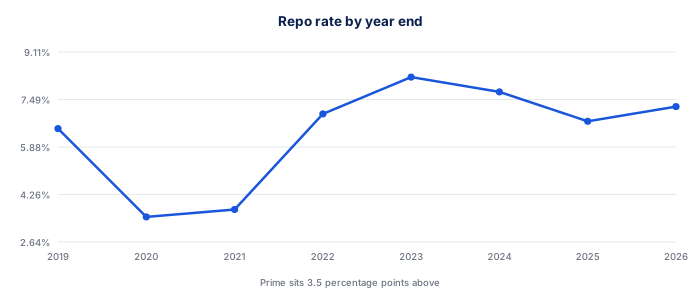
★ What changed this year
The repo rate rose from 6.75% to 7.25% during 2026, in two increases of 25 basis points: the first in May, the second announced on 23 September and effective from the 25th. Both were unanimous. Prime followed to 10.75%.
The driver was external rather than domestic. Conflict in the Middle East disrupted shipping through the Strait of Hormuz, and fuel prices rose more than 34% over the twelve months to June. That pushed headline inflation from 3.0% in February to 5.0% in June, well above the 3% objective the Bank now targets. The Reserve Bank moved with the Federal Reserve, the European Central Bank and the Bank of Japan, all of which raised rates over the same period. The Bank expects inflation back near 3% towards the end of 2027.
| Effective from | Change | Repo rate | Prime |
|---|---|---|---|
| 24 September 2026 | +25 bps | 7.25% | 10.75% |
| 29 May 2026 | +25 bps | 7.00% | 10.50% |
| 30 January 2026 | No change | 6.75% | 10.25% |
| 20 November 2025 | -25 bps | 6.75% | 10.25% |
| 31 July 2025 | -25 bps | 7.00% | 10.50% |
| 29 May 2025 | -25 bps | 7.25% | 10.75% |
| 30 January 2025 | -25 bps | 7.50% | 11.00% |
| 21 November 2024 | -25 bps | 7.75% | 11.25% |
| 19 September 2024 | -25 bps | 8.00% | 11.50% |
| Period | Direction | Range |
|---|---|---|
| 2020, pandemic response | Cut sharply | 6.25% down to 3.50% |
| 2021 to 2023 | Raised through the inflation surge | 3.50% up to 8.25% |
| 2024 into 2025 | Cut as inflation eased | 8.25% down to 6.75% |
| 2026 | Raised again | 6.75% up to 7.25% |
| Year | Started at | Ended at | Direction |
|---|---|---|---|
| 2026 | 6.75% | 7.25% | Raised twice |
| 2025 | 7.75% | 6.75% | Cut four times |
| 2024 | 8.25% | 7.75% | Began cutting |
| 2023 | 7.00% | 8.25% | Raised to the cycle peak |
| 2022 | 3.75% | 7.00% | Raised sharply |
| 2021 | 3.50% | 3.75% | First increase |
| 2020 | 6.25% | 3.50% | Cut through the pandemic |
| Bond size | Instalment change | Over 20 years |
|---|---|---|
| R750,000 | about R125 a month | about R30,000 |
| R1,000,000 | about R170 a month | about R41,000 |
| R1,500,000 | about R250 a month | about R60,000 |
| R2,000,000 | about R335 a month | about R80,000 |
| Year | Repo at year end | Prime | Change over the year | What drove it |
|---|---|---|---|---|
| 2026 | 7.25% | 10.75% | +50 bps | Fuel shock from the Middle East conflict |
| 2025 | 6.75% | 10.25% | -100 bps | Disinflation allowed a full cutting cycle |
| 2024 | 7.75% | 11.25% | -50 bps | Cutting began in September |
| 2023 | 8.25% | 11.75% | +125 bps | Peak of the hiking cycle |
| 2022 | 7.00% | 10.50% | +325 bps | Global inflation surge |
| 2021 | 3.75% | 7.25% | +25 bps | First increase after the pandemic floor |
| 2020 | 3.50% | 7.00% | -275 bps | Emergency cuts through the pandemic |
| 2019 | 6.50% | 10.00% | -25 bps | Weak growth, contained inflation |
| 2018 | 6.75% | 10.25% | 0 | Held through a volatile rand year |
| 2017 | 6.75% | 10.25% | -50 bps | Inflation back inside the band |
| 2016 | 7.00% | 10.50% | +75 bps | Drought and rand weakness |
| 2015 | 6.25% | 9.75% | +50 bps | Start of the tightening cycle |
| 2014 | 5.75% | 9.25% | +75 bps | Rand under pressure |
| 2013 | 5.00% | 8.50% | 0 | Held through the taper tantrum |
| 2012 | 5.00% | 8.50% | -50 bps | Growth concerns |
| 2011 | 5.50% | 9.00% | 0 | Held |
| 2010 | 5.50% | 9.00% | -150 bps | Post-crisis easing continued |
| 2009 | 7.00% | 10.50% | -500 bps | Global financial crisis response |
| 2008 | 12.00% | 15.50% | +150 bps | Inflation peak before the crisis hit |
| 2007 | 11.00% | 14.50% | +200 bps | Credit boom and rising inflation |
| 2006 | 9.00% | 12.50% | +200 bps | Tightening began |
| 2005 | 7.00% | 10.50% | -50 bps | Low inflation |
| 2004 | 7.50% | 11.00% | -50 bps | Strong rand, easing |
| 2003 | 8.00% | 11.50% | -550 bps | Sharp easing as inflation collapsed |
| 2002 | 13.50% | 17.00% | +400 bps | Rand crisis of late 2001 |
| 2001 | 9.50% | 13.00% | -150 bps | Before the currency collapse |
| 2000 | 12.00% | 14.50% | -175 bps | Inflation targeting introduced |
| Year | Repo | Prime | Headline CPI | Real repo rate |
|---|---|---|---|---|
| 2026 | 7.25% | 10.75% | 4.2% | 3.05% |
| 2025 | 6.75% | 10.25% | 3.2% | 3.55% |
| 2024 | 7.75% | 11.25% | 4.4% | 3.35% |
| 2023 | 8.25% | 11.75% | 5.9% | 2.35% |
| 2022 | 7.00% | 10.50% | 6.9% | 0.10% |
| 2021 | 3.75% | 7.25% | 4.5% | -0.75% |
| 2020 | 3.50% | 7.00% | 3.3% | 0.20% |

Download this data
Every table on this page as a spreadsheet, with the source and the date it was checked in the header rows.
⬇ Download CSVHow these figures work
The repo rate is the rate at which the Reserve Bank lends to commercial banks against collateral. It is the anchor for everything else: banks price their lending off it, the bond curve prices expectations of it, and the rand's carry against other currencies is the difference between it and their equivalents.
The Monetary Policy Committee sets it against an inflation objective rather than a growth target. That is why a decision can look wrong for the economy and still be consistent with the mandate.
★ A worked example
A trader holds a long USD/ZAR position into an MPC meeting where a 25 basis point increase is widely expected.
The increase arrives, and the rand barely moves, because the decision was already priced. What moves it is the statement: a unanimous vote with hawkish guidance implies more to come and the rand firms; a split vote with a softer tone implies the cycle is near its end and the rand gives back the move.
The tradeable event is the gap between the decision and what was priced, not the decision itself.
✕ Common mistakes
- Trading the decision rather than the surprise. A widely expected move is already in the price. The reaction comes from the part nobody had.
- Ignoring the vote split. A three to two vote says far more about the next meeting than the headline number does.
- Holding a tight stop through the announcement. Spreads widen and liquidity thins in the minutes around it. A stop close to the market is often filled well away from its level.
- Assuming a cut helps the rand. A cut narrows the carry differential, which usually works against the rand, whatever it does for domestic growth.
Notes on reading these figures
- Prime tracks the repo rate with a fixed spread of 3.5 percentage points. When the repo moves, prime moves the same amount on the same day.
- The MPC meets six times a year and publishes the vote split. A unanimous decision and a narrow split carry different signals for what comes next, which is why the statement matters as much as the number.
- A rate decision moves the rand through the carry differential rather than through domestic demand. That effect shows up in minutes, while the effect on inflation takes quarters.
To put these figures to work, the Prime Lending Rate History runs the arithmetic on your own numbers, and SARB MPC Meeting Calendar covers the same ground in ordinary language. How the repo rate differs from prime and Interest Rate Differential Calculator go into the detail this table only summarises.
Terms used on this page
Put this table on your own site
The table below can sit on your own page and stays current without you editing anything.
- Preview the embeddable table as it will appear on your site
Paste the snippet below into your own page and the table appears there, updating itself as the figures change.
<iframe src="https://www.tradeanswers.co.za/embed/ref-sarb-repo-rate-history.html" width="100%" height="620" style="border:0" title="SARB Repo Rate History"></iframe>Free to use with attribution. The link back to this page is built into the embed.
Frequently asked questions
How often does the MPC meet?
Six times a year, over three days, with the announcement on the final afternoon. The Reserve Bank publishes the following year's dates in advance.
Why does prime move at the same time?
Prime is set at the repo rate plus a spread that has been 3.5 percentage points for years. When the repo moves, prime moves the same amount on the same day.
Does the repo rate affect the rand immediately?
The announcement moves it within seconds through the carry differential. The effect on inflation and growth takes several quarters.
What is the inflation target?
The Reserve Bank has moved toward a 3% objective, having previously worked within a 3% to 6% band. Policy is set against headline CPI.
Where can I see past decisions?
The Reserve Bank publishes every monetary policy statement, and its selected historical rates page carries the series in full.
What is a basis point?
One hundredth of a percentage point. A 25 basis point increase is a quarter of a percent, which is the size of a typical move.