What this page covers
An FSP number tells you a firm is licensed. The category tells you what it is licensed to do, and the two are not the same question. A broker may hold a valid licence that does not cover the product it is selling you.
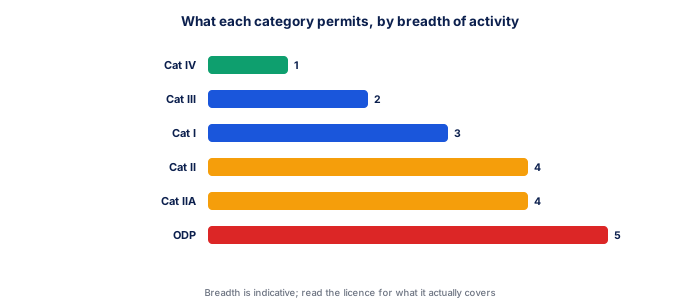
| Category | What it permits |
|---|---|
| Category I | Advice and intermediary services on financial products |
| Category II | Discretionary management, trading on a client's behalf without asking each time |
| Category IIA | Hedge fund management specifically |
| Category III | Administrative services, platforms and LISPs |
| Category IV | Assistance business administration |
| ODP | Over the counter derivative provider, issuing derivatives as principal |
| Check | Why |
|---|---|
| Is the licence active | A lapsed or suspended licence still shows a number |
| Which category is held | Category I alone does not cover issuing CFDs |
| Is an ODP licence held | Required to issue OTC derivatives to South African clients |
| Which products are listed | Each category names the product subcategories it covers |
| Are there conditions | A licence can carry restrictions that limit what may be offered |
| What is offered to you | Category required |
|---|---|
| Advice on a financial product | Category I |
| Placing a trade on your instruction | Category I |
| Issuing a CFD as principal | ODP |
| Managing your account at their discretion | Category II |
| Running a platform holding your investments | Category III |
| Managing a hedge fund | Category IIA |

Download this data
Every table on this page as a spreadsheet, with the source and the date it was checked in the header rows.
⬇ Download CSVHow these figures work
The FAIS Act licenses a firm to perform specific activities, not simply to exist. The category defines the activity; the product subcategories within it define what may be advised on or transacted in.
This matters for a trader because issuing a contract for difference is not the same activity as advising on one. A firm that issues derivatives as principal to South African clients needs the over the counter derivative provider designation, which is a separate regime with its own capital and reporting requirements.
★ A worked example
A broker's website footer shows an FSP number and the words authorised financial services provider.
Searching the register shows the licence is Category I, with subcategories covering long-term insurance and collective investment schemes. The firm is licensed, and the number is real.
But nothing in that licence covers issuing CFDs as principal, which is what the platform actually does. The licence is genuine and the activity sits outside it. That is the situation the register is there to reveal, and it is invisible from the footer alone.
✕ Common mistakes
- Treating an FSP number as sufficient. The number proves a licence exists. It says nothing about what the licence permits.
- Not checking the product subcategories. A licence names the specific products it covers. Anything outside them is not authorised.
- Confusing a representative with a provider. A representative acts under someone else's licence. The register shows whose.
- Assuming an offshore licence is equivalent. A licence elsewhere may be robust, but it puts you outside the FAIS Ombud and outside South African client protections.
Notes on reading these figures
- A CFD is an over the counter derivative. A broker issuing CFDs to South African clients as principal needs the ODP designation, not only a Category I licence.
- A representative is not a licensed FSP. They act under an FSP's licence, and the FSCA register shows which one, which is worth checking when the person selling to you is not the firm.
- A foreign broker with no FSCA licence is not automatically illegal to use, but you fall outside the FAIS Ombud's reach and outside South African client protections if something goes wrong.
To put these figures to work, the How to Verify an FSP Licence runs the arithmetic on your own numbers, and South African Financial Laws Reference covers the same ground in ordinary language. What FSCA regulation protects you from and Authorised FSP vs representative go into the detail this table only summarises.
Terms used on this page
Put this table on your own site
The table below can sit on your own page and stays current without you editing anything.
- Preview the embeddable table as it will appear on your site
Paste the snippet below into your own page and the table appears there, updating itself as the figures change.
<iframe src="https://www.tradeanswers.co.za/embed/ref-fsca-fsp-licence-categories.html" width="100%" height="620" style="border:0" title="FSCA FSP Licence Categories"></iframe>Free to use with attribution. The link back to this page is built into the embed.
Frequently asked questions
What does Category I permit?
Advice and intermediary services on the financial products named in the licence. It does not by itself permit issuing derivatives as principal.
What is an ODP licence?
Over the counter derivative provider. It is required to issue OTC derivatives, including CFDs, to South African clients as principal.
What is Category II?
Discretionary management: trading on a client's behalf without asking before each decision. A managed account needs it.
Can one firm hold several categories?
Yes, and many do. The register lists every category and subcategory held.
Does a licence expire?
It can lapse, be suspended or be withdrawn. The status field on the register is the thing to read, not the number.
Where do I check?
The FSCA's FAIS regulated entities search, which is public and free. Search the legal entity name from your client agreement, not the brand.