What this page covers
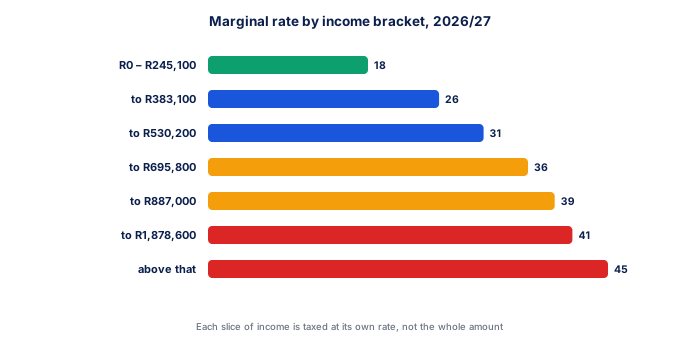
Trading profit that SARS treats as revenue is added to your other income and taxed at these rates. The brackets below are for the 2026/27 year of assessment, 1 March 2026 to 28 February 2027.
★ What changed this year
For 2026/27 the first bracket rose from R237,100 to R245,100 and the primary rebate from R17,235 to R17,820, which lifted the under-65 threshold from R95,750 to R99,000. The brackets had been held flat for three consecutive years before this, so the adjustment restores part of the bracket creep that built up over that period. The top rate of 45% has not changed since it was introduced for 2017/18.
| Taxable income | Rate |
|---|---|
| R0 – R245,100 | 18% of taxable income |
| R245,101 – R383,100 | R44,118 + 26% of the amount above R245,100 |
| R383,101 – R530,200 | R79,998 + 31% of the amount above R383,100 |
| R530,201 – R695,800 | R125,599 + 36% of the amount above R530,200 |
| R695,801 – R887,000 | R185,215 + 39% of the amount above R695,800 |
| R887,001 – R1,878,600 | R259,783 + 41% of the amount above R887,000 |
| R1,878,601 and above | R666,339 + 45% of the amount above R1,878,600 |
| Rebate | Who it applies to | Amount |
|---|---|---|
| Primary | Everyone | R17,820 |
| Secondary | 65 and older | R9,765 on top of the primary |
| Tertiary | 75 and older | R3,249 on top of both |
| Age | Threshold |
|---|---|
| Under 65 | R99,000 |
| 65 to 74 | R153,250 |
| 75 and older | R171,300 |
| Year of assessment | First bracket | Top bracket starts | Primary rebate | Threshold under 65 |
|---|---|---|---|---|
| 2026/27 | R0 – R245,100 at 18% | R1,878,601 | R17,820 | R99,000 |
| 2025/26 | R0 – R237,100 at 18% | R1,817,001 | R17,235 | R95,750 |
| 2024/25 | R0 – R237,100 at 18% | R1,817,001 | R17,235 | R95,750 |
| Taxable income | Tax before rebate | Tax payable | Effective rate |
|---|---|---|---|
| R200,000 | R36,000 | R18,180 | 9.1% |
| R300,000 | R58,392 | R40,572 | 13.5% |
| R400,000 | R85,275 | R67,455 | 16.9% |
| R500,000 | R118,861 | R101,041 | 20.2% |
| R750,000 | R206,363 | R188,543 | 25.1% |
| R1,000,000 | R306,113 | R288,293 | 28.8% |
| Year of assessment | First bracket ends | Top bracket starts | Primary rebate | Threshold under 65 | Top rate |
|---|---|---|---|---|---|
| 2026/27 | R245,100 | R1,878,601 | R17,820 | R99,000 | 45% |
| 2025/26 | R237,100 | R1,817,001 | R17,235 | R95,750 | 45% |
| 2024/25 | R237,100 | R1,817,001 | R17,235 | R95,750 | 45% |
| 2023/24 | R237,100 | R1,817,001 | R17,235 | R95,750 | 45% |
| 2022/23 | R226,000 | R1,731,601 | R16,425 | R91,250 | 45% |
| 2021/22 | R216,200 | R1,656,601 | R15,714 | R87,300 | 45% |
| 2020/21 | R205,900 | R1,577,301 | R14,958 | R83,100 | 45% |
| 2019/20 | R195,850 | R1,500,001 | R14,220 | R79,000 | 45% |
| 2018/19 | R195,850 | R1,500,001 | R14,067 | R78,150 | 45% |
| 2017/18 | R189,880 | R1,500,001 | R13,635 | R75,750 | 45% |
| 2016/17 | R188,000 | R701,301 | R13,500 | R75,000 | 41% |
| 2015/16 | R181,900 | R701,301 | R13,257 | R73,650 | 41% |

Download this data
Every table on this page as a spreadsheet, with the source and the date it was checked in the header rows.
⬇ Download CSVHow these figures work
South Africa taxes income in slices, not at a single rate. Each slice of income is taxed at its own rate, and the cumulative figure in the table is the tax already accounted for on everything below that bracket. This is why moving into a higher bracket never reduces what you keep: only the income above the threshold is taxed at the higher rate.
The rebate is then subtracted from the total. It is a flat amount, not a deduction from income, so it is worth the same to everyone who pays tax. That is also why the tax threshold and the rebate always move together: the threshold is simply the income at which the tax owed exactly equals the rebate.
★ A worked example
A trader with R480,000 of taxable income falls in the third bracket.
The first R245,100 is taxed at 18%, which is R44,118. That is the cumulative figure shown at the start of the second bracket. The next R138,000, up to R383,100, is taxed at 26%, adding R35,880 and bringing the cumulative total to R79,998. The remaining R96,900, from R383,100 to R480,000, is taxed at 31%, which is R30,039.
Total before the rebate is R110,037. Subtract the primary rebate of R17,820 and the tax owed is R92,217, an effective rate of 19.2% even though the marginal rate is 31%.
✕ Common mistakes
- Treating the marginal rate as the rate on all income. A 31% bracket does not mean 31% of everything. The effective rate is almost always far lower, and confusing the two overstates the tax on an extra rand of profit.
- Forgetting the rebate. It is subtracted after the tax is calculated, not from income. Leaving it out overstates the liability by R17,820 for anyone under 65.
- Assuming trading profit is taxed separately. Where SARS treats it as revenue it is added to salary and everything else, so the rate that applies is the one at the top of your combined income.
- Using last year's table. Brackets are adjusted in most budgets. Using a prior year understates the threshold and overstates the tax.
Notes on reading these figures
- A threshold is simply the rebate divided by the lowest rate: R17,820 at 18% is R99,000. That is why the two always move together.
- These are the rates for individuals. A company pays a flat 27% and does not receive a rebate, which is the calculation behind trading through a company rather than personally.
- Trading profit is only taxed at these rates where SARS treats it as revenue. Where a disposal is capital in nature, the capital gains rules apply instead and the effective rate is lower.
To put these figures to work, the Forex Trading Tax Calculator runs the arithmetic on your own numbers, and Marginal Tax Rate Calculator covers the same ground in ordinary language. Completing the ITR12 for trading income and Provisional tax and traders go into the detail this table only summarises.
Terms used on this page
Put this table on your own site
The table below can sit on your own page and stays current without you editing anything.
- Preview the embeddable table as it will appear on your site
To put the live table on your own page, paste this where you want it to appear. It stays current without you editing anything.
<iframe src="https://www.tradeanswers.co.za/embed/ref-sars-income-tax-tables.html" width="100%" height="620" style="border:0" title="SARS Income Tax Tables"></iframe>Free to use with attribution. The link back to this page is built into the embed.
Frequently asked questions
Does a bigger bracket mean I take home less?
No. Only the income above the threshold is taxed at the higher rate, so an extra rand of income always leaves you with more after tax than before it.
What is the difference between the marginal and effective rate?
The marginal rate is what the next rand is taxed at. The effective rate is total tax divided by total income. On R480,000 the marginal rate is 31% while the effective rate is about 19%.
Is trading profit taxed at these rates?
Where SARS treats it as revenue, yes, added to your other income. Where a disposal is capital in nature, the capital gains rules apply instead and the effective rate is lower.
How does the rebate work if I turn 65 during the year?
The secondary rebate applies for the full year of assessment in which you turn 65. It is not apportioned.
Do these rates apply to a company?
No. A company pays a flat 27% on taxable income and receives no rebate, which is the calculation behind trading through a company rather than personally.
Where does SARS publish these?
In the rates of tax tables on the SARS site, updated after each budget. The National Treasury budget review carries the same figures with the reasoning behind any change.