What this page covers
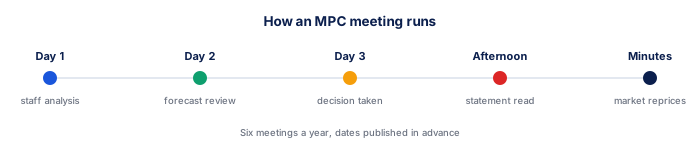
The Monetary Policy Committee meets six times a year over three days, and the Governor announces the decision on the final afternoon. The rand and the bond curve move within seconds of that announcement, which is why the calendar matters for anyone holding a position through it.
★ Where the cycle stands
The Reserve Bank raised the repo rate in May 2026 and again on 23 September, taking it to 7.25% and prime to 10.75%. Both decisions were unanimous, and both were driven by the fuel price shock following the Middle East conflict rather than by domestic demand.
The next scheduled decision is 19 November 2026. The next CPI release before it is 21 October. The Bank has said it expects inflation back near 3% towards the end of 2027, and that its projection has the policy rate broadly stable through the rest of this year.
| Item | Detail |
|---|---|
| Meetings per year | Six |
| Typical months | January, March, May, July, September, November |
| Length | Three days, Tuesday to Thursday |
| Announcement | Thursday afternoon, South African time |
| Published with it | The statement, the vote split and the Bank's forecast |
| Element | Why it matters |
|---|---|
| The rate decision | The headline, already partly priced in |
| The vote split | Shows how close the next move is |
| The inflation forecast | Drives expectations more than the decision itself |
| The growth forecast | Sets the tone for how much room there is to cut |
| The Governor's remarks | Where the guidance actually sits |
| Signal | Hawkish reading | Dovish reading |
|---|---|---|
| Vote split | Unanimous to hold or raise | Narrow, with dissent to cut |
| Inflation forecast | Revised up | Revised down |
| Growth forecast | Unchanged or up | Revised down |
| Guidance language | Risks to the upside | Risks balanced or to the downside |
| Likely rand reaction | Firmer | Weaker |

Download this data
Every table on this page as a spreadsheet, with the source and the date it was checked in the header rows.
⬇ Download CSVHow these figures work
The committee meets over three days. The first two are spent on the forecast and the staff analysis; the decision is taken on the third and announced that afternoon. The statement, the vote split and the Bank's updated forecast are published together.
Markets price the expected decision in advance, through forward rate agreements and the bond curve. By the time the Governor speaks, the number itself is rarely the news. What moves prices is the guidance and the split.
★ A worked example
Before a September meeting, forward rate agreements imply about a 70% chance of a 25 basis point increase.
If the increase arrives with a unanimous vote and a statement warning about persistent inflation, the rand firms, because the market now prices a higher terminal rate. If the same increase arrives on a three to two vote with a softer tone, the rand can weaken despite the hike, because the cycle now looks closer to its end.
Same decision, opposite reaction, from the part of the announcement that is not the number.
✕ Common mistakes
- Treating the calendar as fixed. The Reserve Bank publishes dates a year ahead and they shift. Confirm before planning around one.
- Entering a position minutes before the announcement. Spreads widen and liquidity thins. Execution in that window is materially worse than normal.
- Reading only the headline. The vote split and the forecast carry more information about the next meeting than the decision does.
- Assuming South African time. The announcement is in South African time, which does not shift for daylight saving. Overseas counterparts move around it twice a year.
Notes on reading these figures
- The Reserve Bank publishes the following year's dates in advance. Confirm them on the Bank's site rather than relying on the usual months, because they shift.
- Spreads widen around the announcement and liquidity thins. A stop placed close to the market can be filled well away from its level in the minutes after the statement.
- The decision is often anticipated. What moves the rand is the gap between the decision and what was priced, plus the tone of the guidance.
To put these figures to work, the SARB Repo Rate History runs the arithmetic on your own numbers, and South African Inflation History covers the same ground in ordinary language. Prime Lending Rate History and Currency pairs during major news go into the detail this table only summarises.
Terms used on this page
Put this table on your own site
The table below can sit on your own page and stays current without you editing anything.
- Preview the embeddable table as it will appear on your site
Place this snippet on your page and the table is embedded live, rather than copied and left to age.
<iframe src="https://www.tradeanswers.co.za/embed/ref-sarb-mpc-meeting-calendar.html" width="100%" height="620" style="border:0" title="SARB MPC Meeting Calendar"></iframe>Free to use with attribution. The link back to this page is built into the embed.
Frequently asked questions
How many times a year does the MPC meet?
Six, roughly every two months. The Reserve Bank publishes the following year's dates in advance.
What time is the announcement?
The Governor delivers the statement on the final afternoon of the meeting, in South African time.
Where do I find the dates?
On the Reserve Bank's monetary policy pages. They are published ahead of the year and occasionally adjusted.
What is published with the decision?
The statement, the vote split, and the Bank's updated inflation and growth forecasts.
Does the market move before the announcement?
Yes. Expectations are priced through forward rate agreements and the bond curve in the weeks before, which is why only the surprise moves prices on the day.
Should I close positions before a meeting?
That is a risk decision rather than a rule. What is predictable is that spreads widen and stops fill worse than usual in that window.