i Short answer
Formally emigrating or ceasing South African tax residency does not automatically close or restrict your existing trading account, but it does change your tax treatment, your access to SARB exchange control allowances, and potentially which entity you should be trading through going forward.
The process for ceasing tax residency runs through SARS rather than the older, now-discontinued SARB-centric financial emigration process, and is worth completing formally rather than assuming a change of physical address alone updates your status.
📋 ON THIS PAGE
1. What formally ceasing tax residency actually involves
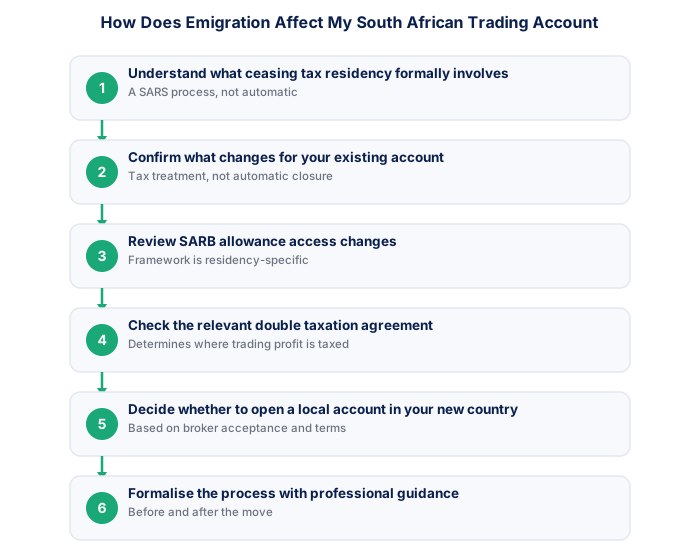
Ceasing South African tax residency is a formal process completed through SARS, generally based on either the physical presence test no longer being met or a change in your ordinarily resident status, and is not automatically triggered simply by moving abroad or spending extended time overseas.
This process has changed over recent years; the older financial emigration process previously administered through the SARB has been phased out, with the current process centred on SARS's own tax residency determination and reporting requirements instead.
2. What changes for your existing trading account
Your existing South African trading account does not automatically close when you cease tax residency, but your tax obligations on it change substantially: as a non-resident, generally only South African-sourced income remains taxable in South Africa, while your worldwide income, including trading profit, may become taxable in your new country of residence instead.
Some brokers may require updated documentation reflecting your new residency status, and depending on your new country of residence, may have their own onboarding or compliance requirements for non-resident clients that differ from what applied while you were a South African resident.
- SARB economic calendar checked for the week
- Next Eskom load shedding schedule reviewed
- GNU stability news reviewed
- Stats SA data releases noted
- Credit agency review dates checked
- US/global events that move EM risk noted
3. SARB exchange control implications
Your access to the Single Discretionary Allowance and Foreign Investment Allowance, both structured around South African tax residency, changes once you formally cease residency, since these allowances are specifically designed for residents transferring funds offshore, a framework that applies differently once you are no longer a resident yourself.
This is a complex area, discuss it directly with a professional who specialises in cross-border tax and exchange control matters, since the specific implications depend significantly on your new country of residence and the nature of your ongoing South African financial ties.
| Event | Frequency | ZAR impact | Source |
|---|---|---|---|
| SARB MPC | 6x per year | High | resbank.co.za |
| Budget Speech | Annual (February) | Very high | treasury.gov.za |
| Credit reviews | Annual each agency | Very high | Agency sites |
| Stats SA CPI | Monthly | Medium | statssa.gov.za |
| Eskom stage | As needed | Low-medium | eskomsepush.com |
- SA context provides genuine informational edge
- ZAR pairs accessible via FSCA brokers in ZAR accounts
- Rand volatility creates larger intraday ranges
- 6 SARB meetings/year create regular macro setups
- Higher geopolitical risk than G10 pairs
- Load shedding creates unique operational disruptions
- SA rand liquidity thinner than major G10 pairs
- SA-specific news requires constant local monitoring
4. Double taxation agreements and where you now owe tax
South Africa has double taxation agreements with numerous countries, which generally determine which country has the primary taxing right over specific types of income, including trading profit, to avoid the same income being fully taxed twice in different jurisdictions.
The specific treatment depends on the terms of the relevant agreement with your new country of residence, and confirming this with a tax professional familiar with both jurisdictions is a far better approach than assuming a general rule applies uniformly across all countries.
5. Should you switch to a broker in your new country?
This depends on several factors: whether your existing South African broker continues to accept clients resident in your new country, whether a locally regulated broker in your new country offers better terms or protections, and practical considerations like currency of your new income and expenses.
Some traders maintain their existing South African account for continuity while also opening an account with a broker regulated in their new jurisdiction, particularly if planning to eventually deposit new capital sourced from income earned in that new country.
6. Practical steps to take before and after emigrating
Before emigrating, consulting both a tax professional and, if significant funds are involved, an exchange control specialist, should be done well in advance rather than only once the move is already underway, since some steps are more straightforward to complete while you are still a South African tax resident.
After emigrating, formally updating your residency status with SARS, notifying your broker of your new circumstances, and keeping clear records of the date your tax residency changed should all be done promptly, since these records become relevant for both South African and your new country's tax filings going forward.
★ Why It Matters
Worth starting the tax residency and cross-border planning conversation with a professional well before your actual move date, similar in spirit to arranging a tax clearance certificate in advance, since several practical steps are considerably more straightforward to arrange while you are still formally a South African resident than after the fact.
✕ Common mistakes
- Assuming moving abroad automatically updates your tax residency status. Ceasing tax residency is a formal SARS process, not an automatic consequence of relocating.
- Not informing your broker of a change in residency status. This can affect your account's compliance status and applicable terms going forward.
- Overlooking how SARB allowance access changes once you're no longer a resident. This framework is specifically structured around South African tax residency.
- Assuming a general double taxation rule applies uniformly to every country. Treatment depends on the specific agreement with your particular new country of residence.
Key Takeaways
- Formally emigrating or ceasing South African tax residency does not automatically close or restrict your existing trading account, but it does change your tax treatment, your access to SARB exchange control allowances, and potentially which entity you should be trading through going forward.
- What formally ceasing tax residency actually involves.
- What changes for your existing trading account.
- SARB exchange control implications.
- Double taxation agreements and where you now owe tax.
See also: Can I Trade Forex as a South African Living Abroad? and Is CFD Trading Regulated in South Africa?.
Frequently asked follow-up questions
Do I need to close my South African trading account if I emigrate?
Not necessarily; many brokers continue to serve non-resident clients, though this depends on the specific broker's policies and your new country of residence.
Is the old 'financial emigration' process through the SARB still available?
No, this older SARB-centric process has been phased out in favour of a SARS-centred tax residency determination process; confirm the current process directly with SARS or a qualified professional.
Will I be taxed twice on my trading profit after emigrating?
Double taxation agreements between South Africa and many countries are specifically designed to prevent this, though the exact mechanism depends on the specific agreement with your new country of residence.
