i Short answer
A liquidity provider supplies the buy and sell prices a broker offers its clients, typically large banks or financial institutions.
The depth and quality of a broker's liquidity provider relationships directly affects the spreads and execution quality clients experience.
📋 ON THIS PAGE
- What liquidity providers actually are
- How brokers connect to and aggregate these providers
- Why more, deeper provider relationships generally mean better pricing
- The connection to the execution models
- Can retail traders check a broker's specific liquidity sources
- Why this matters more for some traders than others
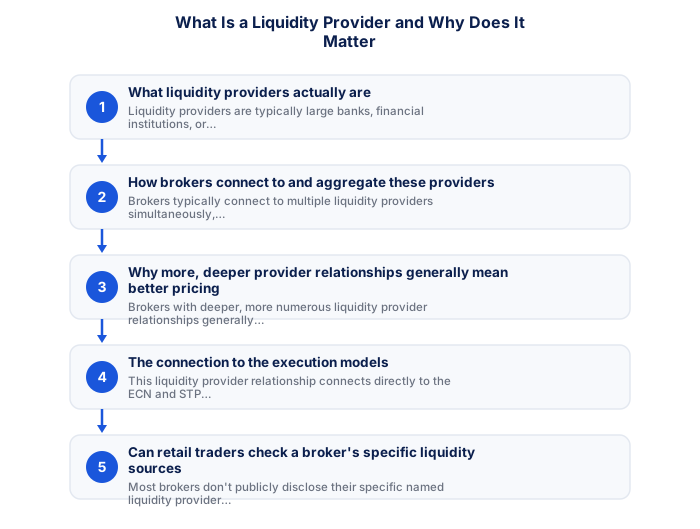
1. What liquidity providers actually are
Liquidity providers are typically large banks, financial institutions, or specialised liquidity firms that continuously quote buy and sell prices for various financial instruments, providing the underlying pricing depth that brokers then access and pass through to their own retail clients, whether through the ECN or STP execution models.
2. How brokers connect to and aggregate these providers
Brokers typically connect to multiple liquidity providers simultaneously, aggregating their respective pricing to offer clients the best available combined price at any given moment, similar in concept to how a price-comparison service might aggregate multiple sources, though the specific technical infrastructure and provider relationships vary considerably between different brokers.
- FSCA-regulated broker verified at fsca.co.za
- Demo account tested for minimum 60 days
- Trading plan written: entry, exits, position sizing
- Risk per trade defined (1-2% of account)
- Backup internet connection tested for load shedding
- Tax implications understood
3. Why more, deeper provider relationships generally mean better pricing
Brokers with deeper, more numerous liquidity provider relationships generally can offer tighter, more competitive spreads and more reliable execution, since this depth provides more genuine buying and selling interest to match client orders against, reducing the kind of liquidity-related cost and execution risk.
4. The connection to the execution models
This liquidity provider relationship connects directly to the ECN and STP execution models, since both models specifically route client orders toward these external liquidity sources, distinct from the market maker model where the broker itself effectively becomes the liquidity source for client trades.
| Item | Detail |
|---|---|
| Regulator | FSCA, fsca.co.za |
| Exchange control | SARB, resbank.co.za |
| Tax authority | SARS, sars.gov.za |
| JSE hours | 09:00-17:00 SAST Mon-Fri |
| Best forex session | 15:00-17:00 SAST |
| CGT annual exclusion | R50,000 (individuals) |
5. Can retail traders check a broker's specific liquidity sources
Most brokers don't publicly disclose their specific named liquidity provider relationships in granular detail, treating this as commercially sensitive business information, though some brokers do provide general information about their liquidity sourcing approach within their broader execution policy documentation.
6. Why this matters more for some traders than others
This factor matters considerably more for traders specifically pursuing execution-sensitive styles like scalping, where the practical effects of liquidity depth, tighter spreads, faster, more reliable execution, directly and meaningfully affect strategy viability, compared to traders following the swing or position trading styles, where these effects matter proportionally less given their lower trading frequency.
Check the agreement for what happens when a loss exceeds the deposit. negative balance protection is offered by some brokers and not others.
South African traders using CFD and forex instruments should build clear awareness of the full cost structure of each trade before committing capital. The visible entry cost, the spread, is often the smallest component for positions held overnight or over multiple days. Overnight financing charges accumulate on the full notional value of the leveraged position, not just the margin deposited, which means positions held for a week can accumulate financing costs that exceed the entry spread many times over. Building these costs explicitly into position sizing and holding period decisions is a discipline that improves long-term trading economics significantly.
ECN brokers aggregate prices from multiple external liquidity providers.
A market maker quotes its own prices and takes the other side of your trades internally. ECN brokers aggregate prices from multiple liquidity providers, typically offering tighter spreads at higher volumes.
★ Why It Matters
Worth asking directly, though many brokers won't fully disclose this: how many distinct liquidity providers feed into your broker's pricing, brokers aggregating from multiple sources can generally offer tighter, more competitive pricing than those relying on a single provider.
✕ Common mistakes
- Assuming all brokers source liquidity identically. The number and quality of liquidity provider relationships genuinely varies.
- Treating spread quality as unrelated to underlying liquidity provider relationships. These relationships directly affect the pricing clients ultimately see.
- Ignoring liquidity provider quality when comparing brokers for execution-sensitive strategies. This factor matters more for scalping and high-frequency approaches.
Key Takeaways
- A liquidity provider supplies the buy and sell prices a broker offers clients, with the depth and quality of these relationships affecting spreads and execution.
- A liquidity provider supplies the buy and sell prices a broker offers its clients, typically large banks or financial institutions.
- The depth and quality of a broker's liquidity provider relationships directly affects the spreads and execution quality clients experience.
- What liquidity providers actually are.
- How brokers connect to and aggregate these providers.
Frequently asked follow-up questions
Do all brokers use the same liquidity providers?
No, specific liquidity provider relationships vary considerably between brokers, contributing to genuine differences in spread competitiveness and execution quality across different brokers.
Does a broker's liquidity provider relationship affect regulatory compliance?
Not directly. Liquidity sourcing is a business and execution quality matter, separate from FSCA regulatory compliance.
Can I request information about my broker's specific liquidity providers?
You can ask, though many brokers treat this as commercially sensitive information and may only provide general, rather than specific named, information in response.
