i Short answer
South African residents can transfer up to R2 million per calendar year offshore using the single discretionary allowance, without prior SARB approval or a tax clearance certificate.
For the vast majority of retail traders depositing reasonable amounts to start out, this comfortably covers their needs without extra paperwork. Note that the underlying exchange control framework itself is being overhauled, see our explainer on the 2026 Capital Flow Management Regulations replacing the 1961 rules.
📋 ON THIS PAGE
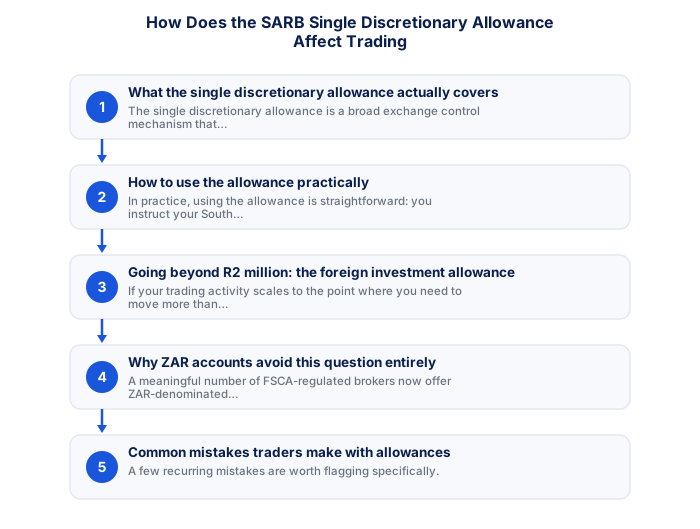
1. What the single discretionary allowance actually covers
The single discretionary allowance is a broad exchange control mechanism that lets South African residents over 18 move up to R2 million abroad each calendar year for a wide range of personal purposes, without needing to specify in advance exactly what the money is for or obtain prior SARB authorisation. This isn't a trading-specific allowance, the same R2 million cap covers travel spending, gifts to family members abroad, school fees for children studying overseas, and offshore investment or trading account funding, all drawing from the same combined annual limit.
| Allowance | Annual limit | Extra requirement |
|---|---|---|
| Single discretionary allowance | R2 million | Simple purpose declaration to your bank |
| Foreign investment allowance | R10 million | Tax clearance certificate (AIT PIN) required |
For related context, see SARB's foreign exchange reserves, reserve levels affect the rand's vulnerability.
The Currency and Exchanges Act treats unauthorised offshore transfers as a serious violation. Penalties include forfeiture, fines, and potential criminal prosecution.
This matters practically: if you're also sending money abroad during the same calendar year for other purposes, say, an overseas holiday or supporting a family member studying abroad, those transfers count against the same R2 million cap as any amount you send to fund a trading account, so it's worth tracking your cumulative usage across all purposes rather than assuming trading-related transfers have their own separate, dedicated allowance.
It's worth confirming the current, exact threshold directly with your bank or SARS before relying on any specific figure quoted elsewhere, including here, since exchange control thresholds can be adjusted over time, and working from an outdated figure risks miscalculating your available allowance.
2. How to use the allowance practically
In practice, using the allowance is straightforward: you instruct your South African bank to process an international transfer to your broker's account details, and the bank processes this under the single discretionary allowance framework, often requiring you to complete a simple form declaring the purpose of the transfer (a standard, low-friction compliance step rather than an approval process). Most banks can process these transfers within a few business days, and many now offer this through online or app-based banking without requiring an in-branch visit.
It's worth confirming your bank's specific process and any transfer fees in advance, since fee structures and processing times can vary meaningfully between South African banks, and some banks have lower default international transfer limits per transaction that may require splitting a larger single transfer into multiple instructions even while staying within your overall annual allowance.
It's worth keeping clear personal records of your cumulative transfers throughout each calendar year, rather than relying on your bank to track this for you automatically, having your own running total helps you avoid accidentally exceeding your allowance without realising it.
3. Going beyond R2 million: the foreign investment allowance
If your trading activity scales to the point where you need to move more than R2 million offshore in a calendar year, the relevant mechanism becomes the foreign investment allowance, which permits transfers of up to R10 million annually but requires obtaining a tax clearance certificate (specifically an Approval International Transfer, or AIT, PIN) from SARS first, confirming that your tax affairs are up to date before the transfer can be authorised and processed.
This process takes meaningfully longer than the simple declaration required under the single discretionary allowance, budget for it to take days to a couple of weeks depending on SARS processing times and the completeness of your tax filing history, so it's worth planning ahead if you anticipate needing to move amounts in this higher range, rather than discovering the requirement only when you're already trying to fund a large, time-sensitive transfer.
| Type | Annual limit | Tax clearance | Reset |
|---|---|---|---|
| Single Discretionary | R2,000,000 | Not required | 1 January |
| Foreign Investment | R10,000,000 | SARS compliance status required | 1 January |
| Above both limits | No fixed limit | Treasury approval required | Case by case |
It's worth starting this process well in advance of when you actually need the funds transferred, given the meaningfully longer timeline involved, planning around this extended processing time prevents a larger planned transfer from becoming an unexpected bottleneck in your broader trading or funding plans.
4. Why ZAR accounts avoid this question entirely
A meaningful number of FSCA-regulated brokers now offer ZAR-denominated trading accounts that South African clients can fund directly via domestic EFT, with the funds essentially staying within the South African banking system rather than crossing the border to reach an offshore-held account. For traders using this structure, the entire SARB allowance question becomes largely moot for day-to-day funding, there's no cross-border transfer triggering exchange control mechanisms in the first place.
This is one of the most practical reasons South African traders increasingly favour brokers offering local ZAR accounts: it removes an entire layer of administrative friction (transfer declarations, allowance tracking, foreign exchange conversion costs) that simply doesn't apply when your trading capital never technically leaves the domestic financial system.
- Calculate transfers made this calendar year to date
- Confirm remaining allowance before proceeding
- Obtain SARS tax clearance if using foreign investment allowance
- Contact bank FX desk with transfer details
- Retain all confirmation documents
- Record transfer in personal allowance tracker
It's worth weighing this genuine simplicity advantage explicitly when choosing between a ZAR and foreign-currency account, discussed elsewhere on this site, for traders who'd rather avoid exchange control considerations entirely, this practical benefit alone can be a meaningful factor in that broader decision.
5. Common mistakes traders make with allowances
A few recurring mistakes are worth flagging specifically. First, forgetting that the single discretionary allowance is shared across all discretionary purposes in a given year, not dedicated solely to trading, someone who's already used R700,000 of their allowance on an overseas trip earlier in the year only has R300,000 of headroom left for trading account funding before hitting the cap. Second, attempting to circumvent allowance limits by splitting transfers across multiple family members' allowances in a way that doesn't reflect the actual beneficial ownership of the funds, which can constitute a more serious exchange control violation than simply staying within your own personal limit.
Third, some traders mistakenly assume that using a foreign-currency credit card to fund a trading account somehow bypasses these allowance considerations, it generally doesn't; card-based international payments are still subject to exchange control limits and reporting, just processed through a different mechanism than a bank wire transfer.
It's worth reviewing this list of common mistakes honestly against your own current practices, catching an error in how you've been tracking or using your allowance now is considerably less costly than discovering a compliance issue after it has already accumulated over an extended period.
6. What your bank will ask when you transfer
When initiating an international transfer under the single discretionary allowance, your bank will typically require you to complete a declaration confirming the purpose of the transfer (selecting something like "investment" or a similar relevant category from a standard list), your South African ID or passport details, and sometimes basic information about the recipient (the broker's name and account details). This is a standard compliance step required of the bank under exchange control regulations, not an approval gate that can result in your transfer being blocked, provided you're within your annual allowance and the declared purpose is legitimate.
Banks are required to keep records of these declarations as part of their own regulatory compliance obligations, so providing accurate information matters both for your own legal standing and because discrepancies between declared purpose and actual fund usage can create complications if scrutinised later.
It's also worth knowing that any FSCA-regulated broker operating in South Africa is bound by POPIA (the Protection of Personal Information Act), which governs how your personal and financial data must be collected, stored, and protected.
The R2 million single discretionary allowance resets every January 1st on the calendar year, not on a rolling 12-month basis, and covers travel, gifts, and trading transfers combined.
★ Why It Matters
Worth knowing as a practical detail: the R2 million single discretionary allowance resets each calendar year on January 1st, not on a rolling 12-month basis from your first transfer, so a trader who transfers heavily in December and again in January can use close to R2 million within a short window.
✕ Common mistakes
- Not tracking cumulative usage across all purposes, not just trading. Travel, gifts, and trading transfers all draw from the same combined limit.
- Assuming this allowance is trading-specific. It's a general exchange control mechanism covering many different uses.
- Ignoring the separate, larger foreign investment allowance for bigger transfers. This requires a tax clearance certificate and serves a different purpose.
Key Takeaways
- South Africans can move up to R2 million offshore yearly without SARB approval. Learn how this allowance affects funding an offshore trading account.
- South African residents can transfer up to R2 million per calendar year offshore using the single discretionary allowance, without prior SARB approval or a tax clearance certificate.
- For the vast majority of retail traders depositing reasonable amounts to start out, this comfortably covers their needs without extra paperwork.
- What the single discretionary allowance actually covers.
- How to use the allowance practically.
See also: Is Forex Trading a Pyramid Scheme in South Africa?.
Frequently asked follow-up questions
Does the R2 million allowance reset every January?
Yes, the single discretionary allowance is calculated on a calendar year basis and resets at the start of each new calendar year.
Can my spouse and I each use a separate R2 million allowance?
Yes, the allowance is per individual resident, so each adult in a household has their own separate R2 million annual allowance, provided any transfers genuinely reflect that individual's own funds and beneficial ownership.
What happens if I accidentally exceed my allowance?
Exceeding allowance limits without proper authorisation can constitute an exchange control contravention; if you realise this has happened, consulting with your bank or a specialist exchange control advisor promptly is advisable rather than attempting further transfers.
Can I use part of my allowance for trading and the rest for something else in the same year?
Yes, the allowance is a single combined annual cap across all discretionary purposes, so you can split it however you like between trading funding, travel, gifts, or other approved uses, provided the total stays within R2 million.
Does withdrawing profits back to South Africa also count against this allowance?
No, bringing money back into South Africa isn't restricted by the discretionary allowance, which specifically governs outbound transfers; repatriating funds generally faces far fewer exchange control hurdles than sending money offshore.
