What this page covers
The JSE runs a continuous session between two auctions. The closing auction sets the price used for valuations and index calculations, which is why volume concentrates into it.
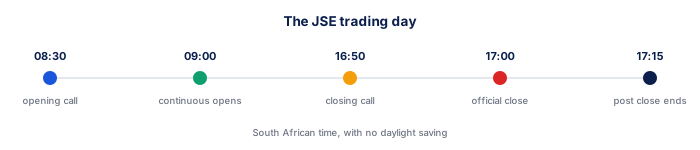
| Session | Time |
|---|---|
| Opening auction call | 08:30 to 09:00 |
| Continuous trading | 09:00 to 16:50 |
| Closing auction call | 16:50 to 17:00 |
| Closing price published | Shortly after 17:00 |
| Post close trading | 17:05 to 17:15 |
| Holiday | Date |
|---|---|
| New Year's Day | 1 January |
| Human Rights Day | 21 March |
| Good Friday | Moves each year |
| Family Day | Moves each year |
| Freedom Day | 27 April |
| Workers' Day | 1 May |
| Youth Day | 16 June |
| National Women's Day | 9 August |
| Heritage Day | 24 September |
| Day of Reconciliation | 16 December |
| Christmas Day | 25 December |
| Day of Goodwill | 26 December |
| Market | Opens | Closes | Overlaps the JSE |
|---|---|---|---|
| JSE | 09:00 | 17:00 | — |
| London | 10:00 or 11:00 | 18:30 or 19:30 | Most of the day |
| New York | 15:30 or 16:30 | 22:00 or 23:00 | The final ninety minutes |
| Tokyo | 02:00 or 03:00 | 08:00 or 09:00 | Just before the open |
| Sydney | 00:00 or 01:00 | 07:00 or 08:00 | No |

Download this data
Every table on this page as a spreadsheet, with the source and the date it was checked in the header rows.
⬇ Download CSVHow these figures work
The JSE runs an auction at each end of a continuous session. An auction collects orders without matching them, then strikes a single price that clears the most volume. That is why the opening and closing prices differ in character from prices during the day.
The closing auction price is the official close, used for index calculation, fund valuation and derivative settlement. That is why volume concentrates into those ten minutes.
★ A worked example
A trader wants to buy a Top 40 share and places a market order at 08:45.
Nothing executes. The opening auction is collecting orders, not matching them, and the order sits until the auction strikes at 09:00. It then fills at the auction price, which may be some distance from the previous close if news broke overnight.
Placing the same order at 09:15 gives continuous trading, where it fills against the visible book at the prevailing price. The auction is not a slower version of continuous trading; it is a different mechanism.
✕ Common mistakes
- Treating auction periods as normal trading. Orders collect rather than match. What looks like a stuck order is the mechanism working.
- Assuming the platform's hours are the exchange's. A broker may accept orders when the exchange is closed. There is no underlying market to price against.
- Forgetting South Africa has no daylight saving. The overlap with London and New York shifts twice a year while JSE hours stay put.
- Ignoring the Sunday holiday rule. Where a public holiday falls on a Sunday, the Monday is the holiday and the exchange is closed then.
Notes on reading these figures
- Where a public holiday falls on a Sunday, the Monday becomes a holiday and the exchange is closed then instead.
- South Africa does not observe daylight saving. London and New York do, so the overlap with those sessions shifts by an hour twice a year while JSE hours stay put.
- A CFD on a JSE share follows the underlying exchange's hours. The broker's platform may be open when the exchange is not, but there is no underlying market to price against.
To put these figures to work, the JSE Settlement Cycle runs the arithmetic on your own numbers, and JSE Trading Cost Schedule covers the same ground in ordinary language. Buying shares on the JSE and JSE Indices Reference go into the detail this table only summarises.
Terms used on this page
Put this table on your own site
The table below can sit on your own page and stays current without you editing anything.
- Preview the embeddable table as it will appear on your site
Drop this into your page where the table should sit. When these numbers move, your copy moves with them.
<iframe src="https://www.tradeanswers.co.za/embed/ref-jse-trading-hours-and-holidays.html" width="100%" height="620" style="border:0" title="JSE Trading Hours and Holidays"></iframe>Free to use with attribution. The link back to this page is built into the embed.
Frequently asked questions
What time does the JSE open?
Continuous trading runs from 09:00 to 16:50 South African time, with an opening auction call from 08:30 and a closing auction call from 16:50.
What is the closing auction for?
It sets the official closing price used for index calculation, fund valuation and derivative settlement, which is why volume concentrates into it.
Can I trade a JSE share outside those hours?
Not on the exchange. A CFD platform may quote, but there is no underlying market setting the price.
Does the JSE close for all public holidays?
Yes, for South African public holidays. Where one falls on a Sunday, the following Monday is the holiday.
Does South Africa observe daylight saving?
No. London and New York do, so the overlap with those sessions shifts by an hour twice a year.
What is post close trading?
A short window after the close in which trades may be reported at the closing price. It is not continuous trading.