i Short answer
Major South African political events, party policy conferences, cabinet reshuffles, and coalition negotiations, tend to affect the Rand through their influence on investor perception of policy direction and governance stability, rather than through any direct, mechanical market mechanism.
The market reaction is usually proportional to how much policy uncertainty the specific event resolves or introduces, meaning a widely anticipated, uneventful outcome often produces limited movement while a genuine surprise can move the Rand meaningfully.
📋 ON THIS PAGE
- Why political events move a currency at all
- Types of political events South African traders typically watch
- Why the reaction is often about surprise, not the event itself
- How to follow these events as they develop
- Practical risk management around political event periods
- Distinguishing genuine policy risk from short-term noise
1. Why political events move a currency at all
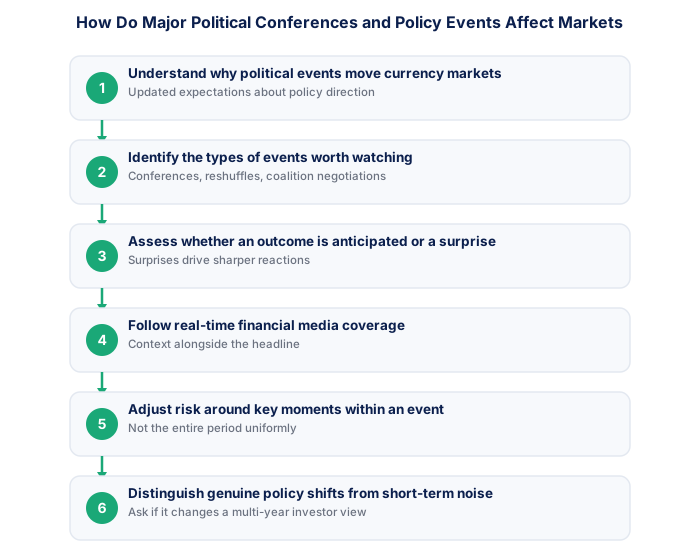
Currency markets price in expectations about a country's future economic policy direction, fiscal discipline, and governance stability. A major political event that could plausibly shift any of these, a change in economic leadership, a significant policy resolution, or a coalition arrangement, gives the market new information to price, which is what produces the actual movement.
This is distinct from the event itself having any direct mechanical effect on trade flows or interest rates, the market reaction is fundamentally about updated expectations for future policy, which is inherently more subjective and harder to model precisely than a scheduled economic data release.
For related context, see South Africa's election cycle, dedicated guide to the SA election cycle and rand.
2. Types of political events South African traders typically watch
Party policy conferences, particularly when they involve significant economic policy resolutions or leadership contests, are closely watched given their potential influence on government economic direction. Cabinet reshuffles, especially involving the finance ministry specifically, tend to produce a more immediate and direct market reaction given the portfolio's direct relevance to fiscal policy.
Coalition negotiations and government formation periods, increasingly relevant given South Africa's recent political environment, introduce a distinct type of uncertainty around policy continuity and stability that markets watch closely during the negotiation period itself.
- FSCA-regulated broker verified at fsca.co.za
- Demo account tested for minimum 60 days
- Trading plan written: entry, exits, position sizing
- Risk per trade defined (1-2% of account)
- Backup internet connection tested for load shedding
- Tax implications understood
3. Why the reaction is often about surprise, not the event itself
A leadership outcome or policy resolution that matches what polling, insider commentary, and analyst expectations had already suggested tends to produce a comparatively muted market reaction, since much of it was already reflected in the Rand's price beforehand.
A genuine surprise result, an unexpected leadership change or an unexpectedly market-unfriendly policy resolution, tends to produce a considerably sharper reaction precisely because it forces a rapid repricing of expectations that the market had not already accounted for.
4. How to follow these events as they develop
Major South African political events are extensively covered by local financial media, which typically provide real-time updates alongside economist and analyst commentary on the likely market implications as an event unfolds, rather than only after a final outcome is confirmed.
For major events, some economists and financial institutions publish pre-event scenario analysis, outlining a range of possible outcomes and each one's likely Rand implication, which can help frame your own expectations going into the event itself.
| Item | Detail |
|---|---|
| Regulator | FSCA, fsca.co.za |
| Exchange control | SARB, resbank.co.za |
| Tax authority | SARS, sars.gov.za |
| JSE hours | 09:00-17:00 SAST Mon-Fri |
| Best forex session | 15:00-17:00 SAST |
| CGT annual exclusion | R50,000 (individuals) |
5. Practical risk management around political event periods
Many traders reduce position size or widen stops heading into a major, highly uncertain political event, given the potential for sharp, headline-driven volatility that can move faster than a standard stop-loss might comfortably absorb during the most active period of an unfolding event.
Being aware of the general timeline of a multi-day event, such as a conference, and specifically when key resolutions or announcements are expected within it, allows more precise risk adjustment around the actual moments of highest uncertainty rather than treating the entire event period uniformly.
6. Distinguishing genuine policy risk from short-term noise
Not every political headline warrants a significant trading reaction, and part of developing judgement in this area is learning to distinguish between a headline with genuine, lasting policy implications and one that generates short-term noise without materially changing the underlying policy trajectory.
A reasonable practical filter is asking whether a specific development would plausibly change an institutional investor's multi-year view of South African policy direction, since that is generally the threshold that produces a lasting Rand reaction versus a brief, quickly-reversed move.
★ Why It Matters
Worth following at least one or two established South African economists or financial commentators specifically for their real-time framing of political developments, since context on what a specific outcome means for policy direction is often more useful for trading purposes than the raw headline alone.
✕ Common mistakes
- Assuming every political headline warrants an immediate trading reaction. Many developments are short-term noise without lasting policy implications.
- Ignoring whether an outcome was already broadly anticipated. Anticipated outcomes are often already priced in, muting the reaction.
- Holding oversized positions through a known period of high political uncertainty. Headline-driven volatility can move faster than standard risk management tools comfortably absorb.
- Treating a multi-day event as uniformly risky throughout. Specific moments within an event, like a key resolution announcement, carry disproportionately higher risk.
Key Takeaways
- Major South African political events, party policy conferences, cabinet reshuffles, and coalition negotiations, tend to affect the Rand through their influence on investor perception of policy direction and governance stability, rather than through any direct, mechanical market mechanism.
- Why political events move a currency at all.
- Types of political events South African traders typically watch.
- Why the reaction is often about surprise, not the event itself.
- How to follow these events as they develop.
See also: How Does the Rand Typically Behave Around SONA and Major Policy Speeches?.
Frequently asked follow-up questions
Do these political events affect the JSE the same way as the Rand?
Broadly yes, since both reflect investor sentiment toward South African assets generally, though specific sectors within the JSE may react differently depending on the policy area involved.
How long does an elevated volatility period around a major political event typically last?
This varies considerably by event, from a single day for a clearly resolved outcome to an extended period for an unresolved or ongoing situation like prolonged coalition negotiations.
Should beginner traders avoid trading during these periods entirely?
Many beginner traders do choose to reduce activity or stay out of the market during periods of unusually high, headline-driven uncertainty, which is a reasonable and common precaution rather than a strict requirement.
