i Short answer
Sovereign credit rating reviews from Moody's, S&P, and Fitch influence the Rand primarily through their effect on foreign investor sentiment toward South African government bonds, with downgrades typically pressuring the Rand and upgrades or stable outlooks generally supportive.
The actual market reaction often depends more on whether the outcome matches or surprises prior expectations than on the rating change itself, since anticipated outcomes are frequently already reflected in the Rand's price before the announcement.
📋 ON THIS PAGE
- Why credit ratings matter to currency markets at all
- The three major agencies and their review calendars
- Why the market reaction varies so much between reviews
- Historical patterns worth understanding
- How traders practically prepare around a review date
- The limits of trading credit rating reviews specifically
1. Why credit ratings matter to currency markets at all
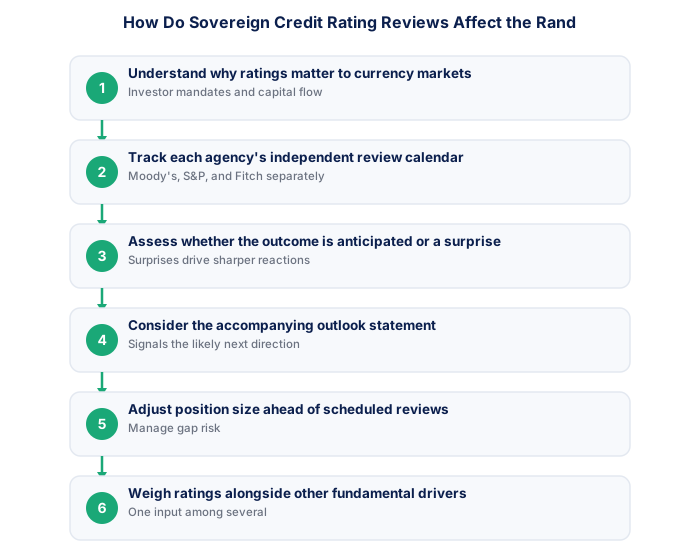
A sovereign credit rating reflects an agency's assessment of a country's ability and willingness to meet its debt obligations. For South Africa specifically, this rating directly affects the cost and availability of government borrowing, and indirectly affects investor appetite for South African assets more broadly, including the Rand itself.
A lower rating typically means foreign institutional investors, many of whom operate under mandates restricting investment below certain rating thresholds, become less willing or able to hold South African bonds, reducing capital inflows that would otherwise support Rand demand.
| Agency | Typical Review Frequency |
|---|---|
| Moody's | 1-2 times per year |
| S&P Global | 1-2 times per year |
| Fitch | 1-2 times per year |
2. The three major agencies and their review calendars
Moody's, S&P Global, and Fitch each maintain their own independent review schedule for South Africa, typically reviewing the rating one to two times per year, though the exact dates can shift. These scheduled review dates are publicly available in advance and are widely tracked by South African financial media and economic calendars.
The three agencies do not always move in sync, one agency downgrading or changing outlook while the others hold steady is a common pattern, meaning traders need to track each agency's specific stance rather than treating "the credit rating" as a single unified figure.
- SARB economic calendar checked for the week
- Next Eskom load shedding schedule reviewed
- GNU stability news reviewed
- Stats SA data releases noted
- Credit agency review dates checked
- US/global events that move EM risk noted
3. Why the market reaction varies so much between reviews
A rating action that matches what the market already broadly expected, based on prior guidance, economic data trends, and analyst commentary, often produces a muted Rand reaction, since the outcome was largely already priced in beforehand. A genuine surprise, either direction, tends to produce a considerably sharper move.
The accompanying outlook statement, positive, stable, or negative, often matters as much as the rating action itself, since it signals the agency's expectation for the direction of the next review, giving the market forward-looking information beyond the current rating level alone.
| Event | Frequency | ZAR impact | Source |
|---|---|---|---|
| SARB MPC | 6x per year | High | resbank.co.za |
| Budget Speech | Annual (February) | Very high | treasury.gov.za |
| Credit reviews | Annual each agency | Very high | Agency sites |
| Stats SA CPI | Monthly | Medium | statssa.gov.za |
| Eskom stage | As needed | Low-medium | eskomsepush.com |
- SA context provides genuine informational edge
- ZAR pairs accessible via FSCA brokers in ZAR accounts
- Rand volatility creates larger intraday ranges
- 6 SARB meetings/year create regular macro setups
- Higher geopolitical risk than G10 pairs
- Load shedding creates unique operational disruptions
- SA rand liquidity thinner than major G10 pairs
- SA-specific news requires constant local monitoring
4. Historical patterns worth understanding
South Africa's loss of investment-grade status in the years following 2017 remains a widely referenced case study, illustrating how a downgrade below investment grade specifically can trigger a more pronounced reaction than incremental changes within an already sub-investment-grade rating, since certain institutional mandates are triggered specifically by that threshold.
More recent reviews have shown a somewhat more measured Rand reaction for changes that stay within the existing sub-investment-grade band, suggesting the market has partly adjusted its sensitivity once a country sits well below the investment-grade threshold rather than right at the boundary.
5. How traders practically prepare around a review date
Many traders reduce position size or widen stops on Rand pairs heading into a scheduled review, given the genuine potential for a sharp, gap-like move, particularly for reviews released outside normal trading hours or over a weekend, which can produce a significant opening gap when markets reopen.
Checking prior consensus expectations from South African economists and financial media ahead of the review date helps gauge how much of a potential outcome is already priced in, which is directly relevant to assessing how large a genuine surprise reaction might be.
6. The limits of trading credit rating reviews specifically
Credit rating reviews are one input among many affecting the Rand, and should not be treated in isolation from the broader fundamental picture, including SARB policy, global risk sentiment, and other local developments occurring around the same period.
Given the genuine unpredictability of the exact market reaction, even when the rating outcome itself is broadly anticipated, many traders treat scheduled review dates primarily as a risk management consideration, reducing exposure rather than as a specific directional trading opportunity.
★ Why It Matters
Worth checking whether a scheduled review falls on a weekend or after normal market hours specifically, since the resulting price gap when markets reopen can be considerably larger and harder to manage than an equivalent move during active trading hours.
✕ Common mistakes
- Treating all three rating agencies as moving in lockstep. Moody's, S&P, and Fitch often diverge, and each needs independent tracking.
- Ignoring the outlook statement in favour of only the rating level. The outlook signals the likely direction of the next review and often moves markets independently.
- Holding oversized positions through a scheduled review without adjustment. Reviews can produce sharp, gap-like moves, particularly outside normal trading hours.
- Assuming a rating change alone explains all subsequent Rand movement. Other simultaneous factors, SARB policy or global sentiment, are frequently also in play.
Key Takeaways
- Sovereign credit rating reviews from Moody's, S&P, and Fitch influence the Rand primarily through their effect on foreign investor sentiment toward South African government bonds, with downgrades typically pressuring the Rand and upgrades or stable outlooks generally supportive.
- Why credit ratings matter to currency markets at all.
- The three major agencies and their review calendars.
- Why the market reaction varies so much between reviews.
- Historical patterns worth understanding.
Frequently asked follow-up questions
Where can I find the exact dates of upcoming rating reviews?
The dates are published by the agencies themselves in advance and are commonly tracked and republished by South African financial news outlets and economic calendars.
Does a rating downgrade always weaken the Rand?
Not always immediately or by a predictable amount, since much of an anticipated downgrade may already be reflected in the Rand's price before the formal announcement.
How is South Africa's current rating generally assessed?
This changes over time and should be checked directly against each agency's current published rating rather than relied on from any single historical reference point.
