i Short answer
USD/ZAR is a currency pair showing how many South African Rand it takes to purchase one US Dollar.
It's one of the most actively traded emerging-market pairs globally, known for relatively higher volatility than major developed-market pairs.
📋 ON THIS PAGE
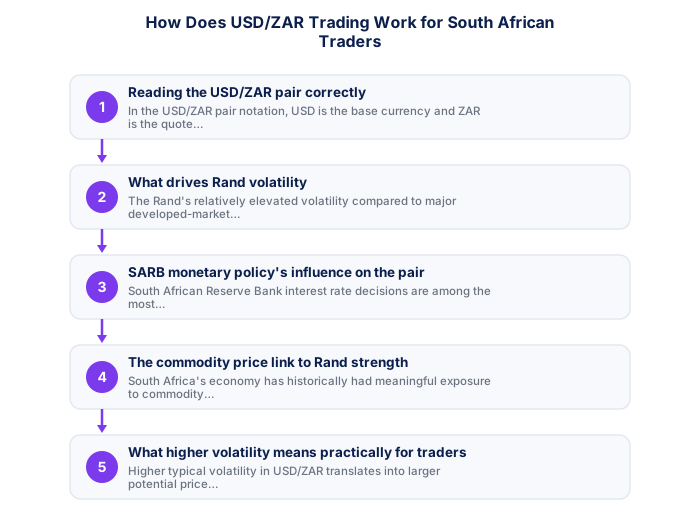
- Reading the USD/ZAR pair correctly
- What specifically drives Rand volatility
- SARB monetary policy's influence on the pair
- The commodity price link to Rand strength
- What higher volatility means practically for traders
- Comparing USD/ZAR to major developed-market pairs
- Where the pair has traded recently, and what moved it
1. Reading the USD/ZAR pair correctly
In the USD/ZAR pair notation, USD is the base currency and ZAR is the quote currency, meaning the quoted price tells you how many Rand are needed to buy one US Dollar. If USD/ZAR is trading at 18.50, for example, that means one US Dollar costs 18.50 Rand. When this number rises, it means the Dollar has strengthened relative to the Rand (or equivalently, the Rand has weakened); when it falls, the Rand has strengthened relative to the Dollar.
This directionality is worth being clear about before trading the pair, since a position that profits from Rand strength (Dollar weakness) requires going short the pair, while a position profiting from Rand weakness (Dollar strength) requires going long, getting this backward is a surprisingly common, costly mistake among newer traders unfamiliar with currency pair notation conventions.
A simple way to keep this straight: think of the quoted number as answering 'how many Rand does it take to buy one Dollar right now.' If that answer is getting bigger, Dollars are becoming more expensive in Rand terms, meaning the Rand is losing ground. Anchoring to that specific phrasing, rather than trying to remember an abstract rule about base and quote currencies, tends to stick better under the pressure of an actual live decision.
2. What specifically drives Rand volatility
The Rand's relatively elevated volatility compared to major developed-market currencies stems from several compounding factors: South Africa's classification as an emerging market, which generally carries higher perceived risk and is more sensitive to shifts in global investor risk appetite; domestic political and policy developments, which can move the currency sharply on both confirmed news and market speculation; relatively lower average daily trading volume compared to major pairs, which can make the Rand more susceptible to larger percentage moves on a given volume of buying or selling; and South Africa's specific economic structural factors, including its current account and fiscal balance dynamics.
This combination means USD/ZAR can experience meaningfully larger percentage moves within a single trading day compared to a pair like EUR/USD, particularly around significant local or global news events, a characteristic that creates both more potential trading opportunity and more potential risk for traders engaging with the pair.
- SARB economic calendar checked for the week
- Next Eskom load shedding schedule reviewed
- GNU stability news reviewed
- Stats SA data releases noted
- Credit agency review dates checked
- US/global events that move EM risk noted
It's worth understanding that these factors don't operate independently of each other, they frequently compound. A period of weak global risk appetite combined with unexpected domestic political news, for example, tends to produce considerably sharper Rand moves than either factor would on its own, which is part of why USD/ZAR volatility can spike suddenly rather than building gradually and predictably.
3. SARB monetary policy's influence on the pair
South African Reserve Bank interest rate decisions are among the most significant scheduled events affecting USD/ZAR, since interest rate differentials between South Africa and other major economies (particularly the US) directly influence the relative attractiveness of holding Rand-denominated versus Dollar-denominated assets for international investors seeking yield. A SARB rate decision that surprises markets, either by moving more or less than expected, or through unexpected forward guidance about future policy direction, can trigger significant, rapid USD/ZAR movement.
Beyond scheduled rate decisions, broader SARB and government commentary about inflation outlook, fiscal policy, and economic growth projections all factor into how international markets price Rand risk relative to other currencies, making South African economic policy commentary a relevant, ongoing input for traders actively following this specific pair.
| Event | Frequency | ZAR impact | Source |
|---|---|---|---|
| SARB MPC | 6x per year | High | resbank.co.za |
| Budget Speech | Annual (February) | Very high | treasury.gov.za |
| Credit reviews | Annual each agency | Very high | Agency sites |
| Stats SA CPI | Monthly | Medium | statssa.gov.za |
| Eskom stage | As needed | Low-medium | eskomsepush.com |
- SA context provides genuine informational edge
- ZAR pairs accessible via FSCA brokers in ZAR accounts
- Rand volatility creates larger intraday ranges
- 6 SARB meetings/year create regular macro setups
- Higher geopolitical risk than G10 pairs
- Load shedding creates unique operational disruptions
- SA rand liquidity thinner than major G10 pairs
- SA-specific news requires constant local monitoring
It's the surprise element specifically that tends to move price the most, not the decision itself. A rate hike that markets had already widely anticipated, and priced in ahead of time, often produces a much smaller immediate reaction than a hike or cut of identical size that catches the market off guard, which is why checking market expectations ahead of a scheduled SARB decision matters as much as knowing the decision itself once it's announced.
4. The commodity price link to Rand strength
South Africa's economy has historically had meaningful exposure to commodity exports, particularly precious metals like gold and platinum, which has at various points created an observable, though not perfectly consistent, relationship between commodity price strength and Rand performance, broadly, periods of strong commodity prices have sometimes coincided with relative Rand strength, reflecting improved export revenue and trade balance dynamics, while commodity price weakness has sometimes coincided with Rand weakness. This same USD/ZAR relationship works in reverse too, feeding directly into South Africa's monthly fuel price.
This relationship isn't a fixed, mechanical formula and can be overridden by other factors (political developments, global risk sentiment, US monetary policy shifts) in any given period, but it's a useful piece of context for understanding why some traders specifically watch global commodity price trends as one input, among several, when forming a view on likely Rand direction.
Traders who find this relationship genuinely useful tend to treat it as one input feeding into a broader view, rather than a standalone signal to trade on directly. Checking commodity price trends alongside interest rate differentials, political developments, and broader risk sentiment together gives a more complete picture than relying on any single one of these factors in isolation.
5. What higher volatility means practically for traders
Higher typical volatility in USD/ZAR translates into larger potential price swings within shorter timeframes compared to major developed-market pairs, which has two practical implications for traders specifically choosing to trade this pair. First, it can create more frequent and larger trading opportunities for strategies designed to capture short-term price movement, since there's simply more price movement happening within a given period. Second, and equally important, it requires correspondingly more conservative position sizing and wider stop-loss placement to account for this larger typical movement, since applying position sizing calibrated for a lower-volatility pair to USD/ZAR without adjustment can result in disproportionately large losses relative to intended risk.
Traders specifically choosing to focus on USD/ZAR, rather than major developed-market pairs, are implicitly taking on this higher volatility profile as part of that choice, and adjusting risk management practices to account for it, rather than applying generic risk rules without reference to the specific pair's typical behaviour, is an important practical adaptation.
This adjustment is worth making concrete rather than treating as a vague principle. If your standard stop-loss distance on a major pair is calibrated to that pair's typical volatility, applying the identical pip distance to USD/ZAR, without scaling it up to reflect the Rand's considerably wider typical daily range, means your stop-loss is likely to be hit by entirely normal price noise far more often than your backtested statistics on the major pair would suggest.
6. Comparing USD/ZAR to major developed-market pairs
For useful context, major pairs like EUR/USD typically exhibit meaningfully lower day-to-day volatility, reflecting deep, highly liquid markets backing two major, developed economies with relatively predictable monetary policy frameworks and extensive market participation that tends to smooth out extreme price movements except during genuinely unusual global events. USD/ZAR, as an emerging-market pair, generally sits at a different point on the volatility spectrum entirely, even during otherwise calm global market conditions.
This doesn't make USD/ZAR inherently a worse or better pair to trade, it simply has a different risk and opportunity profile that traders should explicitly account for in their strategy and risk management approach, rather than assuming techniques and position sizing calibrated for lower-volatility major pairs transfer directly and safely to a meaningfully more volatile emerging-market pair like USD/ZAR.
Broad Dollar strength often explains moves that look domestic.
Broad Dollar strength or weakness, affecting many currencies simultaneously, often explains a USD/ZAR move that initially looks specific to South Africa.
★ Why It Matters
Something worth tracking directly: USD/ZAR often shows higher volatility during the New York trading session specifically, even though it's a Rand pair, since that's when global risk sentiment, the dominant driver of EM currencies generally, is most actively being repriced.
✕ Common mistakes
- Assuming USD/ZAR moves only on South Africa-specific news. Broad Dollar strength or weakness often explains moves that look domestic in isolation.
- Treating USD/ZAR volatility the same as a major developed-market pair. This pair carries meaningfully higher typical volatility.
- Not checking the Dollar Index alongside USD/ZAR . A broad Dollar move can explain a ZAR move that looks unrelated to South Africa.
7. Where the pair has traded recently, and what moved it
Context matters for a pair this volatile. USD/ZAR reached an all-time high near R19.93 in April 2025 and then recovered substantially, trading around R16 through 2026. Anyone whose mental anchor is the 2024 or 2025 highs is working from a range the market has since left, which affects everything from position sizing to whether a level looks like support.
Three things drove the recovery. S&P upgraded South Africa to BB in November 2025, the first upgrade in roughly two decades, citing fiscal consolidation and progress at Eskom. The SARB has held the repo rate is currently 7.25% against a US federal funds target range of 3.50% to 3.75%, which pays investors to hold rands while markets stay calm. And firm gold prices supported export earnings, since gold and USD/ZAR typically show a negative correlation of about -0.6 to -0.75. Why the rand trades where it does covers all three in depth.
Key Takeaways
- USD/ZAR is one of the most volatile emerging-market currency pairs. Learn what drives its movements and what this means for South African traders.
- USD/ZAR is a currency pair showing how many South African Rand it takes to purchase one US Dollar.
- It's one of the most actively traded emerging-market pairs globally, known for relatively higher volatility than major developed-market pairs.
- Reading the USD/ZAR pair correctly.
- What specifically drives Rand volatility.
Frequently asked follow-up questions
Is USD/ZAR available to trade 24 hours a day like major forex pairs?
Generally yes, following standard global forex market hours (essentially continuous from Monday to Friday across major trading sessions), though liquidity can vary at different times of day depending on which major market sessions are active.
Does South African public holiday timing affect USD/ZAR trading?
Local South African market closures can affect liquidity and local market commentary flow on the pair specifically, though the broader global forex market for USD/ZAR generally continues operating through standard international session hours.
Can beginners trade USD/ZAR, or is it better suited to experienced traders?
Beginners can trade USD/ZAR, but given its higher volatility profile, extra care with position sizing and risk management is particularly important compared to starting with a typically lower-volatility major pair.
