i Short answer
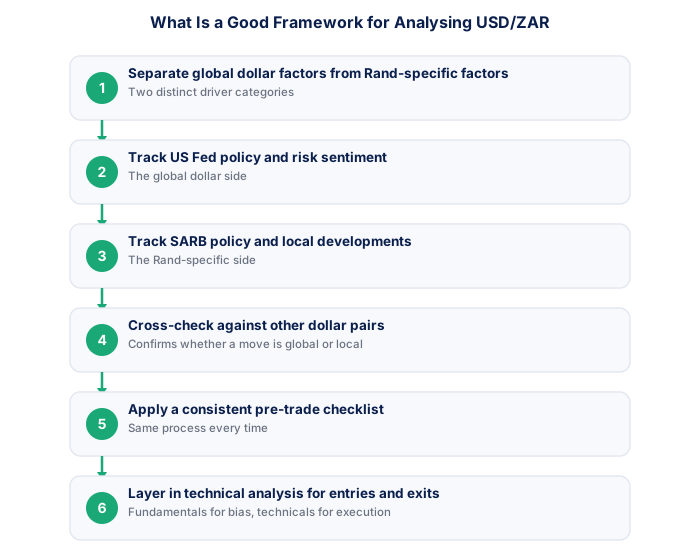
A workable USD/ZAR framework separates global dollar-driven factors (US rate policy, risk sentiment) from Rand-specific factors (SARB policy, local political and commodity developments), since each moves the pair for different reasons.
Building a simple, repeatable pre-trade checklist across both categories, rather than reacting to a single headline, produces more consistent analysis than treating USD/ZAR as either a pure dollar trade or a pure Rand trade.
📋 ON THIS PAGE
1. Why USD/ZAR needs a two-sided framework
USD/ZAR moves for two distinct sets of reasons: broad global US dollar strength or weakness, which affects nearly all currency pairs simultaneously, and Rand-specific developments unique to South Africa. Treating the pair as driven by only one side leads to a systematically incomplete analysis.
A trader who only watches US data will miss a Rand move driven by a local political development or an Eskom-related headline; a trader who only watches South African news will miss moves driven by a US Federal Reserve decision that affects the dollar side of nearly every pair simultaneously.
For related context, see USD/ZAR seasonal patterns, seasonal context adds another analytical layer.
2. The global dollar side of the framework
On the dollar side, the most consistently relevant factors are US Federal Reserve interest rate decisions and forward guidance, US inflation and employment data releases, and broader global risk sentiment, since the dollar tends to strengthen during risk-averse periods as a global safe-haven currency.
These factors affect USD/ZAR the same way they affect USD against most other currencies, meaning a sharp dollar move on a Fed decision day will typically show up across EUR/USD, GBP/USD, and USD/ZAR simultaneously, which is a useful cross-check: if USD/ZAR moves alone while other dollar pairs stay flat, the driver is more likely Rand-specific.
- SARB economic calendar checked for the week
- Next Eskom load shedding schedule reviewed
- GNU stability news reviewed
- Stats SA data releases noted
- Credit agency review dates checked
- US/global events that move EM risk noted
| Global Dollar Side | Rand-Specific Side |
|---|---|
| US Fed rate decisions | SARB rate decisions |
| US inflation/employment data | Current account and trade balance |
| Global risk sentiment | Credit rating reviews |
| Political developments |
3. The Rand-specific side of the framework
On the Rand-specific side, the SARB's own interest rate decisions and Monetary Policy Committee statements matter directly, alongside South Africa's current account and trade balance data, credit rating agency reviews, and significant political developments including major policy announcements or election-related uncertainty.
Commodity prices, particularly gold and platinum group metals given South Africa's export profile, also feed into Rand sentiment as a genuine, if imperfect, proxy for the health of a meaningful part of the local export economy.
| Event | Frequency | ZAR impact | Source |
|---|---|---|---|
| SARB MPC | 6x per year | High | resbank.co.za |
| Budget Speech | Annual (February) | Very high | treasury.gov.za |
| Credit reviews | Annual each agency | Very high | Agency sites |
| Stats SA CPI | Monthly | Medium | statssa.gov.za |
| Eskom stage | As needed | Low-medium | eskomsepush.com |
- SA context provides genuine informational edge
- ZAR pairs accessible via FSCA brokers in ZAR accounts
- Rand volatility creates larger intraday ranges
- 6 SARB meetings/year create regular macro setups
- Higher geopolitical risk than G10 pairs
- Load shedding creates unique operational disruptions
- SA rand liquidity thinner than major G10 pairs
- SA-specific news requires constant local monitoring
4. Building a repeatable pre-trade checklist
A practical checklist before taking a USD/ZAR position might include: checking the economic calendar for both US and South African releases in the relevant window, noting the current broad risk sentiment (risk-on typically pressures the Rand, risk-off typically supports the dollar side), and confirming there is no major South African political or Eskom-related headline currently developing.
Running through the same short checklist consistently, rather than analysing ad hoc each time, is what actually produces the discipline benefit; a framework only works if it is applied the same way every time, not selectively when convenient.
5. Common analytical mistakes specific to this pair
A frequent error is over-weighting a single local headline while ignoring a simultaneous, larger global dollar move, leading to a trade that fights the dominant driver. Another is assuming Rand weakness always means "bad for South Africa" in a simple sense, when in practice a weaker Rand also has genuine benefits for export-oriented sectors of the local economy.
Exotic pair spreads are also typically wider than major pairs, meaning the framework should factor in a somewhat higher bar for a trade idea to be worth the additional cost relative to a comparable EUR/USD or GBP/USD setup.
6. Combining the framework with technical analysis
This fundamental framework is generally most useful combined with, rather than instead of, standard technical analysis: support and resistance levels, trend structure, and volatility context still apply to USD/ZAR the same way they apply to any pair, they simply sit alongside this specific two-sided fundamental picture.
A common practical approach is using the fundamental framework to establish a directional bias or to explain unusual volatility, then using technical levels for the actual entry, exit, and risk management decisions on individual trades.
★ Why It Matters
Worth building a simple habit of checking whether other major dollar pairs are moving alongside USD/ZAR before assuming a move is Rand-specific, since this single cross-check quickly separates genuinely local news from broader global dollar strength or weakness.
✕ Common mistakes
- Analysing USD/ZAR as driven by only global or only local factors. The pair genuinely responds to both, and ignoring either side produces incomplete analysis.
- Over-reacting to a single headline without checking the broader dollar picture. A move may be part of a broader dollar trend rather than Rand-specific.
- Applying major-pair spread expectations to this exotic cross. USD/ZAR spreads are typically wider, affecting the cost-benefit of shorter-term trades.
- Skipping the checklist when a trade idea feels obvious. Consistency is what makes a framework valuable; selective application undermines it.
How does load shedding affect this?
The market keeps moving; you stop being able to reach it. Positions left open through a stage need a stop that works without you. Trading through load shedding covers it in full.
Key Takeaways
- A workable USD/ZAR framework separates global dollar-driven factors (US rate policy, risk sentiment) from Rand-specific factors (SARB policy, local political and commodity developments), since each moves the pair for different reasons.
- Why USD/ZAR needs a two-sided framework.
- The global dollar side of the framework.
- The Rand-specific side of the framework.
- Building a repeatable pre-trade checklist.
Frequently asked follow-up questions
Is USD/ZAR harder to trade than major pairs like EUR/USD?
It carries some additional complexity from the two-sided driver structure and typically wider spreads, though the underlying trading mechanics are identical to any other currency pair.
How much does the SARB interest rate decision typically move USD/ZAR?
This varies significantly by decision and how much of it was already anticipated by the market; a widely expected outcome often moves the pair less than a genuine surprise relative to consensus expectations.
Should I trade USD/ZAR around South African political events?
Many traders reduce position size or widen stops around major political events specifically because volatility can increase sharply and unpredictably in either direction.
