i Short answer
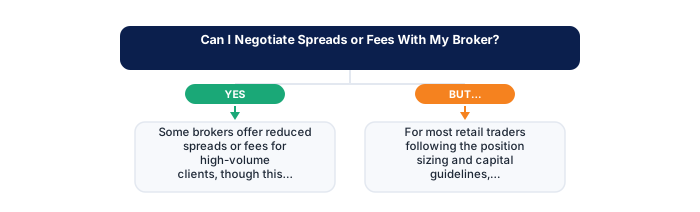
Some brokers offer reduced spreads or fees for genuinely high-volume clients, though this is far less common and flexible for typical retail account sizes.
For most retail traders, comparing brokers' standard published fee schedules remains more practical than attempting direct negotiation.
📋 ON THIS PAGE
- When fee negotiation becomes possible
- What volume thresholds for this typically look like
- How to approach this conversation if you might be eligible
- Why most retail traders won't have this option
- Alternative tiers and VIP account structures worth knowing about
- A more practical approach for typical retail account sizes
1. When fee negotiation genuinely becomes possible
Negotiation becomes realistic mainly for clients trading substantial volume, the kind of monthly notional exposure that generates meaningful commission revenue for the broker from your account alone. Some brokers set formal thresholds for their VIP or institutional tiers; others handle it on a case-by-case basis through relationship managers.
The underlying commercial logic is straightforward: a broker's willingness to negotiate scales directly with how much revenue your activity generates. If replacing your standard spread with a reduced one means giving up a small portion of reliable high-volume revenue, the economics can work for both sides. If your volume doesn't generate enough revenue for that trade-off to make commercial sense for the broker, negotiation isn't a realistic option regardless of how the conversation is framed.
The threshold at which negotiation becomes realistic varies by broker, and some are more open to it at lower volume levels than others. Brokers that cater specifically to active retail traders sometimes have more flexible structures than those primarily targeting institutional clients, precisely because their business model depends on retaining active traders at competitive terms.
South African traders dealing with FSCA-regulated brokers should also understand that fee schedules are regulated disclosures, brokers are required to publish accurate fee information publicly, and any negotiated arrangement would exist alongside those published terms rather than replacing them. Understanding this context helps set realistic expectations for what a negotiation conversation can actually produce.
| Item | Negotiable? | Typical Condition |
|---|---|---|
| Spreads | Sometimes | High trading volume |
| Commission rates | Sometimes | VIP or professional tier |
| Withdrawal fees | Rarely | Set by broker policy |
| Minimum deposit | Occasionally | Direct broker relationship |
| Standard retail account terms | No | Fixed by fee schedule |
2. What volume thresholds for this typically look like
Exactly what volume enables meaningful fee negotiation isn't published by most brokers. These arrangements are handled case by case rather than through an advertised programme, which means the practical answer is that you won't know whether your activity qualifies until you ask, but going in without a realistic estimate of the threshold wastes everyone's time.
The opacity is worth accepting as simply how this part of the industry works rather than assuming there's a discoverable threshold you're just not finding. The volume levels that typically make this conversation worthwhile tend to be in the range of millions of notional turnover per month, not the tens of thousands that characterise typical retail activity, though this varies by broker, instrument, and the specific fee being discussed.
- Search FSP name or number at fsca.co.za
- Confirm licence is current and not suspended
- Check scope covers forex and CFD activity
- Confirm client funds in segregated accounts
- Read FSCA enforcement actions history
- Test customer support before depositing
- Client funds legally segregated
- FSCA complaints process available
- SA consumer protections apply
- ZAR account, no FX conversion costs
- Some offshore brokers offer wider instruments
- Regulatory overhead passed on in spreads
- Stricter position limits for retail clients
- FICA verification required before trading
- Client funds segregated
- Formal complaints process
- FSCA dispute resolution
- SA consumer law applies
- ZAR account available
- Fund safety not guaranteed
- Disputes overseas only
- SA law does not apply
- Currency conversion costs
- Tax reporting more complex
A more useful data point than guessing thresholds is your own trading history. If you've been consistently active and can quantify your monthly notional volume from your account statements, that figure tells you more about whether you're in the conversation-viable range than any general description.
Some brokers publish specific criteria for their premium tiers on their websites, minimum deposit amounts, minimum monthly trade frequency, or minimum monthly volume. These published criteria are worth checking before initiating a negotiation conversation, since they give you a realistic picture of whether you meet the threshold the broker actually uses.
3. How to approach this conversation if you might be eligible
If you genuinely trade enough volume to make this worth exploring, go directly to a relationship manager or senior account contact rather than general customer support. The people who handle standard support queries don't typically have authority over fee structures, and routing this request through the wrong channel just adds delays.
Have concrete, verifiable trading history ready, account statements, trade history reports, notional volume data, rather than making a general claim about your activity level. A broker's relationship manager will assess this request based on your documented activity, not your self-description of it.
Be specific about what you're asking for and what you're offering in return. 'Can I get better spreads?' is a weaker opening than 'I'm currently doing approximately X in monthly notional volume, I'm considering moving some or all of my activity from another broker to consolidate here, and I'd like to discuss whether there's any flexibility on spreads for the EUR/USD and GBP/USD specifically.'
Be realistic about the outcome. Even successful negotiations tend to produce modest improvements, fractions of a pip on major pairs, rather than dramatic reductions. The value of a negotiated arrangement is real but tends to matter most at genuinely high trade frequencies, where small per-trade improvements compound meaningfully.
4. Why most retail traders won't genuinely have this option
Most retail traders following sound position sizing and risk management simply don't generate the trading volume that makes spread negotiation viable from the broker's perspective. This isn't a criticism of their trading activity, it's a consequence of trading correctly. Sensible position sizing inherently limits the notional exposure that any retail account generates.
This is worth accepting without frustration. The pursuit of negotiated spreads by traders who don't have the volume to justify it is usually a distraction from more impactful improvements, better strategy, better execution discipline, lower-friction instruments, that are genuinely within reach.
| Protection | FSCA Regulated | Offshore Unregulated |
|---|---|---|
| Client fund segregation | ✓ Required | Varies by broker |
| SA complaints process | ✓ Available | ✗ Not available |
| SA consumer law applies | ✓ Yes | ✗ No |
| ZAR account available | ✓ Typically | Often USD/EUR only |
The time and energy spent trying to negotiate with a single broker from a position of limited commercial leverage would typically produce better returns if redirected to comparing published fee schedules across two or three regulated brokers. A straightforward broker switch can sometimes achieve more meaningful cost improvement than a negotiation that produces a marginal reduction.
There's also a risk in focusing on spread optimisation when execution quality, platform reliability, and regulatory standing are equally, sometimes more, important to actual trading outcomes. A modestly higher spread at a broker with superior execution and stronger client protections may produce better net results than a lower spread at a broker with more execution uncertainty.
5. Alternative tiers and VIP account structures worth knowing about
Some brokers offer published VIP or premium account tiers with better spreads at specific, advertised deposit or volume thresholds. These are different from negotiated arrangements, they're structured, pre-defined, and documented, and they represent a genuinely accessible path to better terms for active traders without requiring an individual negotiation.
These published tiers are worth checking specifically before attempting any negotiation, since they represent a more transparent and contractually clear path to improved terms. If a broker offers a demonstrably better spread at a specific account tier you qualify for, moving to that tier is straightforwardly more reliable than a negotiated arrangement that exists only in a conversation record.
The distinction between a negotiated arrangement and a published tier matters for practical reasons. Published tiers are documented in the broker's terms, apply consistently across the conditions described, and don't depend on the ongoing relationship with a specific account manager. Negotiated arrangements are more variable and may be less formally documented.
Reviewing tier structures also makes your broker comparison more complete. A broker with a higher standard spread but an accessible premium tier may cost less in practice than a competitor with a lower advertised spread and no tiered structure, particularly if your activity level qualifies for the premium tier without requiring any negotiation.
6. A more practical approach for typical retail account sizes
For most retail account sizes, comparing standard published fee schedules across a few FSCA-regulated brokers is a more reliable and effective path to lower trading costs than attempting to negotiate with your current broker. Transparent comparison of spreads, overnight financing rates, and any explicit commissions tends to surface meaningful differences between brokers that dwarf anything a typical retail account would gain through negotiation.
It's worth checking the full fee picture across brokers, spread, overnight financing, currency conversion charges where applicable, and any platform or withdrawal fees, rather than comparing spread alone. The cheapest spread sometimes comes with higher overnight financing rates that make it more expensive for positions held overnight.
What actually gets a fee discussion taken seriously is sustained monthly volume that genuinely moves the needle for the broker's revenue calculations. Below that level, the most productive approach to reducing trading costs is selecting the right broker at account opening and structuring your trading to minimise unnecessary friction costs rather than seeking post-hoc negotiation with a broker you're already using.
✕ Common mistakes
- Expecting a discount with a large but inactive account. Negotiating leverage tends to come from consistent volume, not balance size alone.
- Not comparing published fee schedules across brokers first. A documented competitor rate is your strongest negotiating point.
- Asking without any trading history to demonstrate value. Brokers respond better to demonstrated activity than requests alone.
- Assuming all account tiers are open to negotiation equally. Entry-level accounts usually have far less room to negotiate than premium tiers.
Do spreads widen during major economic news releases?
Yes. Spreads on most instruments widen during high-impact news as liquidity temporarily decreases. This is most noticeable around central bank decisions, US Non-Farm Payrolls, and major economic data releases.
What causes requotes and how can I avoid them?
Requotes occur when a broker cannot execute your order at the requested price and offers an alternative price instead. They are more common with dealing desk brokers during volatile conditions. Using market execution rather than instant execution accounts reduces requote frequency.
Key Takeaways
- Some brokers offer reduced spreads or fees for high-volume clients, though this is generally less common and less flexible for typical retail account sizes.
- Some brokers offer reduced spreads or fees for genuinely high-volume clients, though this is far less common and flexible for typical retail account sizes.
- For most retail traders, comparing brokers' standard published fee schedules remains more practical than attempting direct negotiation.
- When fee negotiation genuinely becomes possible.
- What volume thresholds for this typically look like.
See also: What Is a Broker's Client Categorisation Process?.
Frequently asked follow-up questions
Is there a minimum deposit that guarantees negotiation eligibility?
No fixed, universal threshold exists; this varies by broker and is generally tied to genuine trading volume rather than deposit size alone.
Should I mention competitor pricing when asking about negotiation?
This is a reasonable approach in any negotiation context, though success still depends primarily on whether your actual volume meets the broker's own internal threshold for this kind of consideration.
Are published VIP tiers a better alternative to direct negotiation?
For most retail traders, yes, since these tiers are transparent and accessible at defined thresholds, rather than depending on uncertain, case-by-case negotiation outcomes.
