i Short answer
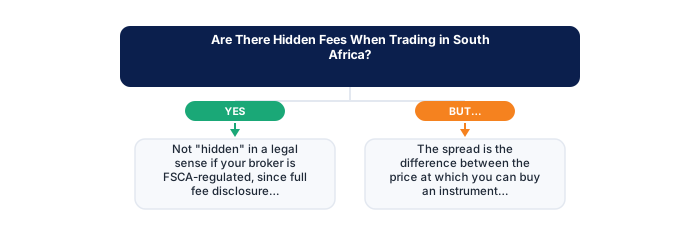
Not "hidden" in a legal sense, not if your broker is FSCA-regulated, since full fee disclosure is mandatory. But fees get overlooked constantly by beginners who skip the fee schedule before depositing.
📋 ON THIS PAGE
1. The spread, explained clearly
The spread is the gap between the price you can buy at (the ask) and the price you can sell at (the bid) at any given moment. It exists on essentially every instrument you'll trade as a retail client and represents the broker's primary compensation on most trades, whether or not they also charge an explicit commission.
Spreads vary by instrument. Major forex pairs typically run tighter than less commonly traded pairs or certain commodities, and they widen during periods of low liquidity, early morning sessions, news events, or when underlying markets are closed. A broker advertising a 0.6 pip spread on EUR/USD is quoting a best-case figure that may not reflect what you'll actually pay at 3am SAST when liquidity is thin.
It's worth actually checking a broker's live spread during your own likely trading hours, rather than relying solely on a published typical or average figure. The difference between a 0.8 pip spread and a 1.5 pip spread sounds small until you multiply it across your actual trading frequency. For active traders, this is often the single most significant ongoing cost.
On instruments priced in South African rand, such as the JSE Top 40 CFD or individual equity CFDs on local shares, spreads can be wider than on the equivalent global benchmark instruments, reflecting lower liquidity and the domestic market structure. This is worth factoring in when comparing the cost of trading locally versus trading an international equivalent.
See also: An Account Inactivity Period vs Dormancy
| Fee Type | What Triggers It | Where to Check |
|---|---|---|
| Spread | Every trade, buy and sell price gap | Trading conditions page |
| Overnight financing (swap) | Holding a leveraged position past rollover | Fee schedule |
| Inactivity fee | Dormant account, commonly 90+ days | Client agreement |
| Currency conversion | Trading instruments priced in a foreign currency | Fee schedule |
| Withdrawal fee | Varies by broker and method | Fee schedule |
2. Overnight financing (swap) charges
Hold a leveraged CFD or forex position open past the broker's daily rollover time, and you'll typically pick up a small financing charge, sometimes called a swap rate or overnight fee. This cost reflects the interest differential between the two currencies in a forex pair, or the cost of funding the leveraged exposure in a CFD.
It's usually modest on any single night, but it adds up over days or weeks, which is exactly why swing and position traders need to factor it in more than day traders who close everything before rollover. A position held for two weeks might accumulate swap charges that meaningfully reduce a profitable trade's net return.
- SARB economic calendar checked for the week
- Next Eskom load shedding schedule reviewed
- GNU stability news reviewed
- Stats SA data releases noted
- Credit agency review dates checked
- US/global events that move EM risk noted
- Predictable cost per trade
- Widens less during news events
- Better for news traders
- Slightly wider on average
- Very low during calm markets
- Widens significantly during news
- Lower average in normal conditions
- Better for longer timeframes
This is worth checking specifically for whatever instruments you trade most, since financing rates vary meaningfully between them and aren't a single universal figure. Long positions typically incur different rates than short positions, sometimes the difference is significant, and rates can shift as central banks adjust interest rates. The SARB's repo rate decisions, for instance, feed into the financing cost on ZAR-denominated positions.
Some brokers publish a dedicated swap rates table in their trading conditions. If this table isn't easy to find, treat that as its own signal about transparency. A regulated broker should make cost information straightforwardly accessible, not require you to dig through marketing materials to locate it.
3. Inactivity fees on dormant accounts
Some brokers charge a monthly inactivity fee once an account sits dormant, no trades placed, for an extended stretch, commonly 90 days or more, though the exact threshold varies by broker and is disclosed in their fee schedule.
If you're opening an account without planning to trade actively for a while, check the inactivity fee policy up front. Some brokers waive it entirely, others apply it aggressively enough to drain a small account over several months. Opening a demo account first while you develop your approach, and only funding a live account when you're ready to trade, sidesteps this cost entirely.
| Event | Frequency | ZAR impact | Source |
|---|---|---|---|
| SARB MPC | 6x per year | High | resbank.co.za |
| Budget Speech | Annual (February) | Very high | treasury.gov.za |
| Credit reviews | Annual each agency | Very high | Agency sites |
| Stats SA CPI | Monthly | Medium | statssa.gov.za |
| Eskom stage | As needed | Low-medium | eskomsepush.com |
- SA context provides genuine informational edge
- ZAR pairs accessible via FSCA brokers in ZAR accounts
- Rand volatility creates larger intraday ranges
- 6 SARB meetings/year create regular macro setups
- Higher geopolitical risk than G10 pairs
- Load shedding creates unique operational disruptions
- SA rand liquidity thinner than major G10 pairs
- SA-specific news requires constant local monitoring
This is worth building into your broker comparison specifically if you know your trading pattern tends to include extended breaks rather than continuous, regular activity. A swing trader who takes positions every few weeks is less exposed than a day trader who stops trading for a quarter. But anyone with an account that might sit idle for a few months should verify the policy before funding it.
FSCA-regulated brokers are required to disclose these fees clearly, which means you can verify them directly from the broker's published terms rather than relying on marketing materials. If a fee schedule requires a support inquiry to locate rather than being published on the broker's website, that's a legitimate concern about transparency.
4. Currency conversion fees
Deposit in ZAR but trade instruments priced in USD or another foreign currency, and your broker runs an implicit currency conversion when calculating your profit or loss back into rand. This conversion typically carries a small margin, the broker's spread on the exchange rate, that gets applied on every trade, not just on deposits and withdrawals.
It's usually modest per trade, but it's a real, often overlooked slice of your overall trading costs, especially if you trade frequently across instruments denominated in different currencies. A South African trader actively trading USD-denominated CFDs is effectively paying a currency conversion cost on every position, in addition to the spread on the underlying instrument.
This cost is easiest to overlook precisely because it doesn't appear as a clearly labelled, separate line item the way a commission or explicit fee would. It's embedded in the exchange rate applied when your P&L is converted back to your account currency. Some platforms show this as a separate figure in account statements; others blend it into the overall trade result.
The SARB's exchange control rules also affect how South African residents can fund and withdraw from offshore trading accounts. While these rules don't create a hidden fee as such, they do constrain how much capital you can deploy offshore and at what cost, using the single discretionary allowance or foreign investment allowance has associated bank fees that are worth factoring into your total cost calculation.
5. Where to find the full disclosed fee schedule
Every FSCA-regulated broker has to publish a complete, accessible fee schedule, usually under a page labelled Trading Conditions or Fees, or embedded in their Client Agreement documentation. Reading it before opening an account, comparing it across two or three regulated brokers if you're weighing options, takes maybe ten or fifteen minutes and removes a significant amount of cost uncertainty.
Reading through it before opening an account, comparing it across two or three regulated brokers if you're weighing options, takes maybe ten or fifteen minutes and produces a clear, side-by-side comparison of the costs you'll actually face. The contrast between brokers can be larger than their marketing suggests.
It's worth treating this document as required reading before opening any account, in the same category as verifying FSCA licensing status, rather than an optional step for the particularly careful. The fee schedule tells you what a trading relationship with that broker actually costs. The marketing tells you what they'd like you to believe it costs. Those two things are sometimes the same; sometimes they aren't.
If you can't locate a clear fee schedule on a broker's website, not buried in a PDF that requires registration to download, but actually accessible and readable, that absence itself provides information. Regulatory requirements exist precisely to ensure retail clients can make informed comparisons before committing capital.
6. Calculating the real cost of a trading strategy
For an active trader, these fees add up: spread costs multiplied across trading frequency, plus overnight financing on anything held longer than a day, plus currency conversion margins on cross-currency positions, plus any platform or inactivity fees. Modelling the full cost picture against your expected trade frequency and holding period before you start tells you what your strategy needs to achieve just to break even.
Get in the habit of tracking actual realised costs, not just gross profit and loss from price movement. Most platforms show this breakdown in account statements, gross P&L from price action versus net P&L after fees, and reviewing it monthly produces a much clearer picture of what your trading actually costs than any pre-trade estimate.
The fee category traders miss most isn't the spread, it's the currency conversion charge that kicks in when your account currency doesn't match the instrument you're trading. For a South African trader with a ZAR account trading USD-denominated instruments, this cost is present on every single trade and compounds alongside trading frequency.
A useful exercise is to calculate your break-even spread requirement for your actual strategy: how many trades per month, at what average size, over what holding period. Then map that against the actual fee schedule for each broker you're considering. The number that comes back, the total cost as a percentage of your deployed capital per year, often surprises traders who'd previously thought only in terms of per-trade fees.
✕ Common mistakes
- Checking only the spread and ignoring financing charges. Overnight costs can quietly outgrow the spread on longer-held positions.
- Skipping the fee schedule before depositing. A few minutes of reading prevents most fee-related surprises.
- Forgetting currency conversion fees on mismatched accounts. This can add 0.5-1% per trade without traders ever noticing.
- Assuming FSCA regulation means fees are capped. Regulation requires disclosure, not specific fee limits, see what FSCA regulation actually protects.
Can I reach JSE shares this way?
Some brokers offer JSE share CFDs, which is exposure rather than ownership: no shareholder rights and a financing cost each night. JSE shares through a forex broker covers which is which.
Key Takeaways
- FSCA-regulated brokers must disclose all fees, but spreads, financing charges, and inactivity fees are often overlooked. Here's the full picture.
- Not "hidden" in a legal sense, not if your broker is FSCA-regulated, since full fee disclosure is mandatory.
- But fees get overlooked constantly by beginners who skip the fee schedule before depositing.
- The spread, explained clearly.
- Overnight financing (swap) charges.
See also: What Is a Joint Trading Account and Can I Open One in South Africa?.
Frequently asked follow-up questions
Do all brokers charge the same spreads?
No, spreads vary meaningfully between brokers and between instruments, which makes comparing them a genuinely worthwhile part of broker selection, especially for active traders where this cost adds up fast.
Can I avoid overnight financing charges entirely?
Yes, close all positions before the broker's daily rollover time and you avoid it entirely, standard practice for day traders specifically, though it's not always practical or even desirable for longer-term strategies.
Where can I see exactly what fees I've paid on my account?
Most platforms provide a detailed transaction history or account statement showing realised spread costs, financing charges, and any other fees applied. Checking it regularly builds an accurate picture of your true trading costs over time.
