ℹ Short answer
A wallet holds keys, not coins. A custodial wallet means the exchange holds those keys; self-custody means you do. Which is right depends on the balance, and above a certain amount the answer stops being a preference.
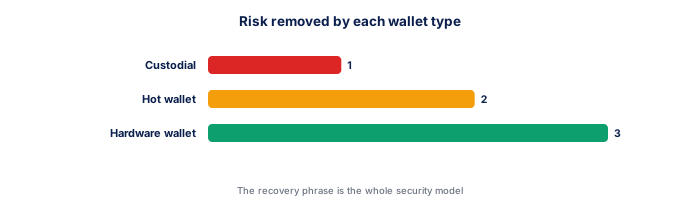
1. What a wallet actually holds
A crypto wallet does not store coins. The coins exist as entries on a blockchain, and the wallet holds the private keys that prove you may move them. Losing the keys means losing the ability to move the coins, and because no institution issued them, no institution can reissue them. The entries stay on the chain permanently with nobody able to touch them. Estimates of bitcoin permanently unreachable for this reason run into the millions of coins. This single property is what makes crypto custody unlike custody of any other asset.
2. Custodial wallets, and what South Africa learned about them
An exchange wallet is custodial: the platform holds the keys and you hold a claim against the platform. It is convenient, recoverable if you forget a password, and entirely dependent on the platform remaining solvent and honest. South Africa has unusually clear evidence of what that dependency costs. Mirror Trading International collapsed in December 2020 holding bitcoin for more than 260,000 members and was later declared an unlawful Ponzi scheme by a South African court. Africrypt followed in April 2021, with roughly 69,000 bitcoin moved through mixing services after the founders left for the United Kingdom. In both cases holders had custodial claims, and in both cases the claim was worth a fraction of the number on the screen.
3. Hot wallets
A hot wallet is software on a device connected to the internet, where you hold the keys. That removes the platform risk and substitutes device risk. A phone with malware is a hot wallet with a problem, and the attacks are not exotic: a fake wallet app, a clipboard hijacker that swaps the address you paste, a browser extension with more permissions than it needs. Hot wallets are appropriate for amounts you are actively using and poor for amounts you are storing.
4. Cold wallets and hardware devices
A hardware wallet keeps the keys on a device that never connects to the internet, signing transactions offline and passing only the signature out. For anything intended to be held for years this is the standard answer, and the devices cost a few thousand rand. The trade-off is friction: it is slower to use, it must be bought from the manufacturer rather than a marketplace, and you become responsible for the backup. That last part is where most hardware wallet losses actually happen.
5. The recovery phrase is the whole security model
Every self-custody wallet generates a recovery phrase of twelve or twenty-four words. Anyone with that phrase controls the coins, permanently and without recourse. It must never be photographed, typed into any website, stored in a password manager that syncs to a cloud, or given to anyone claiming to be support, because legitimate support never asks for it. The common failure is not theft but loss: a phrase written once, stored in one place, and destroyed by water, fire or a move. Two copies in two physical locations is the minimum that makes sense.
6. The South African estate problem
If you die holding self-custody crypto and nobody can reach the recovery phrase, the asset still forms part of your estate for estate duty purposes while being permanently unreachable by your executor. Your estate can owe duty of 20% on something nobody can sell to pay it. This is a specific, foreseeable and badly under-discussed problem. The answer is a documented route for the executor that does not compromise security while you are alive, which usually means a sealed instruction held with your will or with your attorney, describing where the backups are rather than containing the phrase itself.
7. Which to use at what size
A practical division: what you are actively trading can sit on a licensed exchange, where convenience is worth the custodial risk. What you are holding for years belongs in self-custody on a hardware device. The crossover is personal, and a reasonable test is whether losing the balance would materially change your plans. If it would, it should not be custodial, and 2020 and 2021 are the reason that sentence is stated this firmly.
★ Why It Matters
The recovery phrase is the entire security model, and most losses are not thefts but accidents. For South Africans there is a second problem that gets almost no attention: an estate can owe duty on crypto nobody can reach, which is a planning failure rather than a technical one.
Where to take this next: the How to buy crypto safely covers the mechanics in detail; If an exchange collapses sets out the rules behind it; Estate Duty and Donations Tax is the figure to check alongside this; Choosing a crypto exchange answers the question this one raises next; and Common SA trading scams covers what this page leaves out.
✕ Common mistakes
- Storing the recovery phrase in one place. Water, fire and a house move have destroyed more crypto than hackers have.
- Photographing or typing the phrase anywhere. A cloud-synced copy is a copy someone else can reach.
- Leaving no route for an executor. The estate still owes duty on something nobody can sell.
- Keeping a long-term holding on an exchange. That is custodial risk, and South Africa has shown what it costs.
Frequently asked follow-up questions
Can I lose crypto by losing my phone?
Only if the phone held the sole copy of the keys and you have no backup of the recovery phrase. With the phrase you can restore on another device.
Is a hardware wallet worth the cost?
For any balance you would be upset to lose, yes. A few thousand rand removes both exchange risk and device compromise at once.
Can an exchange freeze my crypto?
A custodial platform can, and will where legally required to. That is one of the trade-offs of custody.
What happens to my crypto when I die?
Without access to the keys, nobody can reach it, and the estate may still owe duty on it. A documented, secure route for your executor is essential.
Is a wallet address anonymous?
Pseudonymous rather than anonymous. Every transaction is public, and once an address is linked to you its whole history is linked too.
