i Short answer
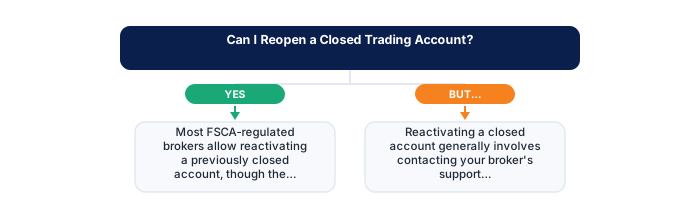
Most FSCA-regulated brokers allow reactivating a previously closed account, though the specific process varies depending on how long it's been closed and the reason for closure.
📋 ON THIS PAGE
1. Voluntary closure versus other closure types
A voluntary closure, you simply stopped trading for a while and the account went dormant, is typically the most straightforward to reverse. If the account closed due to extended inactivity with associated fees, regulatory compliance issues, or broker-initiated reasons, the reactivation process becomes more involved, and in some cases may not be possible without essentially starting fresh.
It's worth asking your broker directly which category your specific closure falls into rather than assuming based on how it felt at the time. Brokers' internal records distinguish between account types and closure reasons, and that distinction determines what reactivation process, if any, applies to your situation.
Accounts closed for regulatory or compliance reasons, such as incomplete KYC documentation, FSCA-related requirements, or suspected unusual activity, require those underlying issues to be resolved before reactivation is possible. The broker cannot simply reopen an account that was closed for a compliance reason without satisfying the compliance requirement first.
Dormant accounts that closed due to inactivity fees depleting the balance to zero are a different category, the account technically still exists in the broker's system, it simply has a zero balance. Reactivating this type of account is often the simplest scenario, typically requiring identity verification and a fresh deposit.
| Closure Type | Typical Difficulty | What's Usually Needed |
|---|---|---|
| Voluntary, brief dormancy | Low | Identity confirmation |
| Extended dormancy | Moderate | Updated FICA documentation |
| Broker-initiated closure | Higher | Depends on original reason |
| Expired ID or address change | Moderate | Fresh proof of identity and address |
2. The typical reactivation process
Reactivating usually means contacting support directly, confirming your identity, and updating documentation if enough time has passed that your original verification is stale. FICA requirements mean that brokers must maintain current, valid identity documentation for active clients, and an account that's been dormant for an extended period may require a partial or full re-verification cycle before it can be reactivated.
It's worth treating this as a genuinely variable process rather than assuming a short, predictable timeline. An account closed last month in good standing has a very different reactivation path than one closed three years ago with some documentation questions outstanding. Your broker's support team is the most accurate source of information about what specifically applies to your account.
- South African ID or valid passport
- Proof of residential address dated within 3 months
- Proof of bank account ownership
- Selfie or photo for biometric verification (some brokers)
- Source of funds declaration if depositing above threshold
Choose an FSCA-regulated broker
Verify the FSP number is current at fsca.co.za.
Submit FICA documents
SA ID or passport, recent proof of address, and bank account proof.
Fund via EFT
Make the initial deposit from your South African bank account in ZAR.
Open demo first
Practice on demo until you are confident in the platform and strategy.
Start with minimum capital
Begin with an amount you can afford to lose while building experience.
Preparing the documentation proactively, current passport or South African ID, recent proof of address matching your current details, updated banking information if your banking has changed, before you contact support reduces the back-and-forth that typically extends the reactivation timeline. Many of the delays in this process come from clients needing to locate and supply documentation after being asked for it.
If there were open positions when the account was closed, which can happen with broker-initiated closures, confirming how those were handled and what the account balance reflects afterward is part of the reactivation conversation. Understanding the account's current status before initiating the process saves confusion later.
3. Whether your documentation still needs updating
If your ID documents have expired, or your address, contact details, or banking information has changed since you first opened the account, your broker will require updated documentation before they'll reactivate. This isn't discretionary, FICA compliance obligations apply to the reactivated account in the same way they applied to the original one.
It's worth checking your own documents proactively before contacting support. Confirming that your current ID is valid, that your proof of address is recent enough to meet the broker's standards, and that your bank account details are current removes the most common friction point in the reactivation process.
South African ID documents and passports have specific validity periods, and a broker's FICA compliance requires them to hold valid identification documentation for active clients. An expired ID that was acceptable when you first opened the account may not be acceptable for reactivation if it's now past its validity date.
Even if your documentation is unchanged and technically still current, a broker may require fresh copies rather than relying on documents submitted years earlier. The re-submission is administrative but it signals that the broker is maintaining their compliance obligations properly, which is ultimately in your interest as a client.
4. What happens to your old account history specifically
Whether your old trading history survives a reactivation depends on your broker's own systems and data retention policies. Some brokers preserve full historical records indefinitely; others archive them after a period of inactivity in ways that may not be fully accessible through the standard platform interface after reactivation.
This matters more than it might initially seem if you've been maintaining a separate trading journal alongside your platform history. A journal that exists outside your broker's system continues uninterrupted regardless of account status, making it the more reliable long-term record. Brokers change their systems, their data retention approaches, and occasionally their business status in ways that your own records are immune to.
| Rejection reason | Fix |
|---|---|
| Address proof older than 3 months | Get a recent utility bill or bank statement |
| Name mismatch between documents | Use documents with exactly matching full name |
| Poor quality scan | Retake with good lighting, all corners visible |
| PO Box address | Brokers require physical residential address only |
For tax purposes, keeping copies of all statements from the original account period before it was closed is important. Even if the broker preserves the history, having your own copies means your SARS records don't depend on a third party's data retention decisions. This applies equally whether you're reactivating an existing account or opening a new one.
If your old account's history is no longer accessible after reactivation, requesting a full historical statement directly from the broker's compliance or records team is worth doing. Brokers are generally required to retain client records for a minimum period under FSCA regulations, and formal requests through the right channel tend to produce records that aren't available through the standard platform interface.
5. Considering opening a new account instead of reactivation
If a lot of time has passed, or you want a different account type than your original one, opening a new account outright might be more straightforward than reactivation. The account opening process is well-defined, the documentation requirements are clear, and you end up with an account that's properly configured for your current needs rather than one that was set up for circumstances that may no longer apply.
This is worth weighing specifically if your trading approach, goals, or financial situation have changed meaningfully since you originally opened the account. A reactivated account carries its original configuration; a new account is set up fresh. If your account type, base currency preference, or instrument access requirements have evolved, starting fresh ensures the new account is optimised from the outset.
There's also a psychological dimension worth acknowledging. Some traders find that a new account, with a clean record and a fresh starting balance, provides a more useful psychological slate than returning to an account with historical performance data that may have been associated with a different trading approach or a difficult period.
One practical consideration: if you have outstanding FSCA-regulated broker relationship questions from the original account, unresolved disputes, questions about historical charges, or documentation gaps, resolving those before either reactivating or opening a new account is the cleaner approach. Carrying unresolved issues from one account relationship into a fresh one tends to complicate rather than simplify.
6. Practical steps to reopen your specific account
The most direct path is contacting your specific broker, explaining that you'd like to reactivate your account, and following whatever guidance they provide. Broker policies on this genuinely vary, and your broker's support team is the authoritative source for what applies to your specific account and closure circumstances.
One detail that catches people out: reopening after a long closure sometimes triggers a fresh FICA verification cycle as if you were a new client, even though your original verification is on record. This can feel redundant but is a legitimate compliance requirement rather than unnecessary friction. Having current documentation ready from the outset means this step doesn't hold up the process.
If your original broker has changed ownership, rebranded, or had regulatory changes since your account was last active, the reactivation process may involve different terms, documentation standards, or account types than you originally agreed to. Reviewing the current terms before proceeding ensures you understand what you're reactivating into.
As a practical precaution, requesting full account statements covering the period before closure, as part of the reactivation conversation, gives you a complete record of your historical activity before the account becomes active again. Having those records in hand is useful both for your own records and for confirming that the account history matches what you remember.
✕ Common mistakes
- Assuming reopening skips verification entirely. A long-closed account can trigger a fresh FICA check.
- Not checking whether old trading history is still accessible. Some data retention policies limit how far back records go.
- Reopening without checking if account terms have changed. Fee schedules and policies can change while an account was dormant.
- Ignoring why the account was closed in the first place. Unresolved issues from before closure may still need addressing.
Will my stop fill at the price I set?
A standard stop becomes a market order when touched, so a gap or thin liquidity fills it worse. A guaranteed stop fills at the level for a fee. The difference is covered on stop-loss against mental stop.
What percentage of capital should I risk per trade?
Most experienced traders risk between 0.5% and 2% of account capital per trade. Risking more creates drawdowns that are psychologically and mathematically difficult to recover from, particularly for strategies with less than a 60% win rate.
Key Takeaways
- Most brokers allow reactivating a closed account, though the specific process varies depending on how long it has been closed and why it was closed.
- Most FSCA-regulated brokers allow reactivating a previously closed account, though the specific process varies depending on how long it's been closed and the reason for closure.
- Voluntary closure versus other closure types.
- The typical reactivation process.
- Whether your documentation still needs updating.
See also: What Happens If I Deposit More Than I Intended? and What Is a Joint Trading Account and Can I Open One in South Africa?.
Frequently asked follow-up questions
Is there a fee to reactivate a closed account?
This varies by broker; checking directly with your specific broker's support team clarifies whether any reactivation fee applies to your situation.
Can I reactivate an account that was closed due to a compliance issue?
This depends on the specific nature of the original issue; contacting your broker directly is necessary to understand whether and how reactivation might be possible in this specific scenario.
Will reactivating my account require a new minimum deposit?
This depends on your specific broker's policy and whether your account previously met any minimum deposit requirement; checking directly clarifies this for your situation.
