What this page covers
South African government bonds are quoted by code and maturity. The yield on the long end is the market's price for holding South African risk over a decade, and it moves on things the repo rate does not.
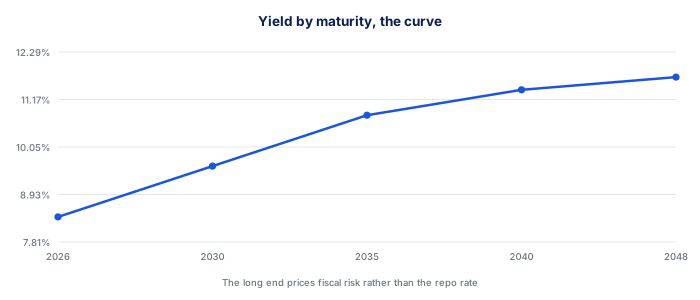
| Code | Maturity | Approximate yield | Role |
|---|---|---|---|
| R186 | 2026 | 8.4% | The old short benchmark, now near maturity |
| R2030 | 2030 | 9.6% | The medium benchmark |
| R2035 | 2035 | 10.8% | A common long reference |
| R2040 | 2040 | 11.4% | The long end |
| R2048 | 2048 | 11.7% | The longest liquid line |
| Segment | Driven mainly by |
|---|---|
| Short end, under 3 years | Expected repo rate over that period |
| Belly, 3 to 10 years | Inflation expectations and the growth outlook |
| Long end, beyond 10 years | Fiscal risk, debt trajectory and the term premium |
| Spread over US Treasuries | Country risk and the global risk appetite |
| Instrument | Yield | Rate risk | Credit risk |
|---|---|---|---|
| Money market | About the repo rate | None | Bank |
| R2030 held to maturity | 9.6% | None if held | Government |
| R2030 sold early | 9.6% plus or minus price | High | Government |
| RSA Retail Savings Bond | Set at issue | None | Government |
| Bond ETF | Tracks an index | High | Government |

Download this data
Every table on this page as a spreadsheet, with the source and the date it was checked in the header rows.
⬇ Download CSVHow these figures work
The figures on this page come from published sources and change on a schedule rather than continuously, which is what makes them worth recording in one place. A bond's yield and its price move in opposite directions. A rising yield means an existing holder has lost capital, which is why a bond fund can fall in a year when rates rise.
The spread between the South African long bond and the US ten-year is the cleanest read on how the market prices country risk. It widens on fiscal news before it widens on anything else.
★ A worked example
Reading the tables together is where the value is. Retail access is through RSA Retail Savings Bonds, a bond ETF, or a unit trust. Buying an individual line directly is possible but the minimum sizes are institutional.
✕ Common mistakes
- A bond's yield and its price move in opposite directions. A bond's yield and its price move in opposite directions. A rising yield means an existing holder has lost capital, which is why a bond fund can fall in a year when rates rise.
- The spread between the South African long bond and the US ten-year is . The spread between the South African long bond and the US ten-year is the cleanest read on how the market prices country risk. It widens on fiscal news before it widens on anything else.
- Retail access is through RSA Retail Savings Bonds, a bond ETF, or a un. Retail access is through RSA Retail Savings Bonds, a bond ETF, or a unit trust. Buying an individual line directly is possible but the minimum sizes are institutional.
- Taking a figure without its date. A number from a reference page is only as good as when it was last checked, which is why the date sits at the top of this one.
Notes on reading these figures
- A bond's yield and its price move in opposite directions. A rising yield means an existing holder has lost capital, which is why a bond fund can fall in a year when rates rise.
- The spread between the South African long bond and the US ten-year is the cleanest read on how the market prices country risk. It widens on fiscal news before it widens on anything else.
- Retail access is through RSA Retail Savings Bonds, a bond ETF, or a unit trust. Buying an individual line directly is possible but the minimum sizes are institutional.
To put these figures to work, the Bond vs Invest Calculator runs the arithmetic on your own numbers, and Bonds and the rand covers the same ground in ordinary language. SARB Repo Rate History and CFDs on bonds go into the detail this table only summarises. The South African Inflation History covers the part this table leaves out.
Put this table on your own site
The table below can sit on your own page and stays current without you editing anything.
- Preview the embeddable table as it will appear on your site
Drop this into your page where the table should sit. When these numbers move, your copy moves with them.
<iframe src="https://www.tradeanswers.co.za/embed/ref-south-african-bond-yields-reference.html" width="100%" height="620" style="border:0" title="South African Bond Yields Reference"></iframe>Free to use with attribution. The link back to this page is built into the embed.
Terms used on this page
Frequently asked questions
Why do bond prices fall when yields rise?
The coupon is fixed. If the market demands a higher return, the only way to deliver it on an existing bond is a lower price.
What does the spread over US Treasuries tell me?
How the market prices South African country risk. It widens on fiscal news before it shows up anywhere else.
Can I buy government bonds directly?
Individual lines are traded in institutional size. Retail access is through RSA Retail Savings Bonds, a bond ETF or a unit trust.
What is the term premium?
The extra yield demanded for holding a longer bond, compensating for uncertainty over that period.
Is a bond fund safe?
It carries no credit risk on government debt, but full price risk. A bond fund can fall in a year when yields rise.
Which bond is the benchmark?
The most liquid line at each maturity. R2030 and R2035 are commonly quoted references.