i Short answer
EUR/USD pairs the Euro against the US Dollar, showing how many Dollars are needed to buy one Euro.
It is the world's most heavily traded currency pair, reflecting the combined economic scale of the Eurozone and United States.
📋 ON THIS PAGE
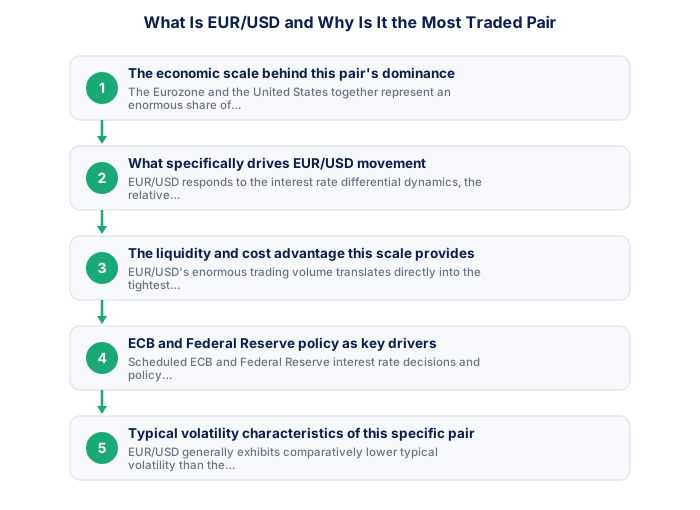
1. The economic scale behind this pair's dominance
The Eurozone and the United States together represent an enormous share of global economic output, international trade, and cross-border investment flow. That scale means a huge volume of genuine commercial, investment, and speculative activity flows through EUR/USD, far exceeding the trading volume of any other single currency pair globally.
This dominance isn't accidental or just a matter of trader preference, it directly reflects the real-world economic relationship between two of the world's largest economic areas, with the pair essentially functioning as a continuously-updated, liquid market price for that relationship.
2. What specifically drives EUR/USD movement
EUR/USD responds to interest rate differential dynamics, specifically the relative monetary policy stances of the European Central Bank (ECB) and the US Federal Reserve. Broader economic data from both regions (growth figures, inflation data, employment statistics) also factors significantly into the pair's movement, alongside global risk sentiment that can shift Dollar demand as a traditional safe-haven currency during market stress.
It's worth following both the Eurozone and US economic calendars together specifically for this pair, discussed elsewhere on this site regarding economic calendar usage, since genuinely significant EUR/USD movement can originate from either side of this pairing.
- FSCA-regulated broker verified at fsca.co.za
- Demo account tested for minimum 60 days
- Trading plan written: entry, exits, position sizing
- Risk per trade defined (1-2% of account)
- Backup internet connection tested for load shedding
- Tax implications understood
3. The liquidity and cost advantage this scale provides
EUR/USD's enormous trading volume translates directly into the tightest typical spreads available across virtually any forex pair, along with highly reliable execution even during periods that might create slippage risk on less liquid instruments.
That combination of deep liquidity and low typical cost is exactly why EUR/USD is so often used as a reference point or comparison benchmark when discussing forex trading concepts generally in trading education content.
4. ECB and Federal Reserve policy as key drivers
Scheduled ECB and Federal Reserve interest rate decisions and policy commentary are among the most significant, closely-watched events for EUR/USD, given how directly the interest rate differential mechanism connects monetary policy to currency value. Traders following this pair benefit from tracking both central banks' announcements and broader policy guidance, rather than focusing on either institution alone.
This dual-central-bank tracking mirrors the same principle that applies to USD/ZAR: tracking both relevant central banks for any currency pair matters, not just the more locally-familiar one.
| Item | Detail |
|---|---|
| Regulator | FSCA, fsca.co.za |
| Exchange control | SARB, resbank.co.za |
| Tax authority | SARS, sars.gov.za |
| JSE hours | 09:00-17:00 SAST Mon-Fri |
| Best forex session | 15:00-17:00 SAST |
| CGT annual exclusion | R50,000 (individuals) |
5. Typical volatility characteristics of this specific pair
EUR/USD generally shows comparatively lower typical volatility than exotic pairs like USD/ZAR, reflecting its deep liquidity and broad market participation. That doesn't mean EUR/USD never moves significantly, major scheduled announcements or genuine economic surprises can still produce meaningful price movement, but its typical, day-to-day volatility sits at a different point on the spectrum than the considerably more volatile emerging-market pairs.
It's worth checking current volatility figures directly using a tool like the volatility calculator discussed elsewhere on this site, rather than assuming EUR/USD's relatively moderate volatility remains fixed, since conditions can shift meaningfully around major scheduled events specifically.
6. Why many beginners specifically start with this pair
Given the combination of deep liquidity, tight spreads, and comparatively lower typical volatility above, many trading educators recommend EUR/USD as a practical starting pair for beginners learning forex trading mechanics, before potentially expanding into other pairs, including the more locally-relevant USD/ZAR, as experience develops.
That recommendation reflects EUR/USD's favourable characteristics for learning the mechanics of forex trading with somewhat reduced cost and volatility pressure, not a claim that it's inherently more profitable or otherwise superior to other pairs.
EUR/USD carries over 20% of daily global forex turnover and often the tightest spreads of any pair. It reflects the relationship between the ECB and Fed, the two most influential central banks in forex.
★ Why It Matters
Worth knowing: EUR/USD's tight spreads come from its enormous trading volume, but that same liquidity means it can also be among the first pairs to react, and sometimes overreact, to any sudden shift in broader global risk sentiment.
✕ Common mistakes
- Assuming EUR/USD's high liquidity means it's immune to sharp moves. It can still react sharply, and sometimes overreact, to global risk sentiment shifts.
- Trading this pair without tracking both the ECB and Fed's relative policy stance. The gap between these two, not either alone, often matters most.
- Treating tight spreads as the only relevant factor for this pair. Volume and liquidity bring other dynamics worth understanding too.
- Ignoring how this pair's behaviour can shift around both central banks' meeting schedules. Both institutions' calendars are relevant, not just one.
Key Takeaways
- EUR/USD pairs the Euro against the US Dollar and is the world's most heavily traded currency pair, given the scale of both underlying economies.
- EUR/USD pairs the Euro against the US Dollar, showing how many Dollars are needed to buy one Euro.
- It is the world's most heavily traded currency pair, reflecting the combined economic scale of the Eurozone and United States.
- The economic scale behind this pair's dominance.
- What specifically drives EUR/USD movement.
See also: What Is a Currency War and Has This Ever Affected the Rand?.
Frequently asked follow-up questions
Is EUR/USD always less volatile than USD/ZAR?
Generally yes on a typical day-to-day basis, though major scheduled events can still produce significant EUR/USD movement. It's about generally lower typical volatility, not an absolute, permanent rule.
Does EUR/USD trade around the clock like other major pairs?
Yes, following the broader global forex session structure, EUR/USD trades continuously from Monday to Friday across major sessions.
Why do some traders specifically avoid EUR/USD?
Some traders seek the higher volatility and bigger potential price swings that exotic pairs offer, finding EUR/USD's typically more contained movement less suited to their strategy or risk appetite.
