i Short answer
The spread is the gap between an instrument's buy price (the "ask") and sell price (the "bid") at any given moment.
It's the most basic cost baked into every trade you place, and it's usually how brokers make their money.
📋 ON THIS PAGE
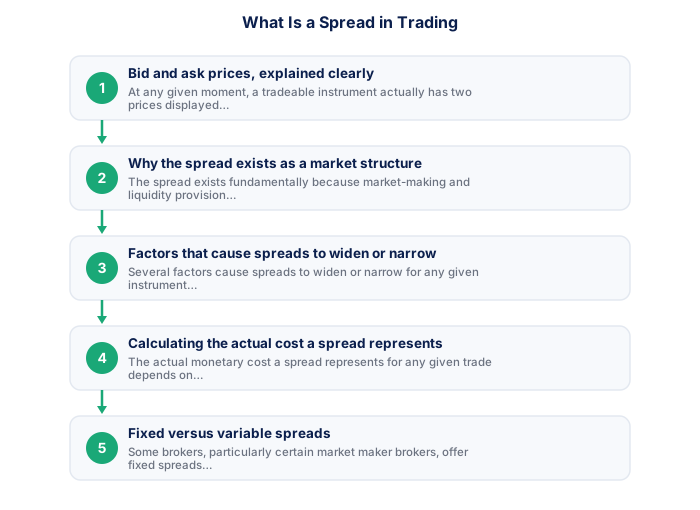
- Bid and ask prices, explained clearly
- Why the spread exists as a market structure
- Factors that cause spreads to widen or narrow
- Calculating the actual cost a spread represents
- Fixed versus variable spreads
- Why comparing spreads across brokers matters practically
- How the spread changes across a South African trading day
1. Bid and ask prices, explained clearly
Any tradeable instrument quotes two prices at once: the bid price, at which you can immediately sell, and the ask price (sometimes called the "offer"), at which you can immediately buy. The ask always sits slightly above the bid, and that gap is the spread.
The practical effect is that the moment you open a position, you're already down by the size of the spread. Close it right away and you'd take that small loss even if the instrument's price hadn't moved at all in the meantime.
| Feature | Fixed Spread | Variable Spread |
|---|---|---|
| Consistency | Stays the same | Changes with market conditions |
| During high volatility | Predictable | Can widen significantly |
| Typical broker model | Market maker | ECN/STP |
2. Why the spread exists as a market structure
The spread exists because market-making carries real cost and risk for whoever is quoting the price, whether that's a broker directly or the liquidity providers behind an ECN execution model. Offering instant, continuous buy and sell pricing ties up capital and exposes the quoting party to risk, and the spread is what compensates for that.
In busy markets with many participants, competition between liquidity providers pushes spreads tighter, since everyone is trying to win order flow with the best pricing. In thinner markets, fewer providers means less competitive pressure and genuinely higher risk in quoting a price at all, so spreads sit wider.
- FSCA-regulated broker verified at fsca.co.za
- Demo account tested for minimum 60 days
- Trading plan written: entry, exits, position sizing
- Risk per trade defined (1-2% of account)
- Backup internet connection tested for load shedding
- Tax implications understood
- Predictable cost per trade
- Widens less during news
- Better for news traders
- Slightly wider average
- Very low in calm markets
- Widens during high-impact news
- Lower average cost
- Better for swing traders
3. Factors that cause spreads to widen or narrow
Three things mainly drive spreads wider or narrower: overall liquidity (spreads widen in off-peak hours when fewer participants are trading), volatility around scheduled news or surprise events (uncertainty makes it riskier to quote a price, so spreads jump), and the instrument's general popularity (major forex pairs stay consistently tighter than less-traded pairs or certain commodities).
This matters in practice: opening or closing a trade right around a major news release means paying a noticeably higher built-in cost than you would during calmer, more liquid conditions on the same instrument.
4. Calculating the actual cost a spread represents
What a spread actually costs you on a given trade comes down to two things: the spread's size, usually measured in pips for forex pairs, and your position size position size. The same pip spread costs more in rand terms on a bigger position. That cost lands the instant you open the trade, and price needs to move enough to cover it before you're actually in profit.
For traders placing a lot of trades, especially higher-frequency styles, this cost adds up fast across total volume. That's why comparing spreads across brokers is worth the time for anyone trading often, since the saving compounds over hundreds of transactions.
| Item | Detail |
|---|---|
| Regulator | FSCA, fsca.co.za |
| Exchange control | SARB, resbank.co.za |
| Tax authority | SARS, sars.gov.za |
| JSE hours | 09:00-17:00 SAST Mon-Fri |
| Best forex session | 15:00-17:00 SAST |
| CGT annual exclusion | R50,000 (individuals) |
5. Fixed versus variable spreads
Some brokers, typically market makers, offer fixed spreads that hold constant regardless of market conditions, which some traders value for risk planning since the exact cost is known in advance. Others, usually those running ECN-style execution, offer variable spreads that move in real time with actual liquidity, tighter in normal conditions but wider and less predictable when liquidity dries up or volatility spikes.
Neither is objectively better. Fixed spreads trade away the occasional tighter pricing you'd get from a variable model in exchange for certainty. Variable spreads can average out cheaper over time, but you give up certainty about what any single trade will cost, particularly in volatile stretches.
6. Why comparing spreads across brokers matters practically
Since the spread is an unavoidable cost on every single transaction, comparing typical spreads across two or three candidate FSCA-regulated brokers for the instruments you'll actually trade is some of the most concrete due diligence you can do. It translates directly into calculable cost differences that add up over your trading history.
Do this comparison for your specific instruments rather than in general, because competitiveness varies by category even within one broker. A broker with tight spreads on major forex pairs might be far less competitive on gold or a minor currency pair, which makes instrument-specific checking more useful than trusting a broker's blanket "low-cost" marketing.
The spread is the gap between bid and ask, and it's an immediate cost on every trade. Scalpers feel spread size most, while swing traders with wider targets feel it proportionally less.
★ Why It Matters
Worth tracking yourself: how your broker's spread on your most-traded pair shifts across the day. Spreads widen predictably at low-liquidity windows like the start of the Asian session, so it's useful to know if you tend to trade around those hours.
✕ Common mistakes
- Assuming the spread is the only cost that matters. Financing charges and commissions can add up alongside it.
- Not tracking how your broker's spread behaves around news events. It often widens meaningfully around scheduled high-impact releases.
- Treating an advertised average spread as guaranteed. The actual spread fluctuates with market conditions throughout the day.
7. How the spread changes across a South African trading day
The advertised spread is a best-case figure quoted during the most liquid part of the day. In South African terms that means roughly 15:00 to 18:00 SAST, when London and New York are both active, and an hour earlier while the northern hemisphere is on daylight saving. Outside that window the same instrument can cost noticeably more to enter.
Two periods are consistently worse. The Sunday evening open, around 23:00 SAST, is thin and spreads widen sharply while the market absorbs weekend news. The late New York session after about 20:00 SAST thins out again into the daily rollover. Both are times when a trade that looked viable on the advertised spread is quietly paying several times that. Forex trading hours in South African time maps the full day.
Key Takeaways
- The spread is the gap between an instrument's buy and sell price, and the most fundamental trading cost. Learn how it works and why it varies.
- The spread is the gap between an instrument's buy price (the "ask") and sell price (the "bid") at any given moment.
- It's the most basic cost baked into every trade you place, and it's usually how brokers make their money.
- Bid and ask prices, explained clearly.
- Why the spread exists as a market structure.
Frequently asked follow-up questions
Is a tighter spread always better for traders?
Generally yes, since it means a lower cost per trade, but weigh it alongside other broker factors like execution reliability and regulatory standing rather than judging on spread alone.
Does the spread change based on my account type?
Often, yes. Some brokers offer a raw-spread account with a separate commission versus a wider, all-inclusive spread with no extra commission, so it's worth checking your specific account type's terms.
Can I avoid paying the spread entirely?
No. It's an unavoidable cost of trading on almost any platform or instrument. The realistic goal is minimising it through broker comparison, not eliminating it.
