i Short answer
FSCA regulation protects you from broker misconduct, fund misappropriation, unfair dealing, and misleading marketing, backed by a formal complaints process.
It doesn't protect you from losing money because a trade moves against you. Market risk and conduct risk are entirely separate categories.
📋 ON THIS PAGE
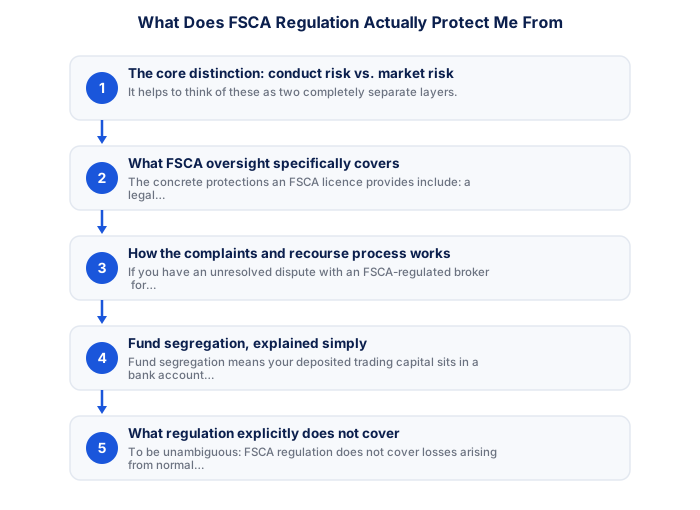
1. The core distinction: conduct risk vs. market risk
Think of these as two separate layers. The first is whether the broker itself behaves honestly and competently: does it hold your money safely, execute trades at fair prices, disclose fees clearly, and respond properly to a complaint? That's conduct risk, and it's exactly what FSCA regulation is built to manage. The second layer is whether the market moves in your favour after you've placed a trade. That's market risk, and no regulator anywhere insures against it, because doing so would contradict what trading and investing actually are.
A fully compliant, well-regulated broker can still be the venue through which you lose your entire deposit, simply because the market moved against you. That's market risk working as intended, not a regulatory failure. Getting this distinction straight before you ever deposit money changes how you read everything else on this page.
It's worth returning to this distinction any time a piece of trading marketing feels reassuring in a way that's hard to pin down. 'Regulated,' 'trusted,' and 'award-winning' are all statements about conduct, at best, never about whether a specific trade or strategy will actually work out in your favour.
2. What FSCA oversight specifically covers
An FSCA licence brings a specific set of protections: a legal requirement to keep your deposited funds in bank accounts segregated from the broker's own operating capital, so your money isn't treated as general company assets; minimum capital adequacy requirements to reduce the odds the broker becomes insolvent and can't return client funds; fit-and-proper standards and background checks for the people running the business; mandatory, standardised risk disclosures (including the well-known CFD loss-percentage statistic); and a formal, externally accessible complaints escalation route if the broker won't resolve a dispute directly.
Each of these exists because of a real historical failure mode at unregulated or poorly-regulated brokers: commingled funds vanishing when a company collapses, brokers run by people with prior fraud convictions, marketing that promises guaranteed returns, and clients left with no recourse when a genuine dispute arises over execution or withdrawal handling.
- Search FSP name or number at fsca.co.za
- Confirm licence is current and not suspended
- Check scope covers forex and CFD activity
- Confirm client funds in segregated accounts
- Read FSCA enforcement actions history
- Test customer support before depositing
- Client funds legally segregated
- FSCA complaints process available
- SA consumer protections apply
- ZAR account, no FX conversion costs
- Some offshore brokers offer wider instruments
- Regulatory overhead passed on in spreads
- Stricter position limits for retail clients
- FICA verification required before trading
- Client funds segregated
- Formal FSCA complaints process
- SA consumer protections apply
- ZAR account available
- Fund safety not guaranteed
- Overseas disputes only
- SA law does not apply
- Currency conversion costs
None of these protections make trading itself less risky, they exist specifically to reduce the risk that the broker itself becomes a source of loss separate from ordinary market risk. Keeping that boundary clear helps you use each protection for what it actually addresses, rather than reading it as a broader guarantee it was never designed to provide.
3. How the complaints and recourse process works
Say you have an unresolved dispute with an FSCA-regulated broker: a disputed trade execution, a withdrawal delayed beyond the stated timeframe, or an undisclosed fee. The first step is usually the broker's own internal complaints procedure, which regulated entities must maintain and publicise. If that doesn't resolve it, you can escalate directly to the FSCA, which can investigate the broker's conduct and, where it finds breaches, impose penalties from formal warnings and fines up to licence suspension or revocation.
That escalation path doesn't exist in any enforceable form with an unlicensed broker. No regulator is obligated to investigate your complaint, and any recourse runs through civil litigation, slower, costlier, and far less likely to succeed against an entity that may sit in a jurisdiction with little cooperation on financial disputes.
Keeping a clear, dated record of your communication with a broker from the outset of any dispute, rather than only once it feels serious, makes this escalation process considerably smoother if you ever need it. The FSCA's investigation process moves faster with specific, documented details than with a general complaint reconstructed from memory weeks after the fact.
4. Fund segregation, explained simply
Fund segregation means your deposited capital sits in a bank account that's legally and operationally distinct from the broker's corporate accounts, the ones paying salaries, office rent, marketing, and other business costs. In a properly segregated structure, if the broker runs into financial trouble or insolvency, funds in client accounts are meant to stay identifiable as client property rather than get absorbed into the pool available to the company's general creditors.
This one structural requirement is a big reason regulated brokers, even ones in business difficulty, have historically been far more likely to return client funds intact than unregulated operators, where no such legal separation exists and client deposits can become indistinguishable from the company's own cash.
| Protection | FSCA Regulated | Offshore Unregulated |
|---|---|---|
| Client fund segregation | ✓ Required | Varies by broker |
| SA complaints process | ✓ Available | ✗ Not available |
| SA consumer law applies | ✓ Yes | ✗ No |
| ZAR account available | ✓ Typically | Often USD/EUR only |
It's reasonable to ask a broker directly which bank holds their segregated client funds and how that segregation is structured, most FSCA-regulated brokers are able and willing to answer this clearly, since it's a standard part of their compliance obligations rather than sensitive proprietary information.
5. What regulation explicitly does not cover
To be unambiguous: FSCA regulation doesn't cover losses from normal market movement against your open positions; it doesn't cover losses from poor personal trading decisions, however avoidable they might have been; it doesn't guarantee any particular platform uptime or execution speed beyond general fair-dealing standards; and it doesn't function as insurance that reimburses trading losses the way deposit insurance protects bank balances in some banking contexts.
Deposit R10,000, open a leveraged position, and watch the market move sharply against you, and losing that R10,000 isn't something the FSCA will investigate or compensate, provided the broker executed the trade fairly, disclosed the risks, and handled your account within its licensed obligations.
This distinction is worth internalising specifically because it's the one most likely to matter emotionally in the moment. A trader who has just lost money on a fair, properly-executed trade sometimes searches for someone to hold accountable, and understanding upfront that FSCA regulation was never meant to prevent this specific kind of loss helps avoid the frustration of pursuing a complaint process that was never designed to address ordinary market risk.
6. Common misconceptions this causes
New traders sometimes read a broker's FSCA-regulated status as a signal that it's been vetted as a "good" or "safe" place to make money, rather than understanding it correctly as meeting minimum standards of honest conduct and operational integrity. That misreading can breed a false sense of security, which shows up as looser risk management, bigger positions or higher leverage than is prudent, on the mistaken assumption that regulation somehow backstops the outcome.
The framing worth holding onto: regulation tells you the casino isn't rigged and will pay out honestly if you win. It says nothing about whether the odds of any given hand favour you. With leveraged CFD products, the house edge in the statistics (that 70-80% retail loss rate) is real and applies regardless of how reputable and well-regulated the broker is.
If a dispute arises with the FSCA itself, over a licensing decision, for instance, the Financial Services Tribunal is an independent body where such decisions can be formally appealed, separate from the broker complaints process.
A useful gut check: if a specific trading decision only feels acceptable because 'the broker is regulated, so it should be fine,' that reasoning is worth pausing on. Regulation status answers a question about the broker's conduct, not about whether your particular position size position size, leverage, or entry timing is sound, and conflating the two is exactly the misconception this section is warning against.
It cannot and does not protect against trading losses or guarantee returns.
FSCA regulation protects against broker misconduct, missing fund segregation, and unlicensed operators. It cannot protect against trading losses or guarantee any level of return.
★ Why It Matters
A common point of confusion worth clearing up: a broker executing your order correctly at the prevailing market price, even if that price then moves against you, is not a conduct violation. This is exactly the boundary where many complaints submitted to the FSCA get misdirected.
✕ Common mistakes
- Filing a complaint about market risk rather than genuine misconduct. A correctly executed trade that moved against you isn't a conduct violation.
- Assuming regulation guarantees profitable outcomes. It addresses fair treatment and disclosure, not trading results.
- Not distinguishing market risk from conduct risk. That distinction decides where a complaint is actually appropriate.
- Expecting the FSCA to resolve disputes about price movement itself. That sits outside what regulatory protection covers.
Key Takeaways
- FSCA regulation protects against broker misconduct and fund misuse, not trading losses. Learn exactly what is and isn't covered before you trade.
- FSCA regulation protects you from broker misconduct, fund misappropriation, unfair dealing, and misleading marketing, backed by a formal complaints process.
- It doesn't protect you from losing money because a trade moves against you.
- The core distinction: conduct risk vs. market risk.
- What FSCA oversight specifically covers.
See also: What Is Market Manipulation and Could I Be Accused of It?.
Frequently asked follow-up questions
If my regulated broker goes bankrupt, will I get my money back?
Properly segregated client funds are meant to be protected from a broker's general creditors in insolvency, which improves the odds of recovery compared to non-segregated structures, though the outcome still depends on the specifics of the insolvency process.
Can I sue an FSCA-regulated broker if I lose money trading?
Not usually for normal trading losses that came from fair execution of your own decisions. Legal action makes more sense where there's evidence of misconduct, fraud, or a clear breach of the broker's regulatory obligations.
Does FSCA regulation mean my personal data is protected too?
FSCA-regulated financial services providers in South Africa are also subject to the Protection of Personal Information Act (POPIA), which separately governs how client data must be handled.
Does FSCA regulation guarantee fair pricing on every single trade?
It requires brokers to maintain a stated execution policy and treat clients fairly overall, but it doesn't guarantee every trade fills at a theoretically perfect price, since normal conditions like spread and slippage still apply.
What's the difference between FSCA protection and a government deposit guarantee?
Entirely different mechanisms. FSCA regulation addresses broker conduct and fund segregation, while a government deposit guarantee, where one exists, typically applies to bank deposits rather than trading account balances.
