i Short answer
Liquidity describes how easily an instrument can be bought or sold without significantly affecting its price.
Higher liquidity generally means tighter spreads, more reliable execution, and reduced slippage risk.
📋 ON THIS PAGE
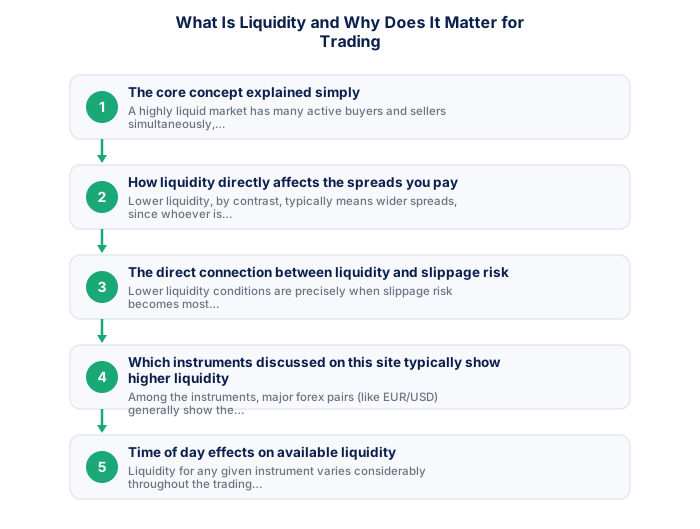
- The core concept explained simply
- How liquidity directly affects the spreads you pay
- The direct connection between liquidity and slippage risk
- Which instruments typically show higher liquidity
- Time of day effects on available liquidity
- Practical implications for your specific trading decisions
- Where liquidity actually sits in a South African day
1. The core concept explained simply
A highly liquid market has many active buyers and sellers at once, so you can generally execute a trade quickly at a price very close to the current quote, since there's ample opposing interest to match against your order. A less liquid market has fewer active participants, so executing a trade, especially a larger one, might mean accepting a less favourable price simply because there isn't enough opposing interest available at your desired price level.
This isn't an abstract, theoretical concept, it translates directly into the real costs and execution quality you experience placing trades on any given instrument.
2. How liquidity directly affects the spreads you pay
Higher liquidity generally supports tighter spreads, since the abundant, competing buying and selling interest in a highly liquid market pushes the gap between bid and ask narrower. Lower liquidity typically means wider spreads, since whoever is providing pricing, your broker directly, or the underlying liquidity providers in an ECN structure, faces genuinely higher risk and cost facilitating trades without that same depth of opposing interest.
This is exactly why major, heavily-traded forex pairs typically show meaningfully tighter spreads than less commonly traded pairs or certain commodities: the underlying liquidity difference between these categories directly drives the observable spread difference.
- FSCA-regulated broker verified at fsca.co.za
- Demo account tested for minimum 60 days
- Trading plan written: entry, exits, position sizing
- Risk per trade defined (1-2% of account)
- Backup internet connection tested for load shedding
- Tax implications understood
3. The direct connection between liquidity and slippage risk
Lower liquidity conditions are exactly when slippage risk becomes most pronounced. The normal, orderly price discovery that keeps execution close to the expected price depends on enough depth of opposing interest being readily available. When that depth is missing, even moderately-sized orders can move price meaningfully during the brief execution window, simply because there isn't enough liquidity to absorb the order at the quoted price.
This is why knowing an instrument's typical liquidity, and being aware of periods when it might be temporarily reduced, matters directly for managing practical execution risk.
4. Which instruments typically show higher liquidity
Major forex pairs (like EUR/USD) generally show the highest liquidity globally, given the sheer scale of global currency trading activity. Gold also generally shows substantial liquidity given widespread global interest, though typically somewhat less than the very largest major forex pairs. More specialised instruments, including some individual shares or less commonly traded currency pairs, can show meaningfully lower liquidity, translating into the wider spreads and elevated slippage risk covered above.
This liquidity hierarchy roughly correlates with, though isn't perfectly identical to, typical spread comparisons across instruments. Generally, more liquid instruments support tighter spreads, though the exact relationship can vary somewhat based on each broker's own pricing and liquidity sourcing.
| Item | Detail |
|---|---|
| Regulator | FSCA, fsca.co.za |
| Exchange control | SARB, resbank.co.za |
| Tax authority | SARS, sars.gov.za |
| JSE hours | 09:00-17:00 SAST Mon-Fri |
| Best forex session | 15:00-17:00 SAST |
| CGT annual exclusion | R50,000 (individuals) |
5. Time of day effects on available liquidity
Liquidity for any given instrument varies considerably throughout the trading day, generally peaking during major session overlaps (the London-New York overlap especially, for major forex pairs) and dropping during quieter periods between sessions or around holidays affecting major financial centres.
This time-of-day variation is exactly why timing matters practically. Trading during genuinely low-liquidity periods means accepting the wider spreads and elevated slippage risk that naturally come with reduced liquidity, whatever instrument you're trading.
6. Practical implications for your specific trading decisions
Practically, understanding liquidity shapes a few trading decisions: favouring more liquid instruments, especially as a newer trader still building experience, given their generally better cost and execution characteristics; staying cautious around known lower-liquidity periods; and making sure a strategy's backtested performance genuinely accounts for realistic liquidity conditions and costs, rather than assuming idealised, perfect execution that real market liquidity might not actually support.
This liquidity awareness underlies a lot of practical trading knowledge more broadly, since it's genuinely foundational to understanding why spreads, slippage, and execution quality behave the way they do across different instruments and times.
High liquidity means more buyers and sellers competing, which tightens spreads. Low liquidity means fewer participants, wider spreads, and more unpredictable execution, particularly during thin sessions.
★ Why It Matters
Worth checking: your traded instrument's typical spread during its lowest-liquidity hours versus its peak hours. The gap between those two figures is often a more practically useful number for planning your trading hours than a generic liquidity ranking.
✕ Common mistakes
- Trading a normal-sized position during known low-liquidity windows. Spreads widen and execution quality can suffer noticeably during these periods.
- Assuming liquidity is constant throughout the trading day. It varies predictably with session overlaps and time of day.
- Ignoring the link between low liquidity and increased slippage risk. These two factors are directly connected.
7. Where liquidity actually sits in a South African day
Liquidity is not constant and its peaks are predictable. For currency pairs, the deepest liquidity of the day falls in the London and New York overlap, roughly 15:00 to 18:00 SAST in the southern winter and an hour earlier while the northern hemisphere is on daylight saving. Outside that window, the same instrument fills worse and costs more, which is a real expense paid on every trade.
On the local equity side the pattern is different and the problem is sharper. The JSE trades from 09:00 to about 16:50 SAST with a closing auction to 17:00, and liquidity is heavily concentrated in the largest constituents. Smaller listed shares can go long stretches with almost no volume, which means a market order can fill several percent away from the last printed price. Buying shares on the JSE covers why limit orders matter more than most beginners expect, and trading hours in SAST maps the currency side.
Key Takeaways
- Liquidity describes how easily an instrument can be bought or sold without significantly affecting its price. Learn why this matters for cost and execution.
- Liquidity describes how easily an instrument can be bought or sold without significantly affecting its price.
- Higher liquidity generally means tighter spreads, more reliable execution, and reduced slippage risk.
- The core concept explained simply.
- How liquidity directly affects the spreads you pay.
Frequently asked follow-up questions
Does liquidity affect long-term position trading the same way as short-term trading?
Liquidity affects entry and exit execution regardless of holding period, though it matters more in practice for shorter-term, execution-sensitive strategies.
Can liquidity for an instrument change permanently over time?
Yes, an instrument's typical liquidity can shift gradually as broader trading interest and participation evolve, though major established instruments generally keep relatively stable, predictable liquidity over most timeframes.
Is liquidity the same concept as volatility?
No, they're related but distinct. Liquidity is about how easily trades execute without affecting price, while volatility is about how much price itself fluctuates over time.
