i Short answer
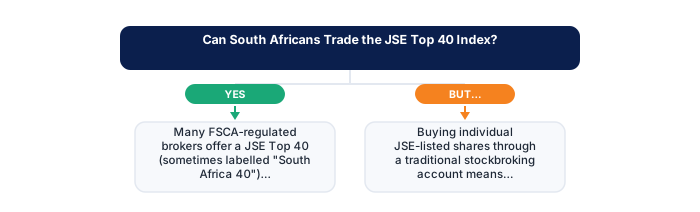
Yes. Many FSCA-regulated brokers offer a JSE Top 40 index CFD, tracking the aggregate performance of the 40 largest companies listed on the Johannesburg Stock Exchange.
This gives traders broad exposure to South Africa's largest listed businesses through a single position, without needing to select and manage individual share holdings.
📋 ON THIS PAGE
1. What the JSE Top 40 index actually represents
The JSE Top 40 (officially the FTSE/JSE Top 40 Index) is a market-capitalisation-weighted index comprising the 40 largest companies listed on the Johannesburg Stock Exchange, ranked by float-adjusted market capitalisation. It's South Africa's most widely referenced equity benchmark and the primary lens through which institutional and retail investors track the performance of the country's large-cap equity market.
As South Africa's most watched equity benchmark, the Top 40 functions as a general barometer of how the largest, most liquid domestic companies are performing. It's referenced in economic commentary, used as a performance benchmark by fund managers, and tracked by international investors assessing South African equity exposure. Its movement often reflects a combination of company-specific earnings news, broader South African macroeconomic conditions, and global emerging market sentiment.
It's worth checking the current constituent weightings periodically rather than assuming they remain fixed. Market-capitalisation weighting means that large moves in major constituents, particularly resource companies, which can be volatile, shift the index's composition dynamically. A company that was the third-largest constituent this year may not be in the same position next year, and the sectors most heavily represented can shift meaningfully over time.
See also: How Can SA Investors Use Forex to Hedge Rand Risk?
The index undergoes formal quarterly reviews where constituents are added, removed, or reweighted based on updated market capitalisation data. These review events can themselves create short-term price movements in companies near the inclusion or exclusion threshold, as index-tracking funds adjust their holdings.
| Feature | Index CFD | Individual Shares |
|---|---|---|
| Diversification | Built-in, across 40 companies | Depends on how many you hold |
| Single-company risk | Diluted | Concentrated |
| Sector concentration risk | Still present, resources and financials heavy | Depends on selection |
| Typical use | Broad economic view | Specific company conviction |
3. Sector composition and concentration risk
The JSE Top 40 has historically carried significant weighting toward resources companies, mining, platinum group metals, gold, and related sectors, alongside substantial financial services exposure from the major South African banks and insurers. This composition is quite different from a US or European broad equity index, which tends to be more evenly distributed across technology, healthcare, consumer goods, and financial services.
This sector concentration means JSE Top 40 movements can sometimes be driven heavily by developments in commodity prices, particularly platinum group metals, gold, and coal, that have only an indirect connection to the South African consumer economy or general business conditions. A South African trader who follows the JSE needs to monitor commodity cycle dynamics and global mining sector sentiment alongside domestic economic indicators.
| Event | Frequency | ZAR impact | Source |
|---|---|---|---|
| SARB MPC | 6x per year | High | resbank.co.za |
| Budget Speech | Annual (February) | Very high | treasury.gov.za |
| Credit reviews | Annual each agency | Very high | Agency sites |
| Stats SA CPI | Monthly | Medium | statssa.gov.za |
| Eskom stage | As needed | Low-medium | eskomsepush.com |
- SA context provides genuine informational edge
- ZAR pairs accessible via FSCA brokers in ZAR accounts
- Rand volatility creates larger intraday ranges
- 6 SARB meetings/year create regular macro setups
- Higher geopolitical risk than G10 pairs
- Load shedding creates unique operational disruptions
- SA rand liquidity thinner than major G10 pairs
- SA-specific news requires constant local monitoring
It's worth revisiting this sector breakdown periodically rather than assuming it stays fixed, since the relative weighting of resources versus financials versus other sectors shifts as market capitalisations change and as global commodity cycles move through phases. The composition that applied during a commodity supercycle looks different from the composition during a commodity trough.
The financial sector weighting brings its own sensitivity to SARB policy decisions. Interest rate movements affect banking profitability, and through it, a meaningful portion of the JSE Top 40's aggregate earnings, in ways that make SARB rate decisions particularly relevant events for tracking JSE index movements.
4. What moves the JSE Top 40
Beyond company-specific earnings from major constituents, the JSE Top 40 responds to several broader factors: global commodity prices (given the resource sector weighting), the rand's exchange rate (which affects both resource company earnings in rand terms and the attractiveness of South African assets to international investors), SARB interest rate decisions, and broader emerging market risk sentiment.
This combination of domestic and global drivers means the index can move on both purely local South African news and on broader international themes. A Federal Reserve policy shift in the US can affect the JSE Top 40 through emerging market fund flows and rand movements, even without any domestic South African catalyst. A platinum supply disruption can move the index through its mining sector weighting, even when the broader economic picture is stable.
Geopolitical events that affect global risk sentiment are also relevant: periods of broad risk aversion tend to weaken emerging market currencies including the rand and reduce demand for South African equities among international investors, creating downward pressure on the index independent of domestic factors. Understanding when JSE movements are primarily domestically driven versus globally driven helps calibrate the research and monitoring that effective JSE Top 40 trading requires.
SARB monetary policy communications deserve specific attention given both the financial sector weighting and the rand impact of rate decisions. A hawkish SARB stance tends to support the rand (which can attract international equity buyers) but may weigh on bank profitability assumptions, creating cross-currents within the index that can produce more complex movements than a simple interest-rate-direction analysis would suggest.
5. Leverage considerations specific to index CFDs
Index CFDs typically offer leverage broadly comparable to other major CFD categories, though specific leverage ratios vary by broker and account type within FSCA retail client guidelines. The JSE Top 40 is treated as a major index by most brokers offering it, which generally means leverage comparable to other major global indices rather than the more conservative limits applied to individual shares.
One nuance worth understanding is that an index, being a composite of many individual companies, sometimes exhibits lower intraday volatility than a single company's shares on days without specific major news, because the gains and losses of individual constituents partially offset each other in the aggregate. This can make index-level stop-loss placement feel more manageable than individual share stops. However, this average behaviour doesn't hold during broad market events when correlations within the index rise and the diversification effect reduces.
It's worth applying identical disciplined position sizing to index CFDs as you would to any other leveraged instrument. The composite nature of an index doesn't remove the amplification effect of leverage on your account, a 1% move in the JSE Top 40 at 1:20 leverage creates a 20% impact on the margin deployed for that position, in the same way it would for any other instrument at the same leverage.
Margin call and stop-out levels operate on the same basis for index CFDs as for other instruments. Understanding the specific margin call and stop-out levels for JSE Top 40 positions at your broker, and sizing positions so that normal intraday fluctuations don't approach those levels, is basic risk management that applies here as it does everywhere else.
6. Using the index to express a broader economic view
Some traders use JSE Top 40 index CFDs specifically to express a directional view on South Africa's large-cap market generally, perhaps linked to a view on rand trajectory, SARB policy, commodity cycle positioning, or the relative attractiveness of South African equities versus other emerging markets. This approach trades off individual company alpha-generation potential for a simpler, single-position expression of a macro view.
This approach trades off the potential for individual stock-picking outperformance, which requires considerably more company-specific research and monitoring, for the simpler expression of a directional market view. It's a legitimate approach for traders whose analytical edge is at the macro level rather than the company level, and for those who want South African equity market exposure without dedicating substantial time to individual company research.
Something worth understanding about this specific index: because a handful of large resource and financial constituents carry disproportionately high weighting, the index can sometimes behave as a proxy for those specific sectors more than for the South African economy broadly. A trade on the JSE Top 40 during a period of commodity price disruption is, in practice, partly a trade on mining and resources, worth being aware of when the economic view you're expressing is about South Africa generally rather than specifically about resources and financials.
✕ Common mistakes
- Assuming the index moves evenly across all 40 constituents. A handful of large resource and financial shares carry disproportionate weight.
- Ignoring how concentrated sector exposure affects the index. Resource-sector news can move the whole index more than expected.
- Treating the Top 40 as a substitute for genuine diversification. Its concentration means it behaves differently from a broader market index.
- Not checking JSE-specific trading hours before placing a trade. These differ from global forex trading hours.
Can I reach JSE shares this way?
As CFDs, through brokers that list them. Ownership requires a different kind of account entirely. JSE shares through a forex broker covers it in full.
Key Takeaways
- Yes, via index CFDs tracking South Africa's 40 largest listed companies. Learn the difference from buying shares directly and what moves the index.
- Many FSCA-regulated brokers offer a JSE Top 40 index CFD, tracking the aggregate performance of the 40 largest companies listed on the Johannesburg Stock Exchange.
- This gives traders broad exposure to South Africa's largest listed businesses through a single position, without needing to select and manage individual share holdings.
- What the JSE Top 40 index actually represents.
- Index CFD versus buying individual shares directly.
Frequently asked follow-up questions
Is the JSE Top 40 the same as the broader JSE All Share Index?
No, the All Share Index covers a much broader, larger set of listed companies beyond just the top 40 by market capitalisation, making it a different, more broadly representative benchmark.
Can I trade the JSE Top 40 outside of South African market hours?
Index CFD trading availability outside the underlying exchange's official trading hours depends on your specific broker's policies; check directly, as out-of-hours pricing and liquidity can differ from regular session trading.
Does Rand weakness always help the JSE Top 40?
Not always or automatically, while Rand weakness can boost reported earnings for companies with significant foreign-currency revenue when translated to Rand, it can also reflect broader economic stress that negatively affects sentiment toward South African equities overall, so the relationship isn't a simple, fixed rule.
