i Short answer
Most FSCA-regulated brokers process withdrawal requests within 1-3 business days, with EFT transfers typically arriving 1-2 business days after that.
Total time from request to funds in your account is commonly between 2 and 5 business days for most standard cases.
📋 ON THIS PAGE
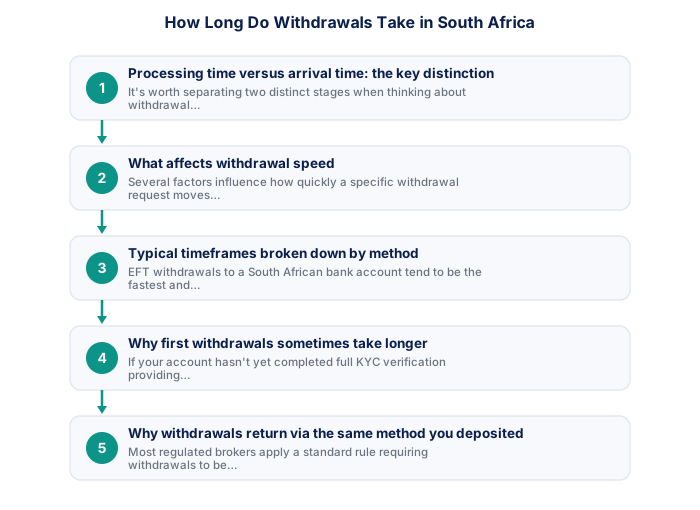
1. Processing time versus arrival time: the key distinction
It's worth separating two distinct stages when thinking about withdrawal speed: the broker's internal processing time (the period between you submitting a withdrawal request and the broker actually approving and releasing the funds) and the banking or payment system's arrival time (the period between the broker releasing funds and those funds actually reflecting in your account). Total withdrawal time is the sum of both stages, and confusion often arises when traders only account for one stage in their expectations.
Most regulated brokers publish their typical internal processing time clearly in their terms or FAQ section, commonly stated as 1-3 business days, but this published figure usually doesn't include the separate banking system transfer time, which adds further days depending on the specific withdrawal method chosen and your own bank's processing speed.
This distinction matters most in the moment you're actually anxious about a withdrawal, since it's easy to see a broker mark a request as 'processed' or 'approved' and assume something has gone wrong when funds don't appear immediately afterward. Understanding that approval and arrival are two genuinely separate stages, with the second stage sitting largely outside the broker's direct control, sets more accurate expectations from the outset.
| Method | Typical Processing Time |
|---|---|
| EFT | 1 to 3 business days |
| Card refund | 3 to 7 business days |
| E-wallet | Same day to 2 business days |
2. What affects withdrawal speed
Several factors influence how quickly a specific withdrawal request moves through both processing stages. Internal broker processing time is affected by whether your account is fully verified (completed KYC, or know-your-customer, documentation), whether the withdrawal request falls within normal business hours and days (most brokers don't process on weekends or public holidays), and sometimes by the size of the withdrawal relative to standard thresholds that might trigger additional internal review.
On the banking side, arrival time depends heavily on the specific method used, EFT transfers between South African banks are generally fast and predictable, while card refunds can be slower and less predictable depending on the card issuer's own processing systems, which the broker has limited direct control over once funds leave their end.
- SARB economic calendar checked for the week
- Next Eskom load shedding schedule reviewed
- GNU stability news reviewed
- Stats SA data releases noted
- Credit agency review dates checked
- US/global events that move EM risk noted
Choose FSCA-regulated broker
Verify the FSP number is current at fsca.co.za.
Submit FICA documents
SA ID, proof of address within 3 months, bank account proof.
Fund via EFT
Make the initial deposit from your SA bank account in ZAR.
Open demo account first
Practice on demo before activating your live account.
Start with minimum capital
Begin with an amount you can afford to lose while learning.
Timing your withdrawal request matters more than many traders realise. Submitting a request late on a Friday afternoon, for example, means the broker's processing clock effectively doesn't meaningfully start until the following Monday, adding what feels like an unexpected delay but is really just the ordinary consequence of weekend timing rather than anything broker-specific.
3. Typical timeframes broken down by method
EFT withdrawals to a South African bank account tend to be the fastest and most predictable overall route, typically totalling 2-4 business days from request to funds reflecting in your account, combining broker processing time with standard domestic EFT transfer speed. Card refund withdrawals (returning funds to the debit or credit card originally used to deposit) can take longer and be less predictable, often 3-7 business days, since this depends partly on the card issuer's own internal processing timelines beyond the broker's control.
Where supported, e-wallet withdrawals can sometimes be among the fastest options, occasionally same-day to one business day, though e-wallet support varies considerably between brokers and isn't universally available, checking your specific broker's supported methods and their stated typical timeframes for each is worth doing before you need to make an urgent withdrawal.
| Event | Frequency | ZAR impact | Source |
|---|---|---|---|
| SARB MPC | 6x per year | High | resbank.co.za |
| Budget Speech | Annual (February) | Very high | treasury.gov.za |
| Credit reviews | Annual each agency | Very high | Agency sites |
| Stats SA CPI | Monthly | Medium | statssa.gov.za |
| Eskom stage | As needed | Low-medium | eskomsepush.com |
- SA context provides genuine informational edge
- ZAR pairs accessible via FSCA brokers in ZAR accounts
- Rand volatility creates larger intraday ranges
- 6 SARB meetings/year create regular macro setups
- Higher geopolitical risk than G10 pairs
- Load shedding creates unique operational disruptions
- SA rand liquidity thinner than major G10 pairs
- SA-specific news requires constant local monitoring
Where you have a genuine choice between methods and speed matters to you, it's worth testing your preferred method with a smaller withdrawal first, rather than assuming the broker's published range applies exactly to your specific bank or card issuer. Actual experience with your own bank's processing habits is more reliable than a general published estimate covering all possible banks and issuers.
4. Why first withdrawals sometimes take longer
If your account hasn't yet completed full KYC verification, providing identity documents, proof of address, and sometimes proof of payment method ownership, your very first withdrawal request may be delayed beyond the broker's typically stated processing time while this verification is completed and reviewed. This is a standard anti-money-laundering compliance requirement applied uniformly across regulated brokers, not something specific or unusual to any single provider.
Completing this verification proactively, ideally at the time of account opening or shortly after rather than waiting until your first withdrawal request, can avoid this specific delay, most brokers allow you to upload the required documents well before you actually need to withdraw funds, and doing so early means your first withdrawal isn't held up by a verification process that could have been completed weeks in advance.
It's worth treating this proactive verification step as part of account setup itself, rather than a separate task to handle later, precisely because there's no genuine downside to completing it early and a real, avoidable cost to leaving it until an urgent withdrawal is already pending.
5. Why withdrawals return via the same method you deposited
Most regulated brokers apply a standard rule requiring withdrawals to be processed back to the same payment method originally used for the corresponding deposit, up to the amount originally deposited via that method, this is a standard anti-money-laundering practice across the regulated financial services industry generally, not a broker-specific inconvenience or unusual restriction.
If you deposited via card and later want to withdraw an amount exceeding what was originally deposited via that card (for example, including trading profits beyond the original deposit), brokers typically handle the excess via an alternative method like EFT, since card networks generally don't support refunding amounts beyond what was originally charged to that specific card.
Knowing this rule in advance helps you plan your deposit method deliberately, rather than discovering the restriction only once you try to withdraw. If you anticipate wanting fast, flexible withdrawal access to any profits, funding your account primarily via EFT from the outset, rather than card, sidesteps this particular limitation for most of your eventual withdrawal needs.
6. Warning signs of problematic withdrawal practices
While normal processing delays of a few business days are standard and expected, certain patterns are worth treating as genuine warning signs rather than routine delay. These include withdrawal requests being repeatedly postponed without clear, specific explanation well beyond the broker's own stated timeframes; the broker introducing new, previously undisclosed conditions or fees specifically at withdrawal time that weren't mentioned during account opening or deposit; or pressure to deposit additional funds before a withdrawal can supposedly be processed.
If you encounter these patterns, it's worth immediately verifying the broker's FSCA licence status on the official register and, if the broker is genuinely unregulated, treating this as a serious indication that further engagement with that platform may not be safe, regulated brokers with active FSCA oversight have considerably stronger incentives to handle withdrawals fairly and promptly, given the regulatory and reputational consequences of failing to do so.
Local EFT deposits and withdrawals run through the infrastructure overseen by PASA (the Payments Association of South Africa), which is part of why Rand-denominated transfers between South African bank accounts tend to clear faster than international wire transfers.
Total withdrawal time includes both broker processing, typically 1-3 business days, and separate bank transfer time, typically another 1-2 days on top.
★ Why It Matters
Worth testing for yourself early rather than discovering it during an emergency: request a small, representative withdrawal shortly after your account is funded, this gives you real, firsthand data on your specific broker's actual processing time rather than relying on their stated policy alone.
✕ Common mistakes
- Requesting a large withdrawal for the first time during an urgent need. First-time large withdrawals sometimes face additional verification steps.
- Not accounting for both broker processing time and bank transfer time separately. Total time includes both stages, not just the broker's portion.
- Submitting withdrawal requests right before a weekend or public holiday. This can add unexpected delay to the overall timeline.
Key Takeaways
- Most regulated brokers process withdrawals within 1-3 business days. Learn typical timeframes by method and what affects withdrawal speed.
- Most FSCA-regulated brokers process withdrawal requests within 1-3 business days, with EFT transfers typically arriving 1-2 business days after that.
- Total time from request to funds in your account is commonly between 2 and 5 business days for most standard cases.
- Processing time versus arrival time: the key distinction.
- What affects withdrawal speed.
Frequently asked follow-up questions
Can I speed up a withdrawal by contacting support directly?
Contacting support can sometimes clarify the status of a pending withdrawal or flag any outstanding verification requirements, though it typically can't override standard processing timeframes for routine requests.
Do withdrawal times differ on weekends and public holidays?
Yes, most brokers and banking systems only process transactions on business days, so a withdrawal requested just before a weekend or public holiday will typically show a longer calendar-day wait even if the business-day processing time remains standard.
Is there a minimum withdrawal amount?
Many brokers set a minimum withdrawal threshold, which varies by provider, check your specific broker's terms for this detail before submitting a request below that threshold.
