What this page covers
Quick answer: A trader working from home rarely claims travel, but anyone running trading through a company or claiming a home office often does. Key figures: per kilometre R4.95; daily subsistence R595; simplified method ceiling 8,000 km; claim without a logbook 0. Figures current at 17 November 2026, for the 2026/27 tax year, from South African Revenue Service, travel allowance.
A trader working from home rarely claims travel, but anyone running trading through a company or claiming a home office often does. These are the figures SARS accepts without requiring actual expenditure to be proved.
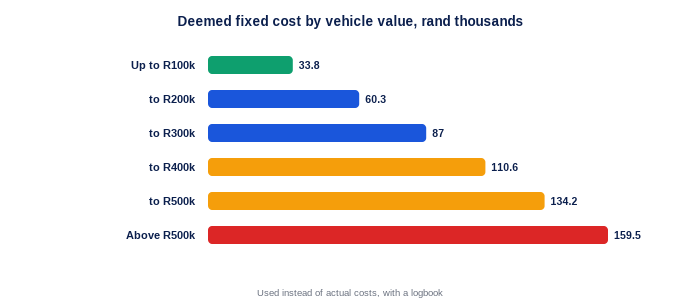
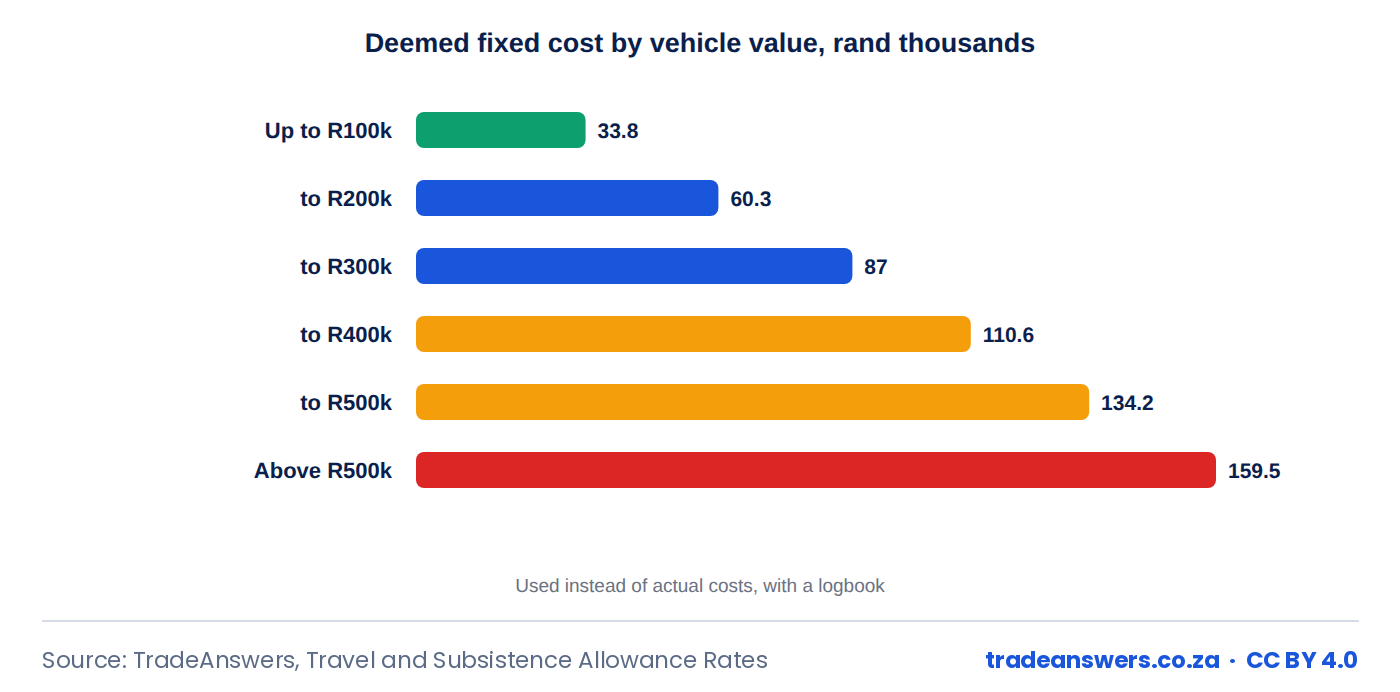
⬇ Download this chart (PNG) · Free to reuse with the credit “Source: TradeAnswers, Travel and Subsistence Allowance Rates” (CC BY 4.0).
| Item | Amount | Condition |
|---|---|---|
| Per kilometre, simplified method | R4.95 (495c) | No other travel allowance received; up to 8,000 km |
| Subsistence, meals and incidentals, local | R595 per day | Away overnight on business |
| Subsistence, incidentals only, local | R184 per day | Away overnight, meals paid separately |
| Subsistence, outside South Africa | Country-specific | Published by SARS per destination |
Source: TradeAnswers, Travel and Subsistence Allowance Rates. Free to reuse with attribution (CC BY 4.0).
| Vehicle value | Fixed cost per year | Fuel per km | Maintenance per km |
|---|---|---|---|
| Up to R115,000 | R38,344 | 132.9c | 49.1c |
| R115,001 to R230,000 | R68,487 | 148.4c | 61.4c |
| R230,001 to R345,000 | R98,689 | 161.2c | 67.8c |
| R345,001 to R460,000 | R125,393 | 173.4c | 74.0c |
| R460,001 to R575,000 | R152,097 | 185.5c | 86.9c |
| R575,001 to R690,000 | R180,078 | 212.8c | 102.0c |
| R690,001 to R805,000 | R208,106 | 216.5c | 114.5c |
| R805,001 to R920,000 | R237,679 | 220.1c | 126.1c |
| Above R920,000 | R237,679 | 220.1c | 126.9c |
Source: the cost scale gazetted for 2026/27 (SARS, rate per kilometre schedule); subsistence amounts from SARS, subsistence allowances. Both apply from 1 March 2026.
TradeAnswers · CC BY 4.0
| Field | Required |
|---|---|
| Opening odometer, 1 March | Yes |
| Closing odometer, end February | Yes |
| Date of each business trip | Yes |
| Kilometres travelled | Yes |
| Destination and reason | Yes |
| Private kilometres | Derived from the total |
TradeAnswers · CC BY 4.0
📋 ON THIS PAGE
How these figures work
The figures on this page come from published sources and change on a schedule rather than continuously, which is what makes them worth recording in one place. Without a logbook there is no travel claim. SARS does not accept an estimate, and this is one of the most common reasons a claim is disallowed on audit.
The simplified rate and the deemed cost tables are alternatives. You use one or the other for the year, not both. To apply these figures to your own numbers, use the marginal tax rate calculator to see what a deduction is worth at your tax rate.
Worked example: the two methods side by side
Hypothetical figures. Without a travel allowance and with 6,000 business kilometres in the year, the simplified method gives 6,000 × R4.95 = R29,700.
An employee who receives a travel allowance and drives a car worth R300,000 for 20,000 kilometres in total, 6,000 of them on business, uses the deemed cost table instead. The fixed cost is 30% of R98,689, about R29,607, and fuel and maintenance add 6,000 × (161.2c + 67.8c), R13,740, for a deduction of about R43,347. Both depend on a logbook that shows the business kilometres.
★ Reading the tables together
Travel between your home and a regular place of work is private, not business, however far it is.
✕ Common mistakes
- Claiming travel without a logbook. SARS rejects travel claims that are not supported by a logbook of business trips.
- Counting the daily trip to the office as business travel. Travel between home and a regular place of work is private.
- Using last year’s rate per kilometre. The rates change each tax year, so use the table for the year of the claim.
Terms used on this page
Recent changes to this page
- : Travel allowance rates and FSCA penalty totals corrected
Every change is recorded on the Updates Log.
Spotted an outdated figure? If a figure or rate on this page no longer matches its source, email us the page and the source. A material correction is dated on the Updates Log; how figures are compiled and checked is set out in our data methodology.
Cite this page
Barosso, G. (2026, November 17). Travel and Subsistence Allowance Rates. TradeAnswers. https://www.tradeanswers.co.za/travel-and-subsistence-allowance-rates.htmlBarosso, G (2026) Travel and Subsistence Allowance Rates, TradeAnswers, figures current at 17 November 2026, https://www.tradeanswers.co.za/travel-and-subsistence-allowance-rates.htmlThe tables and the CSV on this page are free to reuse under a CC BY 4.0 licence: attribution with a link to this page. See the Press & Data Licence page.
Frequently asked questions
Do I need a logbook?
Yes. Without one there is no travel claim at all, and this is among the most common reasons a claim is disallowed.
Can I use both the simplified rate and the deemed cost table?
No. You choose one method for the year.
Is travel to my office claimable?
No. Travel between home and a regular place of work is private, however far it is.
What does the subsistence allowance cover?
Meals and incidental costs while away overnight on business, accepted without receipts up to the daily amount.
What must the logbook record?
Opening and closing odometer readings for the year, and for each business trip the date, kilometres, destination and reason.
Does the rate change each year?
Yes, usually with the budget. Using a prior year's rate understates or overstates the claim.
 Download this data