i Short answer
The minimum deposit at most FSCA-regulated brokers sits between R200 and R1,500, but starting with the bare minimum is rarely a sound idea.
Most experienced traders point toward starting with at least R5,000-R10,000 so that position size position sizes remain practical and risk management can actually be applied.
📋 ON THIS PAGE
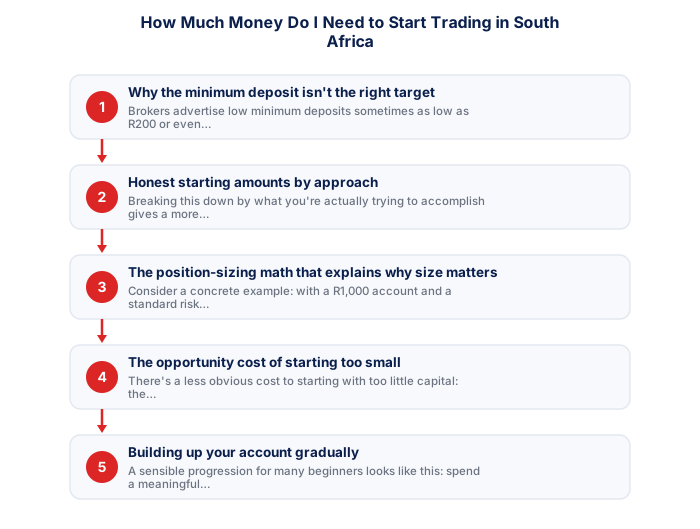
- Why the minimum deposit isn't the right target
- Honest starting amounts by approach
- The position-sizing math that explains why size matters
- The opportunity cost of starting too small
- Building up your account gradually
- What money you should never use to start trading
- What the same money does if you invest it instead
1. Why the minimum deposit isn't the right target
Brokers advertise low minimum deposits, sometimes as low as R200 or even less, primarily because it removes a barrier to opening an account, not because that amount represents a sensible foundation for actually learning to trade. With R200 in an account, even using available leverage, the position sizes you can realistically open are so small that any meaningful price movement, in either direction, represents a disproportionately large percentage swing relative to your tiny capital base.
More importantly, a string of a few losing trades, which is statistically normal and expected even for traders who go on to become consistently profitable, since no strategy wins every single time, can wipe out a R200 or R500 account within days, ending your practical learning experience before you've accumulated enough trades to actually learn anything generalisable about your strategy or your own behaviour under pressure.
It's worth reframing the question entirely, rather than asking 'what's the smallest amount that lets me open an account,' the more useful question is 'what's the smallest amount that lets me apply sound risk management and survive a realistic losing streak long enough to actually learn something.' Those two questions have very different answers, and it's the second one that actually matters for your development as a trader.
2. Honest starting amounts by approach
Breaking this down by what you're actually trying to accomplish gives a more useful answer than a single number. For pure learning with zero financial risk, a demo account costs nothing and lets you practise platform mechanics and strategy testing indefinitely. For learning with some genuine risk involved, which many traders find changes their behaviour meaningfully compared to demo trading, a micro live account in the R1,500-R3,000 range lets you trade small real positions while limiting total exposure.
| Approach | Suggested range |
|---|---|
| Pure learning (demo account) | R0 (no real money at risk) |
| Learning with some real risk (micro account) | R1,500 – R3,000 |
| Small live account, real psychological stakes | R2,000 – R5,000 |
| Standard account, sized for sensible positions | R10,000 – R25,000 |
For what most people picture when they imagine "trading properly", taking positions that feel meaningful without being reckless, applying real risk management rules like risking 1-2% of capital per trade, a standard account in the R10,000-R25,000 range gives you enough room to size positions sensibly. Ambitions toward eventually trading as a significant income source typically require capital well beyond R100,000, reflecting the reality that trading returns are a percentage of capital, and meaningful income requires meaningful capital regardless of how skilled the trader becomes.
- 100+ demo trades completed with consistent rules
- Positive expectancy over full demo sample
- Every demo trade documented in journal
- Written trading plan: entry, exit, position sizing
- FSCA-regulated broker chosen and FSP verified
- Starting capital is genuinely disposable
- Backup connectivity tested
Open a demo
Choose an FSCA-regulated broker. Start with R50,000-R100,000 virtual capital.
Write trading rules
Define entry criteria, stop-loss method, and position sizing in writing.
Trade 2-3 months
Complete at least 50-100 trades across varied market conditions.
Journal everything
Record rationale, emotion, and outcome for every trade.
Evaluate objectively
Move to live only when consistent rule-following meets your benchmark.
It's worth being honest with yourself about which category genuinely describes your current stage, rather than skipping straight to live trading out of impatience with demo practice. There's no shortcut that avoids the genuine value of first confirming your strategy's logic makes sense in a risk-free environment before introducing real money and the psychological pressure that comes with it.
3. The position-sizing math that explains why size matters
Consider a concrete example: with a R1,000 account and a standard risk management rule of risking 1% per trade, your maximum acceptable loss on any single trade is R10. Depending on the instrument's typical price movement and the stop-loss distance a sound strategy requires, R10 of risk tolerance might force you into position sizes so small that the trade is barely worth executing, or it might force you to abandon proper stop-loss placement just to keep position sizes "meaningful", both outcomes undermine sound trading practice.
Now consider a R10,000 account with the same 1% risk rule: your maximum acceptable loss per trade becomes R100, which generally allows for more sensible position sizing relative to realistic stop-loss distances on most instruments, without forcing you to compromise either your risk percentage or your strategy's technical requirements. This mathematical reality, not arbitrary preference, is why a larger starting capital base genuinely changes what's practically achievable with sound risk management.
4. The opportunity cost of starting too small
There's a less obvious cost to starting with too little capital: the psychological and educational opportunity cost. If your account gets wiped out within your first week or two due to undercapitalisation rather than a flawed strategy, you haven't actually learned much about whether your trading approach has merit, you've simply run out of capital before the strategy had a fair chance to play out across a representative sample of market conditions.
This often leads to a frustrating cycle: depositing a small amount, losing it quickly, depositing again, losing again, without ever accumulating the sustained trading experience across enough trades and enough varied market conditions to actually evaluate whether a strategy works or whether specific behavioural patterns are causing the losses. Starting with an amount that can absorb a realistic losing streak gives you the chance to actually learn something from the experience either way.
This cycle is worth recognising explicitly if it describes your own experience so far, since breaking it requires a genuine change in approach, not simply trying again with the same small amount and hoping for a different outcome. Depositing again at the same undercapitalised level essentially repeats the same structural problem, regardless of how much you've learned about your strategy in the meantime.
5. Building up your account gradually
A sensible progression for many beginners looks like this: spend a meaningful period, often a few months, on a demo account specifically testing and refining a strategy without any financial pressure at all. Once you have reasonable confidence in a tested approach, move to a small live account (perhaps R2,000-R5,000) specifically to introduce real psychological stakes and observe how your behaviour changes when actual money, rather than virtual money, is on the line.
If that stage goes reasonably well, meaning your strategy and discipline hold up under real conditions, even if individual trades still lose sometimes, gradually increasing capital as both confidence and consistent process are demonstrated (rather than jumping straight to a large deposit on the basis of early enthusiasm) tends to produce a more sustainable trajectory than either starting too small or starting too large too quickly.
It's worth resisting the temptation to accelerate this progression simply because early results feel encouraging. A few weeks of promising small-account performance is a genuinely small sample size, discussed in more detail regarding trading edge verification elsewhere on this site, and scaling up capital significantly on the basis of that limited evidence alone tends to expose you to risk your actual demonstrated track record doesn't yet support.
6. What money you should never use to start trading
Regardless of which specific amount you settle on, the source and purpose of that capital matters enormously. Never trade with money earmarked for essential living expenses, emergency savings you might need on short notice, or funds borrowed specifically to trade (whether through a personal loan, credit card debt, or borrowing from family), the psychological pressure of trading with money you genuinely cannot afford to lose tends to produce worse decision-making, not better, and compounds financial risk with emotional risk in a way that rarely ends well.
The amount you choose to start with should, realistically, be money you could lose entirely without it affecting your ability to pay rent, cover essential bills, or maintain a reasonable emergency buffer, this isn't pessimism about your prospects, it's simply sound practice given the documented, regulator-disclosed reality that the majority of retail traders do lose money, at least initially, while building genuine skill.
While some FSCA-regulated brokers allow accounts from R500, a more meaningful starting amount allows genuine risk management discipline to be practised from the beginning.
★ Why It Matters
Worth running as a specific calculation: divide your intended starting capital by your planned risk per trade in Rand terms, if this gives you fewer than roughly 20 trades' worth of buffer before exhausting your capital on a losing streak, the account is probably undercapitalised for your position sizing.
✕ Common mistakes
- Starting with a broker's bare minimum deposit. Minimums exist to remove account-opening friction, not to suggest an appropriate trading amount.
- Treating the minimum deposit as proof you're ready to trade properly. Readiness depends on more than the smallest amount a broker will accept.
- Skipping demo or micro-account practice before committing larger capital. A staged approach reduces the cost of early mistakes.
7. What the same money does if you invest it instead
Worth running the comparison before funding a trading account, because the same rand amount behaves very differently in the two activities. R1,000 in a leveraged trading account allows R10 of risk at a 1% rule, which the spread largely consumes, so producing any visible result requires position sizes that abandon risk control. R1,000 in a broad-market exchange-traded fund inside a tax-free savings account buys diversified exposure with no leverage, no financing cost and no forced-closure mechanism.
That does not make investing better in the abstract, but it does mean small amounts have a productive use while trading capital accumulates. The practical sequence for most people is to keep the money invested, practise the process on a demo account, and fund a live trading account only once the balance supports sensible position sizing. What R1,000 can realistically do covers the fee traps at that size, and how ETFs work locally covers the wrapper.
Key Takeaways
- Most brokers allow R200-R1,500 minimum deposits, but R5,000-R10,000 is a more realistic starting point. Learn why the minimum isn't the right target.
- The minimum deposit at most FSCA-regulated brokers sits between R200 and R1,500, but starting with the bare minimum is rarely a sound idea.
- Most experienced traders point toward starting with at least R5,000-R10,000 so that position sizes remain practical and risk management can actually be applied.
- Why the minimum deposit isn't the right target.
- Honest starting amounts by approach.
Frequently asked follow-up questions
Can I really start trading with just R200?
Technically yes, in that most brokers will let you open an account with this amount, but it severely limits practical position sizing and risk management, making it a poor foundation for genuinely learning to trade.
Is it better to start with a demo account or a small live account?
Most traders benefit from spending meaningful time on a demo account first to test strategy mechanics risk-free, then transitioning to a small live account specifically to build experience with the psychological reality of real money.
How do I know when I'm ready to increase my trading capital?
A reasonable signal is sustained, consistent application of your risk management rules and strategy over a meaningful number of trades, rather than a single lucky run of wins, confidence should follow demonstrated process, not the reverse.
Does starting with more capital make me a better trader faster?
No, capital size doesn't accelerate skill development; the same disciplined practice and honest review apply regardless of account size, and a larger account simply means larger consequences for the same learning mistakes.
Should I borrow money to fund my starting trading capital?
This is generally strongly discouraged; trading capital should come from discretionary savings you can afford to lose, not from debt that creates additional financial pressure regardless of how trading performs.
