i Short answer
CFD rollover refers to the daily process, typically around 5pm New York time, where open positions are adjusted for overnight financing charges.
This is distinct from the futures contract expiry rollover that applies to some other instrument types.
📋 ON THIS PAGE
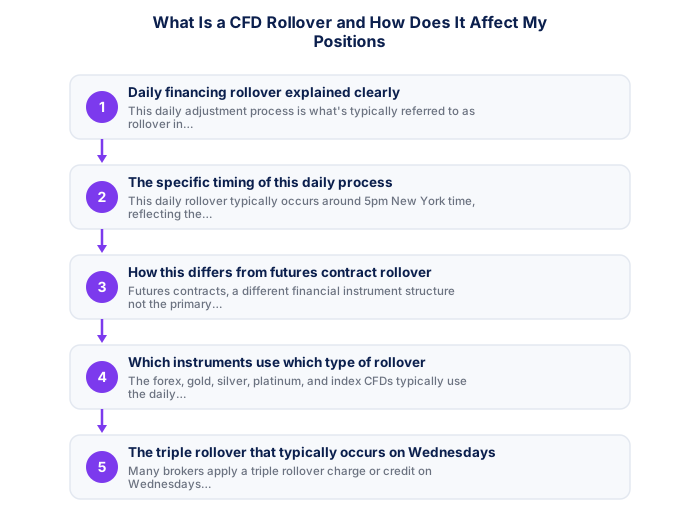
1. Daily financing rollover explained clearly
Most CFD and forex positions held open past a specific daily cutoff time incur or receive a financing adjustment, reflecting the interest rate differential mechanism. This daily adjustment process is what's typically referred to as rollover in the CFD and forex context specifically.
2. The specific timing of this daily process
This daily rollover typically occurs around 5pm New York time, reflecting the conventional end of the trading day within global forex market structure. Any position you hold open at this specific time incurs the relevant financing adjustment for that day, regardless of your own local South African time when this occurs.
See also: What Is Options Trading and How Does It Work in South Africa?
| Lot type | Size | USD/ZAR pip value | Min recommended account |
|---|---|---|---|
| Standard | 100,000 units | ~R1.00 | R100,000+ |
| Mini | 10,000 units | ~R0.10 | R10,000+ |
| Micro | 1,000 units | ~R0.01 | R1,000+ |
| Nano | 100 units | ~R0.001 | R100+ |
- V = Pip value in account currency
- E = Current exchange rate of quote vs account currency
- L = Lot size (100,000 standard / 10,000 mini / 1,000 micro)
- USD/ZAR example = 1 pip = R1 per standard lot
- Leveraged instrument
- Long and short available
- Overnight financing applies
- No ownership of asset
- Typically unleveraged
- Physical currency received
- No daily financing
- Currency ownership
3. How this differs from futures contract rollover
Futures contracts, a different financial instrument structure not the primary focus of most content throughout this site, have a fixed expiry date, requiring traders wanting continued exposure to actively exchange their expiring contract for a new one with a later expiry, this is also sometimes called rollover, but represents a genuinely different process from the daily financing adjustment.
4. Which instruments use which type of rollover
The forex, gold, silver, platinum, and index CFDs typically use the daily financing rollover, since these are generally structured as ongoing CFD contracts without a fixed expiry. Some specific commodity or other CFD products might instead be structured around an underlying futures contract, in which case the futures-style expiry rollover discussed above could become relevant, checking your specific broker's product specifications clarifies which structure applies to any particular instrument.
A R2,000 deposit at 1:30 leverage controls R60,000 notional. Overnight financing is charged on R60,000, not R2,000. This makes holding leveraged positions for days or weeks significantly more expensive than it first appears.
5. The triple rollover that typically occurs on Wednesdays
Many brokers apply a triple rollover charge or credit on Wednesdays specifically, reflecting the standard settlement convention in forex markets where a Wednesday position effectively accounts for the weekend, when markets are closed, in addition to that single day's normal financing. This means Wednesday-held positions typically show a noticeably larger financing adjustment than other weekdays, which is normal and expected rather than an error.
6. Practical implications for your trading
Understanding rollover timing matters practically for traders specifically trying to avoid overnight financing entirely, closing positions before the specific daily rollover cutoff time, rather than simply before the end of your own local trading day, ensures you genuinely avoid this charge if that's your specific intention.
South African traders using CFD and forex instruments should build clear awareness of the full cost structure of each trade before committing capital. The visible entry cost, the spread, is often the smallest component for positions held overnight or over multiple days. Overnight financing charges accumulate on the full notional value of the leveraged position, not just the margin deposited, which means positions held for a week can accumulate financing costs that exceed the entry spread many times over. Building these costs explicitly into position sizing and holding period decisions is a discipline that improves long-term trading economics significantly.
CFD and forex instruments give South African traders access to global markets from a single ZAR-denominated account without needing separate international brokerage relationships. This accessibility comes with structural characteristics that traders must understand clearly. CFDs are derivative instruments, you never own the underlying asset, and profit or loss is purely the mark-to-market difference between entry and exit prices multiplied by position size. The overnight financing charge applies to the full notional value of leveraged positions, not just the deposited margin. For traders holding positions for multiple days or weeks, this financing cost compounds and can meaningfully reduce the profitability of otherwise successful trades. Understanding the exact financing rates your broker applies to each instrument class before trading is fundamental preparation, not an optional detail.
Holding a CFD position overnight attracts a financing charge based on the interbank rate plus the broker's markup. Day traders who close positions before the daily rollover time avoid this cost entirely.
★ Why It Matters
Something worth knowing precisely: many brokers apply triple the normal rollover charge on Wednesdays , to account for weekend settlement conventions, a position held overnight on a Wednesday can cost noticeably more than the same position held on any other weeknight.
✕ Common mistakes
- Assuming rollover charges are negligible without calculating their effect. They can add up meaningfully over an extended holding period.
- Confusing CFD rollover with futures contract expiry rollover. These are different mechanisms applying to different instrument types.
- Holding positions overnight without checking the specific rollover rate first. A quick check avoids unexpected costs accumulating unnoticed.
Do overnight financing charges apply to forex positions held over the weekend?
Most brokers apply three days of financing on positions held over the weekend, typically charged on Wednesday. This reflects the two-day settlement cycle that extends over Saturday and Sunday in the interbank market.
South African traders using CFD instruments should build clear awareness of the full cost structure before committing to any position. The visible cost at entry, the spread, is often the smallest component for traders who hold positions overnight or over multiple days. Overnight financing charges accumulate on the full notional value of the leveraged position, not just the margin deposited, which means a larger leveraged position held for a week can incur financing costs that exceed the initial spread multiple times over. Calculating total expected costs before entry, including estimated holding period financing, is a discipline that improves position sizing and holding period decisions.
Key Takeaways
- CFD rollover refers to the daily process where open positions are adjusted for overnight financing, distinct from futures contract expiry rollover.
- CFD rollover refers to the daily process, typically around 5pm New York time, where open positions are adjusted for overnight financing charges.
- This is distinct from the futures contract expiry rollover that applies to some other instrument types.
- Daily financing rollover explained clearly.
- The specific timing of this daily process.
Frequently asked follow-up questions
Does rollover timing vary by broker?
The underlying convention generally follows the 5pm New York time standard, though confirming this explicitly with your specific broker avoids any confusion about exact timing.
Is the Wednesday triple rollover the same for all instruments?
The specific day this larger adjustment occurs can sometimes vary by instrument or broker convention; checking your specific broker's documentation confirms the exact pattern for your traded instruments.
Can I avoid rollover charges by closing and immediately reopening a position?
This would still incur normal trading costs like the spread, on both the close and reopen, making it generally not a cost-effective way to avoid rollover specifically.
