i Short answer
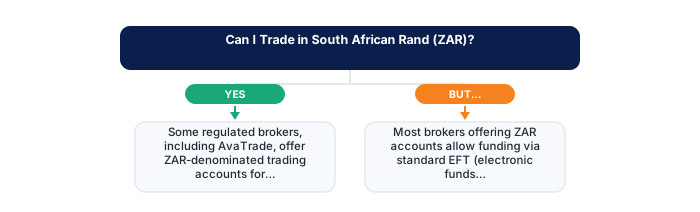
Yes. Some regulated brokers, including AvaTrade, offer ZAR-denominated accounts, so your balance is held and tracked in Rand via local payment methods.
📋 ON THIS PAGE
1. What a ZAR account actually means in practice
A ZAR-denominated account means your balance, profit and loss, deposits, and withdrawals are all tracked in rand rather than in dollars or another foreign currency. Every trade's outcome is automatically converted into rand terms, so your statement, your margin calculations, and your equity figures all appear in the currency you think and plan in.
For many South African traders, especially those starting out, this removes real friction. Constantly converting USD figures into rand to understand your actual exposure, your gains in real money terms, or whether you can afford to open a position at a specific size, adds a layer of mental overhead that's unnecessary when ZAR denomination is available.
This clarity is worth appreciating beyond simple convenience, since it also supports better risk management in practice. Calculating that a position risks two percent of your account balance is more intuitive when you can see that balance in rand rather than having to maintain a running sense of what a dollar-denominated balance translates to at the current exchange rate.
ZAR accounts also typically use local South African banking infrastructure for deposits and withdrawals, which makes funding straightforward through standard EFT from most local banks without foreign exchange steps at the bank level.
| Feature | ZAR Account | USD Account |
|---|---|---|
| Deposit method | Local EFT, same-day | Often requires SARB allowance use |
| Currency conversion on USD-priced instruments | Applies | Avoided |
| Rand volatility exposure on balance | Yes | No |
| Simplicity for SA-based traders | Higher | Lower |
2. Depositing in ZAR via local EFT
Most ZAR accounts fund via standard EFT directly from a South African bank, the same payment rails you'd use for any local transfer. It's typically instant or same-day, avoids foreign exchange conversion steps, and uses familiar South African banking infrastructure. This makes the deposit process straightforward for anyone accustomed to managing their finances through a local bank.
Setting it up typically means your broker provides specific local banking details, sometimes a dedicated local collection account, and your bank transfer references your trading account number for automatic allocation. The process is generally well-documented in your broker's deposit instructions.
- SARB economic calendar checked for the week
- Next Eskom load shedding schedule reviewed
- GNU stability news reviewed
- Stats SA data releases noted
- Credit agency review dates checked
- US/global events that move EM risk noted
It's worth appreciating how much regulatory simplicity this setup provides beyond mere convenience. Because your funds never leave ZAR or the domestic banking system during a local EFT deposit, the SARB exchange control steps that apply to foreign currency transfers don't come into play. This makes compliance significantly more straightforward for the typical South African retail trader than a broker requiring USD deposits from a local ZAR bank account.
Local EFT deposits in South Africa operate through PASA-governed infrastructure, which provides consumer protections and dispute mechanisms for bank transfer issues. Understanding that those protections apply to your broker deposits reassures on the regulatory dimension of the funding process.
3. Trading global markets while holding a ZAR balance
A ZAR balance doesn't restrict you to South African instruments. You still get full access to global forex pairs, including EUR/USD, GBP/USD, and gold, international indices, commodity CFDs, and the full instrument set your broker offers. The ZAR denomination is simply the lens through which your account balance and P&L are expressed, not a constraint on what you can trade.
The broker handles the currency mathematics behind the scenes. You open a position on EUR/USD from your ZAR balance; your broker calculates the required margin in ZAR equivalent, tracks the position's P&L in USD terms, and converts the result back to ZAR when you close it. You don't convert anything manually, your statement just shows the ZAR-equivalent outcome.
| Event | Frequency | ZAR impact | Source |
|---|---|---|---|
| SARB MPC | 6x per year | High | resbank.co.za |
| Budget Speech | Annual (February) | Very high | treasury.gov.za |
| Credit reviews | Annual each agency | Very high | Agency sites |
| Stats SA CPI | Monthly | Medium | statssa.gov.za |
| Eskom stage | As needed | Low-medium | eskomsepush.com |
- SA context provides genuine informational edge
- ZAR pairs accessible via FSCA brokers in ZAR accounts
- Rand volatility creates larger intraday ranges
- 6 SARB meetings/year create regular macro setups
- Higher geopolitical risk than G10 pairs
- Load shedding creates unique operational disruptions
- SA rand liquidity thinner than major G10 pairs
- SA-specific news requires constant local monitoring
This smooth conversion is worth appreciating for what it removes from your day-to-day trading decisions. You can evaluate a trade setup, calculate your risk in rand terms, open the position, and receive the result in rand, all without a separate currency conversion step at any point. For traders who are primarily thinking in rand terms about their capital and risk, this is a genuine quality-of-life improvement.
The ZAR/USD exchange rate at the moment of each position's closure does affect your rand P&L on USD-denominated instruments. This is a secondary effect that most ZAR-account traders are aware of but accept as part of trading international instruments from a rand base. For most trading decisions, the primary driver is the instrument's own price movement, and the currency conversion effect is a secondary consideration.
4. Where currency conversion still applies
Most of what you're actually trading, major forex pairs, gold, global indices, is natively priced in USD or another foreign currency. When you trade these instruments from a ZAR account and close the position, your broker converts the USD profit or loss into rand at the prevailing rate. This conversion typically carries a small margin, the broker's spread on the exchange rate, that represents an additional cost on each trade.
That cost is usually modest per trade and is simply part of how a ZAR account settles foreign-denominated positions. But it does mean your actual ZAR result on a USD-priced instrument is influenced by two things: the instrument's price movement and the prevailing ZAR/USD exchange rate at close. Both factors affect the rand outcome.
It's worth being aware of this specifically if you're holding a position over an extended period, since a meaningful rand move against you during the holding period can reduce a profitable USD-denominated trade's rand outcome below what the raw price movement would suggest. For short-duration trades, this effect is typically negligible; for longer-held positions, it's worth factoring into your thinking.
For South African traders who want to remove this second-order currency effect entirely, trading USD/ZAR and other ZAR-denominated instruments eliminates the conversion layer, your P&L is a direct function of the USD/ZAR rate movement rather than a combination of instrument movement plus conversion.
5. Choosing between a ZAR account and a USD account
Some brokers offer a choice between ZAR and USD accounts. The right choice depends on whether you prefer to track everything in rand terms, how you source your trading capital, and whether you want to maintain the rand/foreign currency conversion as a separate portfolio consideration or fold it into your trading account.
For most traders focused on trading rather than using their account as a currency hedge, ZAR tends to be the simpler choice. Tracking performance in your natural financial currency, funding through familiar local banking infrastructure, and managing risk in rand terms that directly relate to your real-world financial position are all genuine practical advantages.
A USD account may suit traders who primarily trade USD-priced instruments and want to remove the ZAR conversion layer from their P&L entirely, or who receive income in USD from other sources and prefer to keep their trading capital in that currency. The calculus shifts based on your personal financial situation, not a universal preference.
It's worth making this choice deliberately at account opening rather than treating it as an afterthought, since changing your base currency later effectively means opening a new account. Thinking through which currency best serves your specific situation upfront avoids the administrative cost of revisiting the decision.
6. Withdrawing back to your South African bank account
Withdrawals from a ZAR account reverse the deposit path: funds return to your South African bank account via EFT, usually processed within one to three business days depending on the broker's processing schedule. The process is typically uncomplicated for a ZAR account because the funds remain in the domestic banking system throughout, no foreign exchange conversion step is required at the point of withdrawal.
Since the money never leaves ZAR or the domestic banking system in a ZAR account, there's no extra conversion step at withdrawal time unlike withdrawing from a USD account into a South African bank account, which involves a currency conversion with its associated cost. The full withdrawal amount lands in your bank account in rand without an intermediate conversion.
Something worth weighing even with a ZAR account available: if you frequently trade USD-denominated instruments and the conversion at each position close is a meaningful cost, whether there's a net advantage to a USD account despite the more complex withdrawal process. For most retail traders at typical position sizes, the conversion cost in a ZAR account is negligible and the administrative simplicity of ZAR dominates. But for high-frequency traders at meaningful sizes, the comparison is worth running.
✕ Common mistakes
- Assuming a ZAR account removes all currency risk. Trading a USD-priced instrument on a ZAR account still exposes you to USD/ZAR movement.
- Not checking whether all instruments are available in ZAR. Availability can vary by broker and instrument.
- Overlooking the impact of Rand volatility on reported returns. A flat USD price can still show a gain or loss in ZAR terms.
- Choosing ZAR purely for convenience without comparing costs. Conversion fees and spreads can differ from USD-denominated accounts.
Can South African traders trade JSE shares through a forex broker?
Yes. Most major FSCA-regulated CFD brokers offer contracts on JSE-listed shares including JSE Top 40 constituents. This allows leveraged long or short positions on SA equities through a single trading account.
Key Takeaways
- Yes, several FSCA-regulated brokers offer ZAR-denominated accounts. Learn what this means in practice and how depositing in ZAR works.
- Some regulated brokers, including AvaTrade, offer ZAR-denominated accounts, so your balance is held and tracked in Rand via local payment methods.
- What a ZAR account actually means in practice.
- Depositing in ZAR via local EFT.
- Trading global markets while holding a ZAR balance.
Frequently asked follow-up questions
Does a ZAR account limit which instruments I can trade?
No, account currency denomination doesn't restrict instrument access, you can typically trade the full range of instruments your broker's platform offers, regardless of whether your account balance is held in ZAR, USD, or another currency.
Are there extra fees specifically for ZAR accounts?
Generally no specific extra account fee, though the implicit currency conversion margin applied when trading foreign-denominated instruments through a ZAR account is worth checking with your specific broker.
Can I switch from a USD account to a ZAR account later?
Many brokers allow this, though the specific process varies, check with your broker directly, as some may require opening a new account rather than converting an existing one.
