i Short answer
Segregated client accounts keep your deposited funds completely separate from a broker's own operating capital.
This protects your money if the broker faces financial difficulty or insolvency, and is a core part of the FSCA framework.
📋 ON THIS PAGE
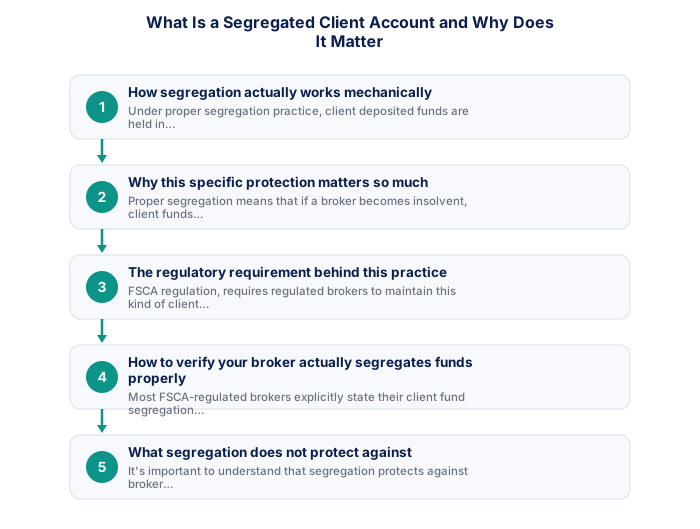
1. How segregation actually works mechanically
Under proper segregation practice, client deposited funds are held in dedicated bank accounts entirely separate from the broker's own corporate operating accounts, meaning the broker cannot use client money for its own business expenses, debts, or other corporate purposes. This separation is maintained continuously, not just at account opening, ensuring your funds remain identifiably yours throughout your relationship with the broker.
It's worth understanding this as an ongoing operational discipline rather than a one-time structural setup completed at account opening and then forgotten. Proper segregation requires the broker to maintain this separation consistently across every single client transaction, every day, which is precisely why regulatory oversight of this practice remains continuous rather than a single approval granted once and never revisited.
2. Why this specific protection matters so much
Proper segregation means that if a broker becomes insolvent, client funds held in these separate accounts generally remain protected and recoverable, rather than becoming entangled with the broker's own creditors and corporate assets during insolvency proceedings, which would otherwise put your money at genuine risk of loss alongside the broker's own business debts.
It's worth picturing the alternative scenario concretely: without proper segregation, client funds sitting in the same pool as a broker's operating capital would simply become one more asset available to satisfy the broker's creditors during insolvency, potentially leaving clients competing alongside landlords, suppliers, and other creditors for whatever remains, rather than having their deposits treated as clearly, legally distinct from the start.
- South African ID or valid passport
- Proof of residential address dated within 3 months
- Proof of bank account ownership
- Selfie or photo for biometric verification (some brokers)
- Source of funds declaration if depositing above threshold
Choose FSCA-regulated broker
Verify the FSP number is current at fsca.co.za.
Submit FICA documents
SA ID, proof of address within 3 months, bank account proof.
Fund via EFT
Make the initial deposit from your SA bank account in ZAR.
Open demo account first
Practice on demo before activating your live account.
Start with minimum capital
Begin with an amount you can afford to lose while learning.
3. The regulatory requirement behind this practice
FSCA regulation requires regulated brokers to maintain this kind of client fund segregation as a core compliance obligation, reflecting the broader investor protection purpose this entire regulatory framework is designed to serve. This isn't an optional best practice some brokers choose to adopt, it's a mandatory requirement for maintaining FSCA licensing in good standing.
This mandatory status is worth appreciating specifically because it means segregation isn't a competitive feature brokers can choose to skip to reduce costs, every genuinely FSCA-licensed broker is bound by this same baseline requirement, which is exactly why verifying licensing status functions as such a meaningful, practical proxy for confirming this specific protection is in place.
4. How to verify your broker actually segregates funds properly
Most FSCA-regulated brokers explicitly state their client fund segregation practices within their terms and conditions or a dedicated section of their website, alongside verifying the broker's active FSCA licence status directly through the official register provides reasonable confidence in this important protection.
It's reasonable to ask a broker directly which specific bank holds their segregated client accounts, most properly compliant brokers answer this without hesitation, since it's a standard part of their regulatory disclosure obligations rather than sensitive information they'd have reason to withhold.
| Rejection reason | Fix |
|---|---|
| Address proof older than 3 months | Get a recent utility bill or bank statement |
| Name mismatch between documents | Use documents with exactly matching full name |
| Poor quality scan | Retake with good lighting, all corners visible |
| PO Box address | Brokers require physical residential address only |
5. What segregation does not protect against
It's important to understand that segregation protects against broker insolvency risk specifically, it does not protect against your own trading losses, which remain entirely your own responsibility regardless of how properly your broker segregates client funds. Segregation addresses counterparty risk (protecting against broker failure), not market risk (protecting against your own trading decisions).
This distinction is worth keeping clearly separate in your own thinking, since conflating the two can lead to a false sense of overall security. A perfectly segregated account still allows you to lose your entire deposit through ordinary, disciplined trading that simply didn't work out, segregation was never designed to address that category of risk at all.
6. Why this matters more for larger account balances specifically
While segregation protection applies regardless of account size, the practical significance of this protection naturally increases with larger account balances, since the potential loss from inadequate segregation during a hypothetical broker insolvency scales directly with how much capital you have deposited, making this verification particularly worthwhile before committing larger sums to any specific broker relationship.
Opening a trading account with an FSCA-regulated broker involves a FICA verification process that provides meaningful protection for the broader financial system as well as the individual trader. The documentation requirements under the Financial Intelligence Centre Act require financial services providers to verify client identity and source of funds as part of South Africa's anti-money-laundering framework. Most brokers complete this process within one to three business days for straightforward applications. The most common source of delays is submitting proof of address documents that are older than three months or that do not exactly match the name on the identity document. Reviewing your documentation for these potential issues before submission typically produces a smoother process and faster account activation, allowing you to move more quickly from application to live trading.
Non-segregated funds could be lost to creditors if the broker fails.
Segregated client funds are held separately from the broker's own operating money. In a broker insolvency, segregated funds should remain protected, while non-segregated funds could be exposed to creditors.
★ Why It Matters
Something worth confirming rather than assuming: ask your broker directly which bank holds the segregated account and whether it's a South African institution, this detail matters more than the general fact of segregation itself if you're ever trying to verify or pursue a claim.
✕ Common mistakes
- Assuming segregation alone guarantees instant, risk-free fund recovery. Recovery can still take meaningful time even with proper segregation in place.
- Treating segregation as a marketing claim rather than verifying it. A broker's stated practice should be confirmable, not just assumed.
- Assuming segregation requirements are identical across every jurisdiction. Rules and enforcement can vary meaningfully between regulators.
Key Takeaways
- Segregated client accounts keep your funds separate from a broker's own operating capital, providing important protection if the broker faces financial difficulty.
- Segregated client accounts keep your deposited funds completely separate from a broker's own operating capital.
- This protects your money if the broker faces financial difficulty or insolvency, and is a core part of the FSCA framework.
- How segregation actually works mechanically.
- Why this specific protection matters so much.
Frequently asked follow-up questions
Can I ask my broker directly to confirm their segregation practices?
Yes, contacting your broker's support or compliance team directly for explicit confirmation is a reasonable, direct way to verify this protection.
Does segregation guarantee I'll get all my money back if my broker fails?
While segregation significantly improves the likelihood of fund recovery, the specific outcome can still depend on the particular insolvency circumstances and process involved.
Do all countries require this kind of segregation?
Regulatory requirements vary by jurisdiction; this is specifically why verifying your broker's FSCA regulatory status matters for confirming this particular South African protection applies to your account.
