i Short answer
Swap-free, or Islamic, trading accounts remove the overnight financing charges that typically apply to leveraged positions held past daily rollover.
These were originally designed for Islamic finance principles prohibiting interest, though some brokers now offer them more broadly.
📋 ON THIS PAGE
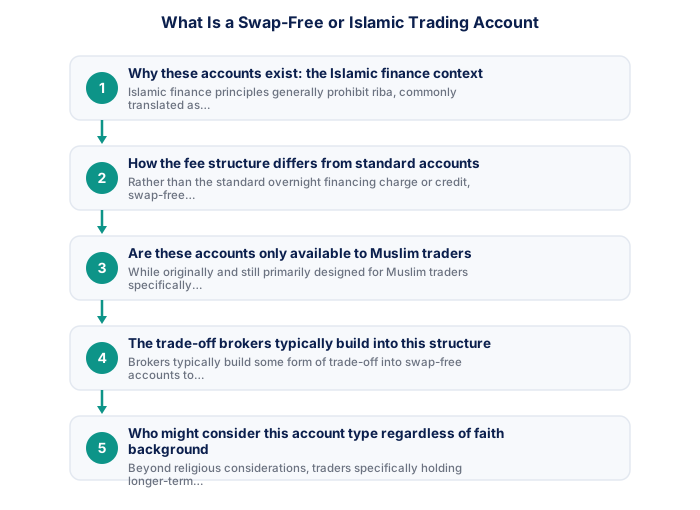
- Why these accounts exist: the Islamic finance context
- How the fee structure differs from standard accounts
- Are these accounts only available to Muslim traders
- The trade-off brokers typically build into this structure
- Who might consider this account type regardless of faith background
- Checking availability and specific terms with your broker
1. Why these accounts exist: the Islamic finance context
Islamic finance principles generally prohibit riba, commonly translated as interest, viewing it as an impermissible way of generating return on capital. Since the overnight financing charge applied to holding leveraged positions essentially functions as an interest-based mechanism, swap-free accounts were developed specifically to allow Muslim traders to participate in forex and CFD trading without this specific element conflicting with their religious principles.
This isn't a minor technicality within Islamic finance, it reflects a genuinely foundational principle that shapes how observant Muslim traders can participate in financial markets at all. Understanding this context helps explain why swap-free accounts exist as a genuine accommodation, rather than simply a minor product variation offered for marketing purposes.
| Feature | Swap-Free Account | Standard Account |
|---|---|---|
| Overnight swap charges | None | Applies |
| Alternative fee structure | Often a flat admin fee instead | N/A |
| Available to | Typically anyone, not faith-restricted | Everyone |
2. How the fee structure differs from standard accounts
Rather than the standard overnight financing charge or credit tied to interest rate differentials and carry trade dynamics, swap-free accounts typically replace this mechanism with either no additional overnight charge at all, or sometimes a flat administrative fee structured differently to avoid the interest-based characterisation, depending on the specific broker's particular implementation.
It's worth reading a specific broker's swap-free terms carefully rather than assuming all implementations work identically, since the exact mechanism, whether it's genuinely fee-free, uses a flat administrative charge, or applies some other structure, varies meaningfully between providers and directly affects the real cost of holding longer-term positions.
| Lot type | Size | USD/ZAR pip value | Min recommended account |
|---|---|---|---|
| Standard | 100,000 units | ~R1.00 | R100,000+ |
| Mini | 10,000 units | ~R0.10 | R10,000+ |
| Micro | 1,000 units | ~R0.01 | R1,000+ |
| Nano | 100 units | ~R0.001 | R100+ |
- V = Pip value in account currency
- E = Current exchange rate of quote vs account currency
- L = Lot size (100,000 standard / 10,000 mini / 1,000 micro)
- USD/ZAR example = 1 pip = R1 per standard lot
- Leveraged instrument
- Long and short available
- Overnight financing applies
- No ownership of asset
- Typically unleveraged
- Physical currency received
- No daily financing
- Currency ownership
3. Are these accounts only available to Muslim traders
While originally and still primarily designed for Muslim traders specifically seeking religious compliance, some brokers make swap-free accounts available to any interested client, regardless of religious background, recognising that the resulting fee structure might also appeal to certain trading styles or preferences independent of any religious consideration.
It's worth checking your specific broker's own eligibility policy directly rather than assuming based on general industry practice, since some brokers do restrict swap-free accounts specifically to clients declaring a religious basis for the request, while others offer it more broadly without this requirement.
4. The trade-off brokers typically build into this structure
Brokers typically build some form of trade-off into swap-free accounts to maintain their own commercial viability, this might include somewhat wider spreads compared to the broker's standard account type, or a flat administrative fee applied after a certain holding period, ensuring the broker can still cover the underlying costs that the standard overnight financing charge would otherwise address.
This trade-off is worth calculating concretely for your own likely trading pattern before assuming a swap-free account is automatically the better choice. A trader holding positions only briefly might find the wider spread costs more overall than the standard account's overnight financing charges would have, despite the swap-free account's superficially more appealing headline feature.
5. Who might consider this account type regardless of faith background
Beyond religious considerations, traders specifically holding longer-term positions might find the predictability of a swap-free fee structure appealing, since it removes the variable overnight financing cost that can otherwise accumulate meaningfully over an extended holding period.
This predictability appeals particularly to position traders and longer-term swing traders specifically, whose strategies inherently involve holding trades across many overnight periods, where the cumulative, sometimes variable cost of standard financing charges can become a meaningful factor worth simplifying into a more predictable structure.
6. Checking availability and specific terms with your broker
Not every broker offers a swap-free account option, and the specific terms and trade-offs vary considerably between those that do, making it worthwhile to check this specific feature directly with your chosen or prospective broker if this account type is relevant to your situation, rather than assuming universal availability or identical terms across the industry.
The cost is often offset through a wider spread or administration fee.
A swap-free account removes overnight financing charges for traders who wish to avoid interest. Brokers typically offset this through a slightly wider spread or an explicit administration fee instead.
★ Why It Matters
Worth checking if you're considering this account type for reasons other than religious observance: some brokers apply a separate administration fee in place of the swap charge. The cost isn't always zero, it's sometimes just restructured rather than eliminated entirely.
✕ Common mistakes
- Choosing this account purely for cost reasons without comparing alternatives. The restructured fee isn't always lower than a standard swap charge.
- Not confirming the specific terms with your broker before assuming benefits apply. Implementation details vary between providers.
- Treating all swap-free accounts as functionally identical. Specific structures and any substitute fees differ by broker.
Key Takeaways
- Swap-free accounts remove overnight financing charges, originally designed to comply with Islamic finance principles, though some brokers offer them more broadly.
- Swap-free, or Islamic, trading accounts remove the overnight financing charges that typically apply to leveraged positions held past daily rollover.
- These were originally designed for Islamic finance principles prohibiting interest, though some brokers now offer them more broadly.
- Why these accounts exist: the Islamic finance context.
- How the fee structure differs from standard accounts.
See also: What Happens If I Deposit More Than I Intended? and What Is a Joint Trading Account and Can I Open One in South Africa?.
Frequently asked follow-up questions
Do swap-free accounts cost more overall than standard accounts?
This depends on your specific trading style and holding periods. The trade-off involved means overall cost comparison requires considering your particular usage pattern.
Can I switch between a standard and swap-free account with the same broker?
Some brokers allow this, though the specific process varies; checking directly with your broker clarifies whether and how this switch can be made.
Are swap-free accounts available for all instruments?
Availability can vary by instrument category; checking your specific broker's terms clarifies which instruments are covered under their swap-free account structure.
