What this page covers
South Africa does not cap retail leverage the way Europe and Australia do. What a broker offers is its own decision, which makes the number on the marketing page a choice rather than a regulatory floor.
| Instrument | Common leverage | Margin required | Position on R10,000 margin |
|---|---|---|---|
| Major forex pairs | Up to 1:500 | 0.2% | R5,000,000 |
| Minor and exotic pairs | 1:100 to 1:200 | 0.5% to 1% | R1,000,000 to R2,000,000 |
| Gold | Up to 1:200 | 0.5% | R2,000,000 |
| Indices | 1:100 to 1:200 | 0.5% to 1% | R1,000,000 to R2,000,000 |
| Single shares | 1:5 to 1:20 | 5% to 20% | R50,000 to R200,000 |
| Crypto | 1:2 to 1:20 | 5% to 50% | R20,000 to R200,000 |
| Jurisdiction | Retail cap on major pairs | Negative balance protection |
|---|---|---|
| South Africa | No statutory cap | Broker discretion |
| European Union | 1:30 | Mandatory |
| United Kingdom | 1:30 | Mandatory |
| Australia | 1:30 | Mandatory |
| United States | 1:50 | Not mandated in the same form |
| Leverage | Margin on a R1m position | Loss on a 1% move | Percentage of margin |
|---|---|---|---|
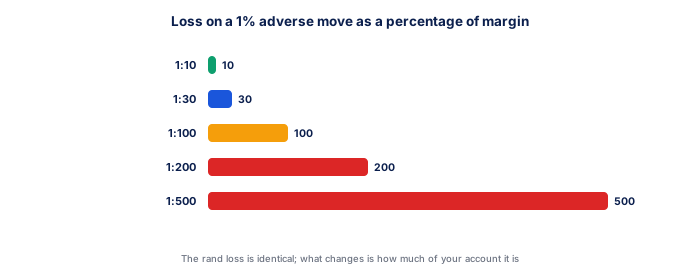
| 1:10 | R100,000 | R10,000 | 10% |
| 1:30 | R33,333 | R10,000 | 30% |
| 1:100 | R10,000 | R10,000 | 100% |
| 1:200 | R5,000 | R10,000 | 200% |
| 1:500 | R2,000 | R10,000 | 500% |

Download this data
Every table on this page as a spreadsheet, with the source and the date it was checked in the header rows.
⬇ Download CSVHow these figures work
The figures on this page come from published sources and change on a schedule rather than continuously, which is what makes them worth recording in one place. Leverage does not change the risk of the position, only the capital tied up behind it. A R1 million position loses the same rand amount on a 1% move at 1:10 as at 1:500; what changes is how much of your account that represents.
The absence of a cap is why negative balance protection matters more here than in Europe. Without it, a gap can leave you owing the broker.
★ A worked example
Reading the tables together is where the value is. Margin call and stop-out levels differ by broker and are usually expressed as a percentage of margin used. Find both before funding, because they decide when the position is closed for you.
✕ Common mistakes
- Leverage does not change the risk of the position, only the capital ti. Leverage does not change the risk of the position, only the capital tied up behind it. A R1 million position loses the same rand amount on a 1% move at 1:10 as at 1:500; what changes is how much of your account that represents.
- The absence of a cap is why negative balance protection matters more h. The absence of a cap is why negative balance protection matters more here than in Europe. Without it, a gap can leave you owing the broker.
- Margin call and stop-out levels differ by broker and are usually expre. Margin call and stop-out levels differ by broker and are usually expressed as a percentage of margin used. Find both before funding, because they decide when the position is closed for you.
- Taking a figure without its date. A number from a reference page is only as good as when it was last checked, which is why the date sits at the top of this one.
Notes on reading these figures
- Leverage does not change the risk of the position, only the capital tied up behind it. A R1 million position loses the same rand amount on a 1% move at 1:10 as at 1:500; what changes is how much of your account that represents.
- The absence of a cap is why negative balance protection matters more here than in Europe. Without it, a gap can leave you owing the broker.
- Margin call and stop-out levels differ by broker and are usually expressed as a percentage of margin used. Find both before funding, because they decide when the position is closed for you.
To put these figures to work, the Leverage Calculator runs the arithmetic on your own numbers, and Margin Calculator covers the same ground in ordinary language. Why leverage is dangerous and Negative balance protection go into the detail this table only summarises. The Margin calls covers the part this table leaves out.
Put this table on your own site
The table below can sit on your own page and stays current without you editing anything.
- Preview the embeddable table as it will appear on your site
Paste the snippet below into your own page and the table appears there, updating itself as the figures change.
<iframe src="https://www.tradeanswers.co.za/embed/ref-leverage-and-margin-limits-reference.html" width="100%" height="620" style="border:0" title="Leverage and Margin Limits Reference"></iframe>Free to use with attribution. The link back to this page is built into the embed.
Terms used on this page
Frequently asked questions
Does South Africa cap retail leverage?
No. There is no statutory cap, so what a broker offers is its own decision rather than a regulatory floor.
Does higher leverage mean more risk?
Not by itself. The risk is in the position size. Leverage changes how much capital sits behind that size, and therefore how much of your account a move represents.
What is a margin call?
A demand for additional capital when your margin level falls below a threshold set by the broker.
What is a stop-out?
The level at which the broker closes positions automatically. It is usually a lower threshold than the margin call.
Is negative balance protection standard here?
No. It is mandatory in Europe, the UK and Australia, and discretionary in South Africa, which is why the client agreement matters.
How does South African leverage compare?
Brokers here commonly offer up to 1:500 on major pairs, against a 1:30 retail cap in Europe and the UK.