i Short answer
Day trading involves opening and closing all positions within the same trading day, deliberately avoiding overnight exposure.
This requires active, concentrated attention during your chosen session.
📋 ON THIS PAGE
- The core defining characteristic of day trading
- Why traders avoid overnight exposure
- The typical time commitment this style requires
- Common day trading approaches and techniques
- How this differs from scalping
- Whether this style suits your circumstances
- Which hours day trading is actually viable from South Africa
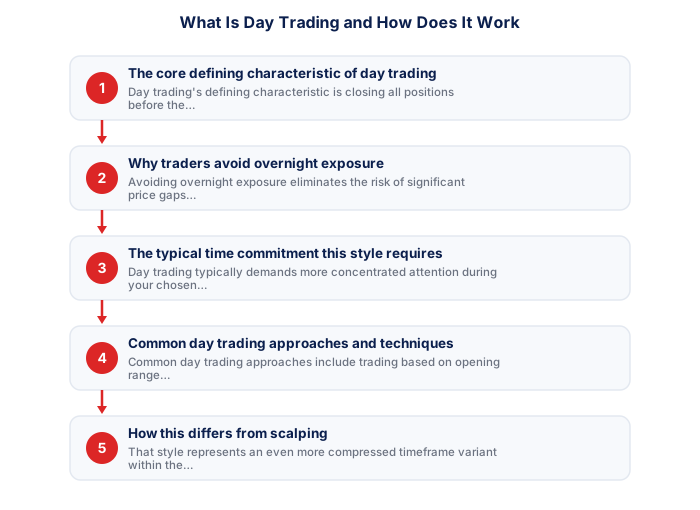
1. The core defining characteristic of day trading
Day trading's defining characteristic is closing all positions before the trading day ends, rather than carrying any open exposure into the next session, distinguishing it from swing or position trading, which deliberately hold positions across multiple days or longer.
It's worth using this same-session closure as your genuine litmus test when reading about different trading styles, since terminology across trading education content isn't always applied with perfect consistency, worth checking this specific defining characteristic rather than relying on labels alone.
2. Why traders specifically avoid overnight exposure
Avoiding overnight exposure eliminates the risk of significant price gaps occurring while markets are closed and you're unable to react, a specific risk longer-timeframe traders deliberately accept in exchange for less constant attention.
It's worth appreciating this as a deliberate risk management choice rather than an arbitrary rule, avoiding overnight exposure specifically protects against exactly the kind of unpredictable, gap-risk scenarios discussed elsewhere on this site regarding trading around major news events.
3. The typical time commitment this style requires
Day trading typically demands more concentrated attention during your chosen session compared to swing or position trading, since you're actively monitoring and managing positions throughout that specific window rather than checking periodically.
It's worth being genuinely honest with yourself about whether this time commitment fits your actual circumstances, discussed elsewhere on this site regarding realistic weekly time budgets, before committing to day trading specifically as your chosen approach.
- Economic calendar checked for high-impact events
- Key levels marked for target instruments
- Maximum trades per session defined
- Stop-losses set on overnight positions
- Backup connectivity available
- Eskom schedule checked
- Post-session journal time scheduled
4. Common day trading approaches and techniques
Common day trading approaches include trading based on opening range breakouts, technical patterns forming within the session, or reacting to scheduled news events.
It's worth exploring each of these approaches through demo trading before committing to one as your primary focus, discussed elsewhere on this site regarding demo account usage, since each technique genuinely suits different temperaments and market conditions.
| Session | SAST | Instruments | Liquidity |
|---|---|---|---|
| Pre-market | 07:00-09:00 | Any | Low |
| JSE morning | 09:00-12:00 | JSE shares | High |
| Midday lull | 12:00-15:00 | Any | Low |
| London-NY overlap | 15:00-17:00 | Major forex | Very high |
| NY afternoon | 17:00-21:00 | Major forex | Medium |
5. How this differs from scalping
That style represents an even more compressed timeframe variant within the broader day trading category, typically holding positions for mere minutes or seconds, while standard day trading positions might last anywhere from minutes to several hours within the same day.
It's worth understanding both as points along the same same-session trading spectrum, discussed elsewhere on this site regarding scalping specifically, rather than entirely separate categories, the distinction lies primarily in typical holding time and required precision rather than a fundamentally different underlying approach.
6. Whether this style genuinely suits your circumstances
Honestly assessing whether you can realistically dedicate the concentrated attention this style requires, and whether the faster-paced decision-making suits your personal temperament, matters before committing to this specific approach.
Volume concentrates late in the day in South African time, in the hours London and New York share. liquidity
It demands continuous attention during sessions, unlike swing or position trading.
Day trading closes all positions before end of session, avoiding overnight financing. This requires continuous session attention and makes it difficult to combine with a full-time job, unlike swing or position trading.
South African day traders face a practical challenge that their international counterparts do not: the primary high-liquidity window for major forex pairs, the London-New York overlap, falls between 15:00 and 17:00 SAST, one of the most common afternoon load shedding time slots. Building explicit contingencies for this overlap, including backup connectivity, pre-set stops on all open positions before the window, and a reduced position size policy during load shedding windows, converts this operational risk into a managed condition rather than an unplanned disruption.
★ Why It Matters
Something worth testing honestly on yourself: track how many of your 'day trades' you planned for that specific day in advance versus how many were opportunistic reactions to something you noticed mid-session, the ratio reveals whether you're running a structured approach or trading reactively under a day-trading label.
✕ Common mistakes
- Holding positions overnight despite intending to day trade. This blurs the defining boundary between day trading and other styles.
- Reacting to opportunistic setups rather than planning trades in advance. Tracking how many trades were genuinely planned versus reactive reveals your real process.
- Underestimating the sustained attention day trading actually requires. This demand is often higher than newcomers anticipate.
- Treating day trading as inherently more serious than other trading styles. Frequency doesn't determine trading quality or seriousness.
7. Which hours day trading is actually viable from South Africa
Day trading depends on movement and tight costs arriving together, and for a South African that combination occupies a fairly narrow window. The London and New York overlap runs roughly 15:00 to 18:00 SAST in the southern winter, an hour earlier while the northern hemisphere is on daylight saving, and that is where spreads are tightest and average ranges largest.
The geography works unusually well here. Unlike traders in Asia or the Americas, South Africans get the most active hours of the global day in the afternoon and early evening rather than before dawn, which makes disciplined part-time day trading genuinely workable. If local equities are the focus instead, the JSE session runs 09:00 to about 16:50 SAST with a closing auction to 17:00, so the two overlap only at the end of the local day. Trading hours in South African time maps the whole schedule, including how the sessions shift twice a year while SAST stays fixed.
Key Takeaways
- Day trading involves opening and closing all positions within the same trading day, avoiding overnight exposure but requiring active, concentrated attention.
- Day trading involves opening and closing all positions within the same trading day, deliberately avoiding overnight exposure.
- This requires active, concentrated attention during your chosen session.
- The core defining characteristic of day trading.
- Why traders specifically avoid overnight exposure.
Frequently asked follow-up questions
Is day trading more profitable than longer-term trading styles?
Neither style is inherently more profitable. Outcomes depend on the specific trader's skill and discipline within their chosen style.
Can I day trade alongside a full-time job?
This is genuinely challenging given the concentrated attention day trading requires, though some traders manage this during specific available windows.
Does day trading require more starting capital than other styles?
Capital requirements relate more to position sizing and risk management generally, than specifically to the day trading style itself.
Is day trading legal in South Africa?
Yes, this trading style itself carries no special legal restriction beyond the standard regulatory framework applying to all trading.
How long does it typically take to become proficient at day trading?
This varies considerably by individual, though most traders require considerable sustained practice before achieving consistent proficiency.
