i Short answer
A pip is the smallest standard price movement quoted for a currency pair, for most pairs the fourth decimal place (Yen pairs use the second).
Pips are the standard unit traders use for measuring price movement and calculating profit or loss.
📋 ON THIS PAGE
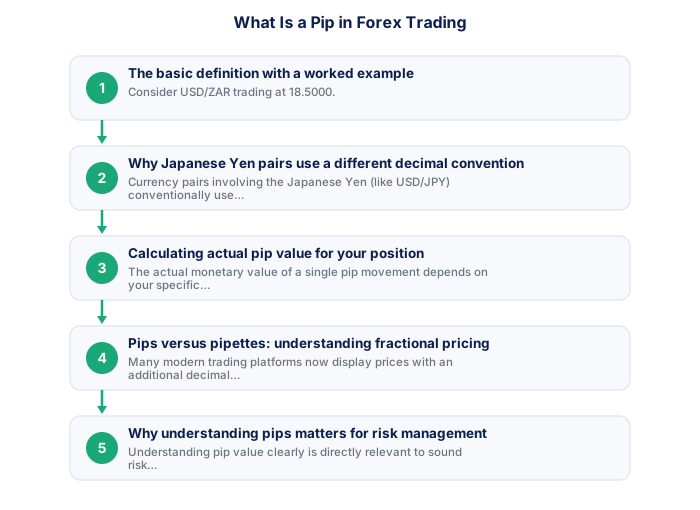
- The basic definition with a worked example
- Why Japanese Yen pairs use a different decimal convention
- Calculating actual pip value for your position
- Pips versus pipettes: understanding fractional pricing
- Why understanding pips matters for risk management
- How this concept extends to non-forex instruments
- What a pip is worth on a South African account
1. The basic definition with a worked example
Consider USD/ZAR trading at 18.5000. If the price moves to 18.5010, that represents a 10-pip movement, each individual pip corresponds to a change of 0.0001 in the quoted exchange rate for this type of currency pair. This standardised unit gives traders a consistent way to discuss and measure price movement regardless of the specific numerical price level a given currency pair happens to be trading at any particular time.
Using pips as a standard unit makes it considerably easier to communicate about price movement in a way that's immediately meaningful across different currency pairs, saying a trade moved "20 pips" in your favour is more immediately useful and comparable across different contexts than simply stating the raw decimal price change, particularly when comparing movement across different currency pairs trading at very different absolute price levels.
A common early confusion is treating a pip as a fixed percentage of price rather than a fixed decimal increment. Because 10 pips on USD/ZAR at 18.5000 represents a much smaller percentage move than 10 pips on a pair trading closer to 1.0000, comparing "pip counts" alone across very different pairs can be misleading without also considering the pair's typical volatility and pip value in monetary terms. Traders new to a specific pair often benefit from first checking its average daily pip range before assuming their usual stop-loss or target distances, expressed in pips, will behave the same way they do on a more familiar pair.
| Unit | Decimal Place | Example (EUR/USD) |
|---|---|---|
| Pip | 4th decimal (2nd for JPY pairs) | 1.0850 to 1.0851 |
| Pipette | 5th decimal (3rd for JPY pairs) | 1.08501 to 1.08502 |
2. Why Japanese Yen pairs use a different decimal convention
Currency pairs involving the Japanese Yen (like USD/JPY) conventionally use the second decimal place for pip calculation rather than the fourth, reflecting the Yen's historically much larger numerical value relative to other major currencies (where, for example, one US Dollar might equal over 100 Yen, compared to most other major currency pairs trading much closer to a 1-to-1 or low-single-digit ratio).
This different decimal convention for Yen pairs specifically is simply a market convention reflecting this underlying numerical scale difference, rather than representing any fundamentally different concept, the underlying idea of a pip as the standard smallest quoted price movement unit remains identical in principle; only the specific decimal place used to define it differs for this particular category of currency pairs.
| Lot type | Size | USD/ZAR pip value | Min recommended account |
|---|---|---|---|
| Standard | 100,000 units | ~R1.00 | R100,000+ |
| Mini | 10,000 units | ~R0.10 | R10,000+ |
| Micro | 1,000 units | ~R0.01 | R1,000+ |
| Nano | 100 units | ~R0.001 | R100+ |
- V = Pip value in account currency
- E = Current exchange rate of quote vs account currency
- L = Lot size (100,000 standard / 10,000 mini / 1,000 micro)
- USD/ZAR example = 1 pip = R1 per standard lot
- Leveraged instrument
- Long and short available
- Overnight financing applies
- No ownership of asset
- Typically unleveraged
- Physical currency received
- No daily financing
- Currency ownership
This distinction becomes particularly easy to overlook for traders who split their attention between Yen and non-Yen pairs on the same platform, since the visual difference between the two quoting conventions on a price chart can be subtle at a glance. Carrying over a pip-value assumption from EUR/USD or USD/ZAR directly onto USD/JPY without adjusting for the different decimal convention is a genuine, and entirely avoidable, source of miscalculated risk. Many platforms display the pip value for the specific instrument you have selected directly in the order ticket, which is worth checking deliberately rather than assumed from memory whenever you're trading a Yen pair alongside your more usual pairs.
3. Calculating actual pip value for your position
The actual monetary value of a single pip movement depends on your specific position size position size (the size of the trade you've opened) and the specific currency pair being traded. For a standard position size in a typical major currency pair, a single pip movement might be worth a specific, calculable amount in your account's base currency, and this pip value scales directly and proportionally with your chosen position size, meaning a larger position size means each pip of price movement translates into a correspondingly larger monetary profit or loss.
Most trading platforms calculate and display this pip value automatically based on your specific position size and the instrument being traded, removing the need for manual calculation in practice, but understanding the underlying concept clearly remains valuable specifically for planning appropriate position sizes relative to your account size and risk tolerance, as discussed in detail regarding leverage and risk management elsewhere on this site.
To put the scaling relationship concretely: if a standard lot on a given pair is worth roughly $10 per pip, a mini lot (one-tenth the size) is worth roughly $1 per pip, and a micro lot (one-hundredth the size) is worth roughly $0.10 per pip. This proportional relationship is precisely why smaller lot sizes are often recommended for beginners, they allow the same number of pips of adverse movement to translate into a far smaller monetary loss, giving newer traders more room to absorb normal price fluctuation while they're still building consistency, without that fluctuation threatening a disproportionate share of their account.
4. Pips versus pipettes: understanding fractional pricing
Many modern trading platforms now display prices with an additional decimal place beyond the traditional pip convention, sometimes called a "pipette" or fractional pip, providing more granular price precision than the traditional pip-based quoting convention alone would offer. For example, a price quoted as 18.50005 for USD/ZAR includes a fractional pipette beyond the standard fourth-decimal pip convention.
This additional precision reflects modern electronic trading systems' capability to quote and execute prices with finer granularity than older, more traditional quoting conventions required, though the underlying concept and practical significance of the standard "pip" as the primary unit traders discuss and think in terms of remains the dominant convention in everyday trading conversation and analysis, even as the underlying technical price quoting precision has increased.
5. Why understanding pips matters for risk management
Understanding pip value clearly is directly relevant to sound risk management, since setting an appropriate stop-loss level, a core component of any trading strategy, typically involves defining your acceptable risk in terms of a specific number of pips of adverse price movement, then translating this into both the appropriate stop-loss price level and, combined with your pip value calculation, the actual monetary risk that specific stop-loss placement represents for your chosen position size.
Without a clear, working understanding of pip value and how it scales with position size, it's genuinely difficult to translate a strategy's technical stop-loss placement (often defined in pip terms based on chart analysis) into the concrete, monetary risk percentage of your account that disciplined risk management requires you to calculate and respect consistently across every trade.
For South African traders working in Rand-denominated accounts specifically, this calculation carries an extra layer worth being deliberate about: pip value on ZAR-quoted pairs and cross-pairs converted into Rand can look like a larger number than the equivalent risk on a Dollar-denominated pair, simply because of the exchange rate, even when the underlying percentage risk to the account is identical. Checking your platform's displayed pip value in your own account currency, rather than mentally converting from a Dollar figure you're used to seeing quoted elsewhere, helps avoid misjudging a position's real risk.
6. How this concept extends to non-forex instruments
While "pip" is specifically a forex-trading term, similar concepts apply to other instruments too, even though the specific terminology and decimal conventions differ: gold price movement, for example, is typically discussed in terms of dollar movement per ounce rather than pips , while index CFDs like the JSE Top 40 are typically discussed in terms of index points rather than pips.
Regardless of the specific terminology used for any particular instrument category, the underlying principle remains consistent: understanding the standard unit of price movement for whatever specific instrument you're trading, and how that standard unit translates into actual monetary profit or loss for your specific position size, is a foundational practical skill applicable across all the different instrument categories you might trade.
This matters in practice whenever you diversify beyond forex: a trader accustomed to thinking in pips can find index or commodity price movement genuinely disorienting at first, simply because the scale and unit feel unfamiliar, even if the underlying discipline of translating price movement into monetary risk is identical. Getting comfortable with each instrument's own convention before sizing a live position in it, rather than assuming pip-based intuition carries over directly, is a small but worthwhile step when trading multiple asset classes.
A pip is the fourth decimal place in most forex pairs, or the second decimal in JPY pairs. Its Rand value depends on the pair being traded, the lot size, and your account's base currency.
★ Why It Matters
Something worth double-checking with Yen pairs: since they use the second decimal place rather than the fourth, a position sized using a standard pip-value assumption from a non-Yen pair will be wrong by a factor of 100, a mistake worth verifying before your first Yen-pair trade.
✕ Common mistakes
- Not double-checking pip value assumptions before sizing a position. A wrong assumption can size a trade incorrectly by a meaningful margin.
- Confusing pip movement with monetary value without converting properly. These require a specific calculation, not a direct equivalence.
- Assuming pip definitions are identical across all instrument types. Indices and commodities sometimes use different conventions entirely.
7. What a pip is worth on a South African account
The abstract definition becomes useful the moment you convert it into rands. On a standard lot of 100,000 units, one pip on most dollar-quoted majors is worth about $10, which at an exchange rate near R16 is roughly R160 per pip. On a mini lot it is about R16, and on a micro lot roughly R1.60. Those three numbers tell you more about whether a position is survivable than any chart pattern does.
USD/ZAR behaves differently because the rand is the quote currency. A pip there is worth a fixed R10 per standard lot rather than a dollar amount that fluctuates, which makes the arithmetic simpler for local traders but hides a larger issue: USD/ZAR routinely moves several hundred pips in a session, so the same lot size that feels comfortable on EUR/USD can produce a far larger rand swing. What actually moves the rand covers why those ranges are so wide.
Key Takeaways
- A pip is the smallest standard price movement in a currency pair, typically the fourth decimal place. Learn how pip value is calculated and why it matters.
- A pip is the smallest standard price movement quoted for a currency pair, for most pairs the fourth decimal place (Yen pairs use the second).
- Pips are the standard unit traders use for measuring price movement and calculating profit or loss.
- The basic definition with a worked example.
- Why Japanese Yen pairs use a different decimal convention.
See also: What Is Maximum Drawdown and Why Does It Matter?.
Frequently asked follow-up questions
Does pip value change based on account currency?
Yes, pip value calculations are affected by your account's base currency, since the calculation ultimately converts the underlying currency pair movement into your specific account currency's monetary terms.
Is a bigger pip movement always better for traders?
Not inherently, a large pip movement is favourable if it's in your trade's intended direction and unfavourable if against it; the size of the movement itself is neutral, with the direction relative to your position determining whether it's beneficial or harmful.
Do all trading platforms calculate pip value automatically?
Most modern trading platforms display pip value and potential profit/loss automatically based on your position size, removing the need for manual calculation during actual trading, though understanding the underlying concept remains valuable for planning purposes.
