i Short answer
Joint trading accounts with shared formal ownership are uncommon among South African retail brokers, who typically require accounts in a single individual's name.
📋 ON THIS PAGE
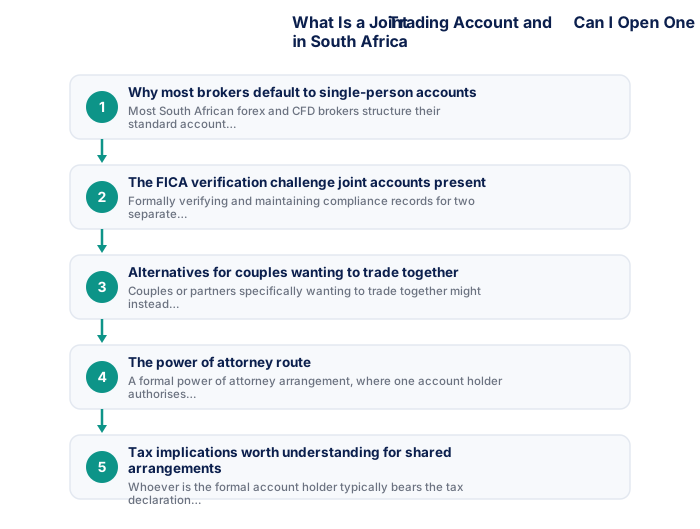
1. Why most brokers default to single-person accounts
Most South African forex and CFD brokers structure their standard account opening process around individual ownership, reflecting both regulatory verification requirements and the practical simplicity of managing a single accountable party for each account.
This design choice is worth understanding as a genuine reflection of how the regulatory verification and accountability framework, discussed throughout this site's legal content, is built around individual identity and responsibility. Retrofitting that framework to accommodate shared ownership cleanly isn't simply a matter of broker preference, it touches genuine compliance complexity most standard retail platforms haven't been built to handle.
2. The FICA verification challenge joint accounts present
Formally verifying and maintaining compliance records for two separate individuals on a single shared account, under FICA requirements, introduces additional administrative complexity that many retail-focused brokers simply haven't built their standard systems to accommodate.
This is worth appreciating as more than administrative inconvenience, questions like whose funds are actually being deposited, who bears responsibility if verification details change for one party but not the other, and how disputes between joint holders would even be resolved all become genuinely more complicated once two separately verified identities share formal ownership of the same account.
- SARB economic calendar checked for the week
- Next Eskom load shedding schedule reviewed
- GNU stability news reviewed
- Stats SA data releases noted
- Credit agency review dates checked
- US/global events that move EM risk noted
Choose FSCA-regulated broker
Verify the FSP number is current at fsca.co.za.
Submit FICA documents
SA ID, proof of address within 3 months, bank account proof.
Fund via EFT
Make the initial deposit from your SA bank account in ZAR.
Open demo account first
Practice on demo before activating your live account.
Start with minimum capital
Begin with an amount you can afford to lose while learning.
3. Alternatives for couples wanting to trade together
Couples or partners wanting to trade together might instead consider each opening their own individual account while informally coordinating strategy and decisions, keeping in mind the distinction between informal discussion and actually managing someone else's account.
This informal coordination can work well for shared learning and discussion, provided both parties are honest with themselves about where coordination ends and one person effectively directing the other's trades begins, since that latter scenario edges into the trading-on-behalf-of-someone-else territory discussed elsewhere on this site, with its own separate considerations.
| Event | Frequency | ZAR impact | Source |
|---|---|---|---|
| SARB MPC | 6x per year | High | resbank.co.za |
| Budget Speech | Annual (February) | Very high | treasury.gov.za |
| Credit reviews | Annual each agency | Very high | Agency sites |
| Stats SA CPI | Monthly | Medium | statssa.gov.za |
| Eskom stage | As needed | Low-medium | eskomsepush.com |
- SA context provides genuine informational edge
- ZAR pairs accessible via FSCA brokers in ZAR accounts
- Rand volatility creates larger intraday ranges
- 6 SARB meetings/year create regular macro setups
- Higher geopolitical risk than G10 pairs
- Load shedding creates unique operational disruptions
- SA rand liquidity thinner than major G10 pairs
- SA-specific news requires constant local monitoring
4. The power of attorney route
A formal power of attorney arrangement, where one account holder authorises another specific individual to trade on their behalf under documented, broker-approved terms, gives one potential alternative structure to genuine joint ownership.
This route is worth pursuing formally through your broker's own documented process, rather than as an informal understanding between partners, since a properly documented arrangement gives both parties genuine clarity and protection, while an informal one leaves ambiguity about authority and responsibility that could matter considerably if a dispute or misunderstanding ever arose.
When evaluating brokers operating in South Africa, the FSCA register is the definitive verification resource. Checking not only that a broker is listed but also that their specific scope of authorisation covers the instruments and services you intend to use is an important step that many traders skip. The FSCA also publishes enforcement actions and consumer warnings on its website, which are worth reviewing for any broker you are considering.
6. Checking your specific broker's policy directly
Given that specific policies can vary, and some brokers may offer arrangements not widely advertised, directly asking your broker whether any joint or shared account structure is available clarifies definitively what's genuinely possible, rather than assuming the general pattern above applies universally without exception.
Both parties require full FICA verification and share liability.
Joint trading accounts are less commonly offered by South African brokers than individual accounts. Where available, all account holders require full FICA verification and share joint liability.
★ Why It Matters
Worth doing instead if you're trading as a couple or family: open separate individual accounts but keep a shared spreadsheet tracking combined exposure and goals. This achieves most of the practical coordination benefit without the legal complexity of true joint ownership.
✕ Common mistakes
- Assuming joint accounts are widely available among local brokers. Most require accounts in a single individual's name.
- Treating informal shared trading as equivalent to a legally joint account. These carry genuinely different legal and liability implications.
- Ignoring how disputes would be resolved without a formal joint structure. This is worth thinking through before any informal shared arrangement.
Key Takeaways
- Joint trading accounts allowing shared ownership between two individuals are uncommon among South African brokers, who typically require single-person accounts.
- Joint trading accounts with shared formal ownership are uncommon among South African retail brokers, who typically require accounts in a single individual's name.
- Why most brokers default to single-person accounts.
- The FICA verification challenge joint accounts present.
- Alternatives for couples wanting to trade together.
Frequently asked follow-up questions
Do any South African brokers offer genuine joint accounts?
This varies and isn't universal. Directly asking your broker clarifies what's genuinely available, since this isn't a standard offering across the industry.
Can my spouse and I simply share login credentials to one account instead?
This isn't generally advisable from a security or accountability perspective, compared to the more structured alternatives above.
Does a joint bank account help with opening a joint trading account?
Not directly. Trading account structure is generally separate from your banking arrangements, even if you use a joint bank account for funding purposes.
Who is liable for losses on an account if ownership structure is unclear?
The formal account holder generally bears this responsibility. This is exactly why clarity about formal ownership matters, regardless of how informally a couple might otherwise coordinate.
Can business or trust structures hold trading accounts instead of individuals?
Some brokers do offer corporate or trust account structures separate from individual retail accounts. Checking directly with your broker clarifies what's available for this kind of structure.
