i Short answer
Review your complete trade history, total realised costs, net balance change, and check for any unfamiliar or unexpected charges.
Comparing this against your own trading journal helps confirm consistency and catch discrepancies early.
📋 ON THIS PAGE
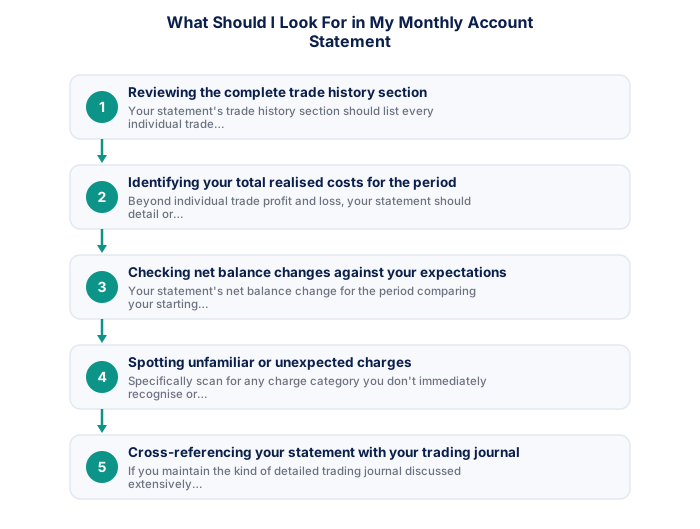
1. Reviewing the complete trade history section
Your statement's trade history section should list every individual trade executed during the period, including entry and exit prices, position size position size, and the resulting profit or loss on each. Reviewing this complete list, rather than just the summary totals, lets you confirm that every trade you recall placing actually appears correctly, and that no unfamiliar trades you don't recognise have somehow appeared on your account.
This detailed review connects directly to the broader trading journal discipline worth building as a trader. Your own journal entries should align closely with this official broker record, and any mismatch between what you recorded and what the statement shows is worth investigating specifically to understand the source of the discrepancy.
See also: What Is an Account Base Currency and Can I Change It?
See also: How Do I Open a Trading Account as a South African?
See also: How Do I Evaluate Trading Podcasts and Audio Content?
See also: Is Any Currency Pegged to the Rand?
See also: What Does the Term Lot Size Mean in Forex Trading?
See also: How Does Emigration Affect My South African Trading Accou
See also: Am I Ready to Start Trading? A Practical Checklist
See also: What Are Common SA Trading Scams and How Do I Spot Them?
See also: How Do EFT Deposits Work for South African Trading Accoun
2. Identifying your total realised costs for the period
Beyond individual trade profit and loss, your statement should detail or allow you to calculate your total realised costs for the period, cumulative spread costs, any overnight financing charges accumulated across positions held past daily rollover, and any explicit fees like inactivity charges if applicable. Summing these costs gives a clear picture of your total trading cost burden for the period, separate from the underlying market-driven profit or loss on your actual trading decisions.
Tracking this cost figure monthly, rather than only focusing on overall account balance change, helps you understand specifically how much of any shortfall between your trading decisions' theoretical performance and your actual account result is attributable to costs versus genuine trading losses, an important distinction for accurately evaluating your strategy's real effectiveness.
- South African ID or valid passport
- Proof of residential address dated within 3 months
- Proof of bank account ownership
- Selfie or photo for biometric verification (some brokers)
- Source of funds declaration if depositing above threshold
Choose FSCA-regulated broker
Verify the FSP number is current at fsca.co.za.
Submit FICA documents
SA ID, proof of address within 3 months, bank account proof.
Fund via EFT
Make the initial deposit from your SA bank account in ZAR.
Open demo account first
Practice on demo before activating your live account.
Start with minimum capital
Begin with an amount you can afford to lose while learning.
3. Checking net balance changes against your expectations
Your statement's net balance change for the period, comparing your starting and ending balance, adjusted for any deposits or withdrawals made during that time, should align reasonably closely with your own running mental or journal-based tracking of your account's performance throughout the month. A significant, unexplained discrepancy between your own tracking and the official statement figure warrants closer investigation rather than being dismissed as a minor rounding difference.
This check serves as a useful, periodic sanity check on both your own record-keeping accuracy and the broker's statement accuracy, catching potential errors on either side before they compound or go unnoticed over an extended period.
4. Spotting unfamiliar or unexpected charges
Specifically scan for any charge category you don't immediately recognise or fully understand, while most charges should align with your broker's published fee schedule, occasionally genuine billing errors or charges you'd forgotten about (like an inactivity fee triggered by an unplanned pause in trading) can appear and are worth confirming you understand fully.
Contacting your broker's support team for clarification on any charge you don't recognise or understand is entirely reasonable and is a legitimate use of customer support, a transparent, well-regulated broker should be able to explain any specific charge on your statement clearly and promptly upon request.
| Rejection reason | Fix |
|---|---|
| Address proof older than 3 months | Get a recent utility bill or bank statement |
| Name mismatch between documents | Use documents with exactly matching full name |
| Poor quality scan | Retake with good lighting, all corners visible |
| PO Box address | Brokers require physical residential address only |
5. Cross-referencing your statement with your trading journal
If you maintain a detailed trading journal, comparing your journal entries against the official statement for the same period serves multiple purposes: confirming your own record-keeping accuracy, verifying the broker's statement accuracy, and providing an additional opportunity to reflect on your trading patterns and decisions for the period with the benefit of the complete, official record in front of you.
This monthly cross-referencing habit, performed consistently, builds a sound, mutually verifying record of your trading activity over time, reducing the risk of either your own memory-based tracking or any potential broker-side errors going unnoticed for extended periods.
6. What to do if you find a genuine discrepancy
If your review reveals a genuine discrepancy, a trade you don't recognise, a calculation that doesn't match your own records, or a charge that seems inconsistent with the broker's published fee schedule, contact your broker's support team promptly with specific details, including the relevant dates, amounts, and your own supporting records. Most discrepancies stem from straightforward misunderstandings or minor administrative errors that brokers can clarify or correct quickly once flagged.
If a genuine, serious discrepancy isn't resolved satisfactorily through this direct support channel, this is precisely the kind of documented issue that would form the basis of a formal complaints process, with your statement review and journal cross-referencing providing exactly the kind of clear documentation that process benefits from having ready.
Total fees, overnight financing, and conversion costs are easy to miss.
Cross-referencing the trade list against your journal catches discrepancies. Total fee burden, overnight financing, and currency conversion costs are easy to overlook if you only check the headline net P&L.
★ Why It Matters
Worth checking specifically every month rather than only when something feels wrong: your total financing charges paid, summed across the month, this single figure is easy to lose track of trade-by-trade but can add up to a meaningfully larger monthly cost than most traders realise until they total it.
✕ Common mistakes
- Not cross-referencing the statement against your own trading journal. This habit catches discrepancies early and reinforces your own record-keeping.
- Assuming all charges shown are automatically correct without verification. A periodic, careful check is a reasonable practice regardless of broker reputation.
- Discarding statements rather than retaining them for tax and dispute purposes. These records matter more than they seem until they're actually needed.
Key Takeaways
- Review your trade history, realised costs, balance changes, and any unfamiliar fees each month. Learn what a thorough statement review actually involves.
- Review your complete trade history, total realised costs, net balance change, and check for any unfamiliar or unexpected charges.
- Comparing this against your own trading journal helps confirm consistency and catch discrepancies early.
- Reviewing the complete trade history section.
- Identifying your total realised costs for the period.
Frequently asked follow-up questions
How often should I review my account statement?
Monthly review is a common, practical rhythm, though more active traders might benefit from more frequent review given the higher volume of activity to track.
Can I request a statement covering a custom date range?
Most brokers allow exporting account history for custom date ranges through their platform, beyond just standard monthly statements, which can be useful for specific review purposes.
What should I do if my statement shows a trade I never placed?
Contact your broker's support team immediately, since this could indicate either an account security issue or an administrative error requiring prompt investigation.
