i Short answer
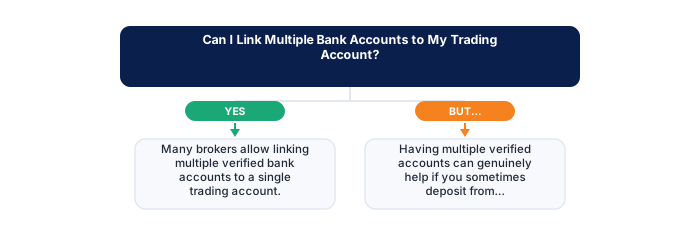
Many brokers allow linking multiple verified bank accounts to a single trading account. However, withdrawals typically must return to the same account originally used for the corresponding deposit.
📋 ON THIS PAGE
- Why brokers generally allow multiple linked accounts
- The same-account withdrawal rule explained
- Why this rule exists from a compliance perspective
- Verification requirements for each additional linked account
- Practical scenarios where multiple accounts genuinely help
- Checking your specific broker's policy on this
1. Why brokers generally allow multiple linked accounts
Brokers generally allow you to register more than one verified bank account, since plenty of people use a primary transactional account for day-to-day payments alongside a separate savings or investment account that they prefer for larger transfers. Having both options available means you're not forced to move capital between your own bank accounts before a deposit.
It's worth registering any additional bank account you genuinely plan to use before you actually need it for a deposit or withdrawal, rather than rushing through the verification process when you're trying to move capital quickly. Verification takes time, and a bank account that hasn't been pre-verified creates a delay at exactly the moment you're trying to act.
The practical benefit here is straightforward: flexibility to deposit from whichever account holds available funds at a given time, without the friction of transferring between your own bank accounts first. For traders who maintain separate accounts for trading capital versus operational cash flow, this removes an unnecessary intermediate step.
South African traders should also be aware that the SARB's FICA requirements mean each linked bank account needs to be in your own name, you can't link a third party's bank account for deposits or withdrawals, and brokers are required to enforce this consistently regardless of the relationship between you and the account holder.
2. The same-account withdrawal rule explained
Withdrawals have a stricter rule than deposits: funds return to whichever account funded the original deposit. Deposit via your FNB account and your withdrawal goes back to that FNB account. If you later deposit from your Nedbank account, that portion of your capital can only be withdrawn to Nedbank. The rule applies on a per-deposit basis rather than to your balance as a single undifferentiated pool.
This is worth keeping firmly in mind when deciding which bank account to deposit from in the first place, since the choice you make at deposit time constrains your withdrawal options. If you want the flexibility to withdraw to a specific account, the corresponding deposit must originate from that account.
- South African ID or valid passport
- Proof of residential address dated within 3 months
- Proof of bank account ownership
- Selfie or photo for biometric verification (some brokers)
- Source of funds declaration if depositing above threshold
Choose an FSCA-regulated broker
Verify the FSP number is current at fsca.co.za.
Submit FICA documents
SA ID or passport, recent proof of address, and bank account proof.
Fund via EFT
Make the initial deposit from your South African bank account in ZAR.
Open demo first
Practice on demo until you are confident in the platform and strategy.
Start with minimum capital
Begin with an amount you can afford to lose while building experience.
The implication for traders who maintain multiple bank accounts is that keeping a clear mental record, or written record, of which deposits came from which source is more important than it might initially seem. Ambiguity about deposit origins can create friction when you request a withdrawal, particularly if your activity spans multiple deposits from different accounts over a period of time.
This rule also means that routing trading capital through an account you don't intend to receive withdrawals to creates an unnecessary complication. If your preferred withdrawal destination is your primary bank account, depositing from that same account is the path of least resistance.
3. Why this rule exists from a compliance perspective
This rule traces back to anti-money laundering principles embedded in FICA. Returning funds to their verified, originating source closes off the mechanism by which a trading account could otherwise be used to move money from one bank account into a different one, a pattern characteristic of layering in money laundering schemes.
It's worth appreciating this as part of the same protective framework that FICA verification and fund segregation represent. These aren't arbitrary administrative requirements, they're part of a compliance structure that financial institutions are legally required to maintain, and that exist partly to protect clients by ensuring their funds can be traced and returned correctly.
FSCA-regulated brokers are required to implement and enforce this rule consistently, not as a courtesy policy. A broker that allowed withdrawals to accounts other than the originating source would be creating FICA compliance risk for itself, which is why this rule is non-negotiable regardless of how straightforward a client's specific situation might seem.
Understanding the regulatory basis for this rule is also practically useful when you need to communicate with a broker's support team about withdrawal routing. Knowing why the rule exists means you can engage more productively with a support agent about your specific situation rather than treating the rule as an arbitrary obstacle.
4. Verification requirements for each additional linked account
Every additional bank account you want to link needs its own verification confirming it belongs to you, the same general standard as your original account verification. This typically requires a recent bank statement or account confirmation letter showing your name and account details matching the personal information in your trading account profile.
It's worth having the required documentation ready before initiating the link, rather than starting the process and then searching for the right documents. A bank statement that's more than three months old often won't be accepted, and the documentation standard varies slightly between brokers, checking the exact requirements from your broker's FAQ or terms before submitting saves a rejected-submission delay.
| Rejection reason | Fix |
|---|---|
| Address proof older than 3 months | Get a recent utility bill or bank statement |
| Name mismatch between documents | Use documents with exactly matching full name |
| Poor quality scan | Retake with good lighting, all corners visible |
| PO Box address | Brokers require physical residential address only |
Some brokers process new bank account verifications quickly through their client portal; others route them to a compliance team with a longer processing timeline. If you're planning to make a deposit from a newly linked account within a specific timeframe, initiating the verification early enough to allow for processing delays is prudent.
The verification of additional bank accounts is also a step that brokers may periodically require to be refreshed, if your account details at the bank have changed, or if the bank statement you originally submitted is very old, the broker may ask for updated documentation during a periodic KYC review.
5. Practical scenarios where multiple accounts genuinely help
Multiple linked accounts genuinely help traders whose cash flow means deposits come from different bank accounts at different times. Perhaps your salary goes to one account and your investment capital sits in another. Having both verified means you can deposit from whichever holds your planned trading capital without an intermediate transfer step.
This flexibility is worth using deliberately rather than defaulting to whichever account has available funds at any given moment, since the withdrawal destination is fixed at deposit. A considered approach, deciding which bank account you want your eventual withdrawals to land in, and depositing from that same account, minimises the complexity of managing multiple deposit sources.
For South African traders who use a dedicated savings or investment account to hold their trading capital separately from day-to-day finances, the ability to deposit from and withdraw to that specific account, rather than routing through a transactional account, keeps the capital flow clean and makes tracking trading-related expenses and income for tax purposes simpler.
There's also a practical benefit for tax tracking: keeping deposits and withdrawals associated with a specific bank account that you use exclusively for trading purposes makes it straightforward to cross-reference your bank statements with your broker's deposit and withdrawal history. This simplifies the bookkeeping that accurate SARS reporting requires.
6. Checking your specific broker's policy on this
Exactly how many bank accounts you can link, and what verification each one requires, varies by broker. Checking your specific provider's terms or FAQ directly is more reliable than assuming the standard approach, since broker policies differ more than their marketing materials suggest.
Worth clarifying before you need it: brokers that allow multiple linked accounts for deposits don't always allow withdrawals to any of those accounts freely. Some brokers default to withdrawing only to the most recently used deposit account, while others maintain separate records per deposit and require you to specify the return account at the time of each withdrawal. Understanding how your broker's system works avoids a last-minute discovery when you initiate your first withdrawal.
If you're planning to use multiple bank accounts across currencies, a ZAR account and a USD account, for instance, checking whether your broker can process multi-currency withdrawals and what exchange rate applies is worth doing before you set the arrangement up. The mechanics of cross-currency withdrawals vary considerably between brokers, and the costs involved can be material for larger withdrawal amounts.
✕ Common mistakes
- Assuming deposit and withdrawal account rules are identical. Withdrawal rules are typically stricter than deposit rules.
- Linking an account that isn't in your own name. This usually fails anti-money-laundering checks entirely.
- Not confirming which account a withdrawal will actually return to. Mismatches between deposit and withdrawal accounts cause processing delays.
- Forgetting to update linked accounts after switching banks. Outdated linked accounts can stall a withdrawal unexpectedly.
How do I know if my broker is trustworthy?
Check that the broker holds a current FSCA FSP licence at fsca.co.za, keeps client funds segregated, is transparent about spreads and fees, and has accessible customer support. Independent reviews on platforms the broker does not control provide additional verification.
Key Takeaways
- Many brokers allow linking multiple verified bank accounts, though withdrawals typically must return to the original account used for deposits.
- Many brokers allow linking multiple verified bank accounts to a single trading account.
- However, withdrawals typically must return to the same account originally used for the corresponding deposit.
- Why brokers generally allow multiple linked accounts.
- The same-account withdrawal rule explained.
Frequently asked follow-up questions
Can I withdraw to a completely different account than any I've used for deposits?
Generally no. The same-account rule typically applies regardless of whether the alternative account is otherwise verified.
Is there a limit to how many bank accounts I can link?
This varies by broker; checking your specific broker's terms clarifies any such limit that might apply to your account.
Does linking multiple accounts speed up withdrawal processing?
Not directly. The standard withdrawal timeline applies regardless of how many accounts are linked, since the same verification and processing steps still apply.
