How Do I Evaluate Trading Podcasts and Audio Content?
Written by Daniel Petek· Reviewed on 13 July 2026
· 5 min read
i Short answer
Apply the same substantive-content and verifiable-credibility checks used for video content, while recognising the podcast format favours discussion and interviews over visual chart analysis.
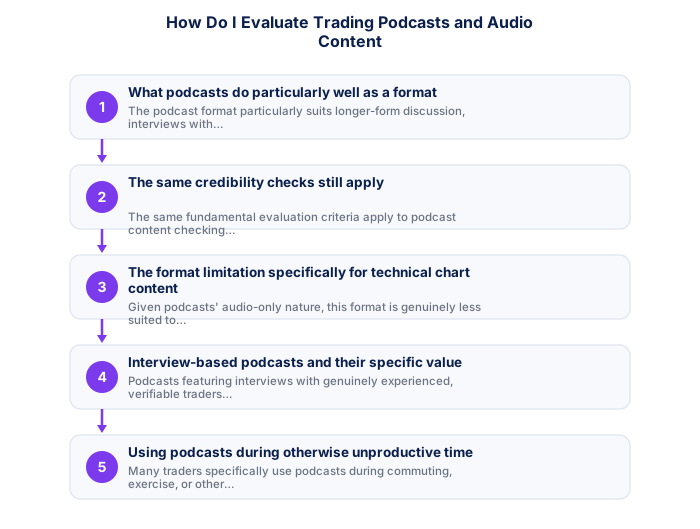
The podcast format particularly suits longer-form discussion, interviews with experienced traders or industry figures, and broader market commentary and analysis that doesn't necessarily require visual charts to convey effectively, making it well-suited to building broader market understanding and hearing varied perspectives.
It's worth appreciating this format's particular strength for psychology and mindset content specifically, hearing an experienced trader talk candidly through their own genuine struggles and lessons learned often conveys the emotional, human dimension of trading more effectively than written or purely visual content typically manages.
✓
Practical tip: Apply each concept in this guide to your specific account size, risk tolerance, and instruments. Generic rules always need calibration to your individual trading setup.
2. The same credibility checks still apply
The same fundamental evaluation criteria used for evaluating YouTube and influencer content apply to podcast content: checking for substantive discussion over hype, honest acknowledgment of risk and uncertainty, and verifiable credibility of hosts or guests, rather than assuming the audio-only format itself confers any particular additional credibility or authenticity.
General Trading Readiness Checklist
FSCA-regulated broker verified at fsca.co.za
Demo account tested for minimum 60 days
Trading plan written: entry, exits, position sizing
Risk per trade defined (1-2% of account)
Backup internet connection tested for load shedding
Tax implications understood
DODON'T
Apply each concept to your specific account size and instruments
Use generic rules without calibrating to your own setup
Test any new approach on demo before live application
Skip demo when trying new methods
Keep written records of every decision and its rationale
Review performance against your rules, not just P&L
Judge trading quality solely by whether money was made
3. The format limitation specifically for technical chart content
Given podcasts' audio-only nature, this format is genuinely less suited to detailed technical analysis instruction involving specific chart patterns or indicator setups, which generally benefit from the visual demonstration that video or written content with embedded images can provide more directly and clearly.
It's worth pairing any technical concepts discussed on a podcast with your own hands-on chart review afterward, rather than trying to fully absorb a chart-pattern explanation purely through audio description, following up with visual practice closes the gap this format's inherent limitation creates.
79%retail CFD accounts lose money
1-2%recommended max risk per trade
100+demo trades before going live
5 yearsSARS minimum record keeping
South African Trading Quick Reference
Regulator
FSCA, fsca.co.za
Tax authority
SARS, sars.gov.za
Exchange control
SARB, resbank.co.za
JSE trading hours
09:00-17:00 SAST Mon-Fri
Best forex window
15:00-17:00 SAST (overlap)
CGT exclusion
R50,000 per year (individual)
4. Interview-based podcasts and their specific value
Podcasts featuring interviews with genuinely experienced, verifiable traders can offer valuable exposure to varied perspectives on psychology, risk management philosophy, and broader career journey insights, complementing the more technical, chart-focused content other formats typically provide more directly.
It's worth listening across several different interviewed traders rather than treating any single guest's specific approach as universally correct, hearing genuinely varied perspectives on risk management philosophy and psychology helps you develop your own informed view rather than simply adopting one person's particular framework wholesale.
SA Trading Quick Reference
Item
Detail
Regulator
FSCA, fsca.co.za
Exchange control
SARB, resbank.co.za
Tax authority
SARS, sars.gov.za
JSE hours
09:00-17:00 SAST Mon-Fri
Best forex session
15:00-17:00 SAST
CGT annual exclusion
R50,000 (individuals)
5. Using podcasts during otherwise unproductive time
Many traders specifically use podcasts during commuting, exercise, or other activities where visual attention isn't available but audio attention is, making this format particularly practical for incorporating ongoing trading education into an already busy schedule alongside other commitments.
It's worth being mindful that passive listening during another activity, driving, exercising, genuinely differs from focused, dedicated attention, useful for building general awareness and exposure to ideas, but worth revisiting more deliberately later if a specific concept seems genuinely important enough to apply directly to your own trading.
6. A balanced place for podcasts within your broader learning
Treating podcasts as one valuable input within a broader, varied learning approach, complementing rather than replacing more visually-oriented technical analysis content and hands-on practice, supports a well-rounded, complete approach to ongoing trading education.
The quality of trading education available to South African traders has improved substantially with the growth of FSCA-regulated broker educational content and global online resources. The critical evaluation skill, separating genuinely educational content from thinly disguised marketing for signals, courses, or investment schemes, is as important as the content itself. South African traders should additionally prioritise educational resources that address SA-specific topics including ZAR trading dynamics, SARB policy implications, FSCA regulatory requirements, and SARS tax treatment, since virtually all internationally produced trading education was created without these local dimensions in mind.
What podcasts suit versus what they don't
Well suited
Less suited
Long-form discussion
Yes
N/A
Interviews with traders
Yes
N/A
Passive listening
Commute, exercise
NIA
Detailed technical analysis
No
Audio-only limits this
Sole learning source
No
Better as one input
Podcasts suit long-form discussion and passive listening. They're genuinely less suited to detailed technical analysis.
Podcasts particularly suit longer-form discussion and passive listening during commuting or exercise, but the audio-only format is genuinely less suited to detailed technical analysis.
★ Why It Matters
One thing we'd listen for specifically: whether guests with opposing views on a given strategy or market call are ever featured, podcasts that only platform one viewpoint consistently tend to function more as marketing for that viewpoint than genuine, balanced education.
✕ Common mistakes
Listening only to podcasts that confirm your existing views. Exposure to opposing, well-reasoned views improves overall analysis.
Not checking whether guests with differing opinions are ever featured. A single consistent viewpoint can resemble marketing more than education.
Treating audio-only formats as inherently less rigorous. Format says little about the substance of what's actually discussed.
Apply the same substantive-content and verifiable-credibility checks used for video content, while recognising podcasts' format favours discussion over charts.
Apply the same substantive-content and verifiable-credibility checks used for video content, while recognising the podcast format favours discussion and interviews over visual chart analysis.
What podcasts do particularly well as a format.
The same credibility checks still apply.
The format limitation specifically for technical chart content.
Should I rely on podcasts as my primary trading education source?
Given the format limitation for detailed chart instruction, complementing podcasts with more visually-oriented technical content is generally advisable for complete learning.
Are South African trading podcasts available specifically?
Some local content does exist; searching specifically for South African financial and trading podcasts can reveal locally-relevant options alongside broader international content.
Can podcast hosts have the same incentive concerns as YouTube creators?
Yes, similar revenue and promotional incentive structures can apply to podcast hosts and sponsors as well.
Business Development Analyst | Online Trading & Partnerships
Last reviewed: 2 June 2026
Daniel writes on the practical, account-level side of trading: brokers, platforms, deposits and withdrawals, and how the online trading industry actually operates behind the scenes. His background is in partnerships and business development across the online financial services sector, working closely with brokers and affiliates internationally.
This article draws on general information published by the South African regulators and established financial education resources listed below. Always check each source directly for the most current detail.