Home โ€บ Forex Pairs & Currencies โ€บ What Is a Currency Peg and Are Any Currencies Pegged to the Rand?

What Is a Currency Peg and Are Any Currencies Pegged to the Rand?

i Short answer

A currency peg fixes one currency's value to another at a set, maintained rate.

Both Lesotho's loti and Namibia's dollar are pegged at parity (1:1) to the South African Rand under the Common Monetary Area arrangement.

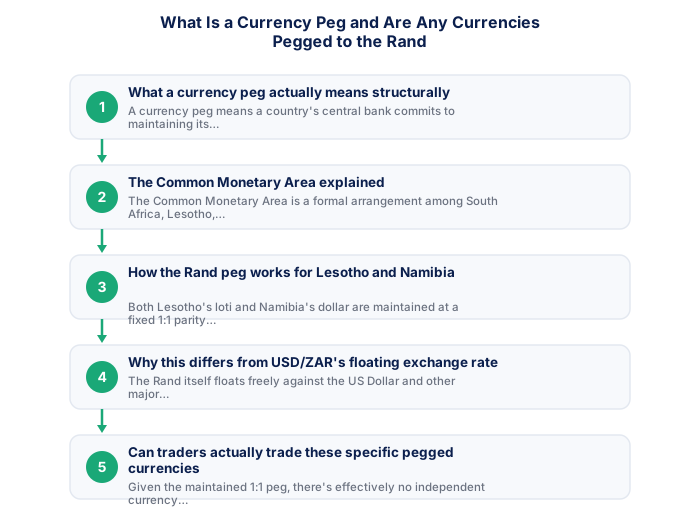
1. What a currency peg actually means structurally

A currency peg means a country's central bank commits to maintaining its currency's value at a fixed rate relative to another specific currency, actively intervening in currency markets as needed to defend this fixed rate, rather than allowing the currency to float freely based on market supply and demand the way USD/ZAR, does.

6/yrSARB MPC meetings affecting ZAR
3credit agencies reviewing SA annually
Februarybudget speech month
3-5 pipstypical USD/ZAR retail spread
ZA
SA market context: USD/ZAR is moved by both global EM risk appetite and SA-specific drivers. Separating these two components produces more precise ZAR analysis than treating the pair as one signal.

2. The Common Monetary Area explained

The Common Monetary Area is a formal arrangement among South Africa, Lesotho, Namibia, and Eswatini, allowing these countries' currencies to circulate alongside or be pegged to the Rand within this regional framework, reflecting their close historical and economic integration with South Africa specifically.

South African traders accessing forex and CFD markets should understand that the instruments they trade through FSCA-regulated brokers are derivative contracts rather than ownership of the underlying asset. This means that all profits and losses are settled in cash, position sizes can be adjusted to suit any account size, and the same trading infrastructure provides access to global markets from a ZAR-denominated account. Understanding this fundamental structure helps traders make better decisions about instrument selection, position sizing, and account management.

Weekly SA Market Monitoring Checklist
  • SARB economic calendar checked for the week
  • Next Eskom load shedding schedule reviewed
  • GNU stability news reviewed
  • Stats SA data releases noted
  • Credit agency review dates checked
  • US/global events that move EM risk noted
SA Market Calendar Reference
SARB MPC
6 meetings/year, rate decision
Budget Speech
Late February, fiscal signal
Moody's review
Typically October/November
S&P Fitch review
Typically October/November
Stats SA CPI
3rd week of each month
Eskom stages
Real-time, check eskomsepush.com
~R16-22USD/ZAR trading range 2022-2025
6/yearSARB MPC meetings
3rating agencies reviewing SA annually
Februaryhighest SA market volatility month

3. How the Rand peg works for Lesotho and Namibia specifically

Both Lesotho's loti and Namibia's dollar are maintained at a fixed 1:1 parity with the South African Rand, meaning these currencies' value moves in perfect lockstep with the Rand's own value against other global currencies, there's no independent exchange rate fluctuation between the Rand and either of these two specific currencies given this maintained peg.

SA ZAR Event Calendar
EventFrequencyZAR impactSource
SARB MPC6x per yearHighresbank.co.za
Budget SpeechAnnual (February)Very hightreasury.gov.za
Credit reviewsAnnual each agencyVery highAgency sites
Stats SA CPIMonthlyMediumstatssa.gov.za
Eskom stageAs neededLow-mediumeskomsepush.com
Pros
  • SA context provides genuine informational edge
  • ZAR pairs accessible via FSCA brokers in ZAR accounts
  • Rand volatility creates larger intraday ranges
  • 6 SARB meetings/year create regular macro setups
Cons
  • Higher geopolitical risk than G10 pairs
  • Load shedding creates unique operational disruptions
  • SA rand liquidity thinner than major G10 pairs
  • SA-specific news requires constant local monitoring

4. Why this differs from USD/ZAR's floating exchange rate

The Rand itself floats freely against the US Dollar and other major currencies, with its value determined by market forces, the pegged relationship with the loti and Namibian dollar is a separate, regional arrangement distinct from this broader, freely-floating relationship with major global currencies.

!
Load shedding during 15:00-17:00 SAST is a specific risk

This peak forex liquidity window coincides with common afternoon load shedding slots. Pre-set stop-losses and a tested mobile data backup are standard operating procedure, not optional extras.

5. Can traders actually trade these specific pegged currencies

Given the maintained 1:1 peg, there's effectively no independent currency pair trading opportunity between the Rand and these specific pegged currencies, since their value simply mirrors the Rand exactly, this differs entirely from the genuine independent price discovery that occurs in USD/ZAR or other freely floating pairs.

6. Why this context is still worth understanding for South African traders
While not directly tradeable as an independent currency relationship, understanding this Common Monetary Area context provides useful broader regional economic context, particularly relevant if you have any personal or business connection to Lesotho, Namibia, or Eswatini, and helps clarify why these specific currencies don't appear as independently tradeable forex pairs through typical broker platforms.

Rand pairs specifically are also sensitive to SARB policy decisions, particularly repo rate announcements, which can move USD/ZAR and other Rand crosses sharply around the announcement window regardless of the technical picture beforehand.

South African traders have a natural advantage when analysing ZAR-denominated instruments because they observe the domestic drivers of rand movements directly and continuously. The key analytical discipline is separating USD/ZAR movements that are driven by global USD strength from those driven by SA-specific factors. When the rand is weakening at the same time as other major EM currencies, the driver is typically global risk appetite, not a SA-specific issue. When the rand is weakening while EM peers are stable or strengthening, a domestic SA factor is at work and requires a different analytical and positioning response.

For South African traders operating within the FSCA-regulated environment, the combination of clear regulatory oversight, ZAR account access, and the unique analytical opportunities provided by rand-specific market drivers creates a well-structured foundation for developing a professional trading practice. The key to converting this foundation into consistent results is not finding the perfect strategy or the perfect instrument but developing the discipline to execute a sound strategy consistently across a large enough sample of trades to allow the strategy's statistical edge to express itself.

South Africa's financial markets reward traders who develop genuine familiarity with the country's specific economic and political drivers rather than applying global frameworks without local adaptation. The JSE's heavy concentration in resources companies means it behaves differently from broad international equity indices during commodity cycles. USD/ZAR's sensitivity to domestic political events, SARB policy signals, and the decisions of credit rating analysts creates analytical opportunities for traders who follow SA-specific news closely. SARB MPC decisions are made against a backdrop of structural inflation and current account pressures that differ from the developed market central banking environment that most global frameworks assume. Traders who invest time in understanding these SA-specific layers develop informational advantages that remain relevant across multiple market cycles.

South Africa's financial markets reward traders who develop genuine familiarity with the country's specific economic and political drivers rather than applying global frameworks without local adaptation. The JSE's heavy concentration in resources companies means it behaves differently from broad international equity indices during commodity cycles. USD/ZAR's sensitivity to domestic political events, SARB policy signals, and the decisions of credit rating analysts creates analytical opportunities for traders who follow SA-specific news closely. SARB MPC decisions are made against a backdrop of structural inflation and current account pressures that differ from the developed market central banking environment that most global frameworks assume. Traders who invest time in understanding these SA-specific layers develop informational advantages that remain relevant across multiple market cycles.

โ˜… Why It Matters

Something worth knowing : because the Lesotho loti and Namibian dollar are pegged to the Rand, traders sometimes mistakenly assume there's a tradeable arbitrage opportunity here, in practice the peg is maintained by monetary policy coordination, not an exploitable retail trading opportunity.

Pegged currency
Fixed to another
Central bank defends the rate
Free-floating currency
Market determined
Rand is free-floating
Rand's regional role
Lesotho Loti
pegged to Rand 1:1
Eswatini Lilangeni
pegged to Rand
Namibian Dollar
pegged to Rand
Rand itself
free-floating

The Rand itself is a free-floating currency. Several regional currencies including the Lesotho Loti, Eswatini Lilangeni, and Namibian Dollar are pegged to it at a 1:1 rate.

โœ• Common mistakes

  • Confusing a regional currency peg with the Rand's own floating status. The Rand itself floats freely, only specific regional currencies are pegged to it.
  • Treating pegged currencies as having independent monetary policy from the Rand. Their value is specifically anchored to Rand movements by design.
  • Ignoring how this peg arrangement reflects the Common Monetary Area structure. Understanding this context clarifies why the peg exists at all.
Are CFDs available on JSE-listed shares for South African traders?

Yes. Most major FSCA-regulated CFD brokers offer contracts on JSE-listed shares and the JSE Top 40 index. These allow leveraged trading on SA equities through a single account without needing a separate stockbroker.

Do overnight financing charges apply to forex positions held over the weekend?

Most brokers apply three days of financing on positions held over the weekend, typically charged on Wednesday. This reflects the two-day settlement cycle that extends over Saturday and Sunday in the interbank market.

South Africa's financial markets have structural characteristics that differentiate them from the global trading environment covered in most international trading education resources. The JSE's significant weighting toward resources and mining companies means it responds differently to global commodity cycles than more diversified international indices. USD/ZAR's dual sensitivity to global EM risk appetite and domestic SA fundamentals creates a richer analytical environment for traders who are willing to develop both dimensions of analysis, rather than relying solely on technical charts that ignore the fundamental context entirely.

South African traders have a natural analytical advantage on rand-paired currencies because they observe the domestic drivers of ZAR directly and continuously. The technical relationships between major currency pairs and the USD/ZAR, particularly the negative correlation between USD/ZAR and risk-on periods, become more predictable once you understand which component of USD/ZAR movement is driven by global USD strength and which is driven by SA-specific fundamental factors. Building this analytical separation into your daily market review produces more precise ZAR trading hypotheses than treating USD/ZAR as a single undifferentiated signal.

Understanding how South African market conditions differ from the global trading environment covered in most textbooks gives local traders a genuine analytical edge. The JSE's resources weighting, the rand's dual sensitivity to global EM flows and domestic fundamentals, and the specific calendar of SA market events, SARB MPC dates, budget speeches, credit rating reviews, create a richer analytical environment than pure technical analysis alone captures. Building awareness of these SA-specific layers alongside standard trading principles produces more sound analysis for ZAR instruments and JSE-listed products.

Key Takeaways

  1. A currency peg fixes one currency's value to another, with both Lesotho's loti and Namibia's dollar pegged at parity to the South African Rand.
  2. A currency peg fixes one currency's value to another at a set, maintained rate.
  3. Both Lesotho's loti and Namibia's dollar are pegged at parity (1:1) to the South African Rand under the Common Monetary Area arrangement.
  4. What a currency peg actually means structurally.
  5. The Common Monetary Area explained.

Frequently asked follow-up questions

Can I use Rand directly in Lesotho or Namibia?

Yes, given the close monetary arrangement and peg discussed in this piece, the Rand is generally widely accepted alongside the local currency in these specific countries.

Is Eswatini's currency also pegged to the Rand?

Eswatini participates in the same broader Common Monetary Area framework, with its own currency similarly linked to the Rand through this regional arrangement.

Does this peg ever face pressure to change?

Currency pegs generally require ongoing active maintenance by the pegging country's central bank; this specific Common Monetary Area arrangement has been a longstanding regional structure.

๐Ÿ“š Sources & further reading

This article draws on general information published by the South African regulators and established financial education resources listed below. Always check each source directly for the most current detail.

Explore more South African trading guides on TradeAnswers.

๐Ÿ›ก๏ธ
Practice without risk

Trade This Pair With Zero Risk

Get a feel for this currency pair's real behaviour on a free, FSCA-regulated demo account.

Trade This Pair Free
  • FSCA RegulatedTrade with confidence
  • Practice Risk FreeReal market conditions
  • Beginner FriendlyPerfect for learning

79% of retail CFD accounts lose money. Demo accounts do not guarantee future profits.