i Short answer
Incorrect banking details typically cause a withdrawal to fail or bounce back to your broker rather than being lost entirely.
This requires you to correct the details and resubmit, extending the overall timeline before receiving your funds.
📋 ON THIS PAGE
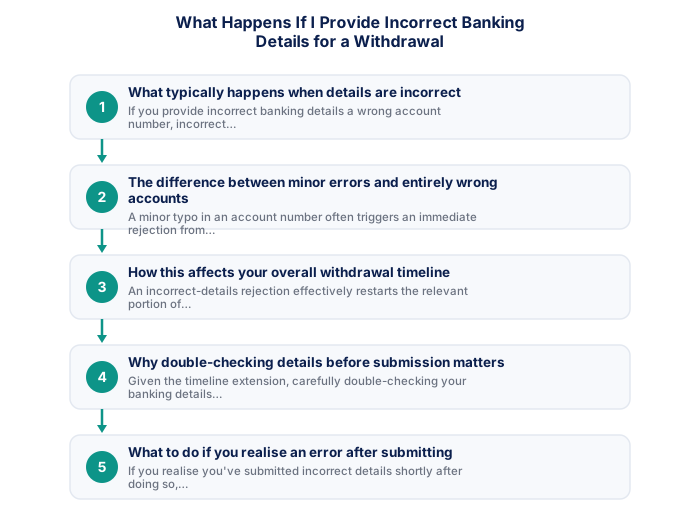
- What typically happens when details are incorrect
- The difference between minor errors and entirely wrong accounts
- How this affects your overall withdrawal timeline
- Why double-checking details before submission matters
- What to do if you realise an error after submitting
- Preventing this in future withdrawals
1. What typically happens when details are incorrect
If you provide incorrect banking details, a wrong account number, incorrect branch code, or mismatched account holder name, the receiving bank typically rejects the transfer, causing the funds to bounce back to your broker rather than being lost or sent to an unintended recipient, particularly given the name-matching checks many banks apply during this kind of transfer.
It's worth understanding this as a genuine protective mechanism working in your favour, however inconvenient it feels in the moment, this same rigorous checking that occasionally catches a minor error is exactly what prevents your funds from being sent to a genuinely wrong destination account entirely.
2. The difference between minor errors and entirely wrong accounts
A minor typo in an account number often triggers an immediate rejection from the banking system itself, since the specific account simply doesn't exist as entered, while providing genuinely different but valid account details (perhaps an old, closed account) might take slightly longer to identify as a problem, though the underlying outcome, failed transfer requiring correction, remains similar.
It's worth double-checking each specific field individually rather than reviewing the form as a whole, account numbers, branch codes, and account holder names each carry their own specific formatting requirements, worth verifying each one deliberately rather than a single, quick overall glance.
- South African ID or valid passport
- Proof of residential address dated within 3 months
- Proof of bank account ownership
- Selfie or photo for biometric verification (some brokers)
- Source of funds declaration if depositing above threshold
Choose FSCA-regulated broker
Verify the FSP number is current at fsca.co.za.
Submit FICA documents
SA ID, proof of address within 3 months, bank account proof.
Fund via EFT
Make the initial deposit from your SA bank account in ZAR.
Open demo account first
Practice on demo before activating your live account.
Start with minimum capital
Begin with an amount you can afford to lose while learning.
3. How this affects your overall withdrawal timeline
An incorrect-details rejection effectively restarts the relevant portion of this timeline, since you'll need to resubmit corrected details and wait for this corrected request to process, this can meaningfully extend your overall wait beyond what a correctly-submitted request would have taken from the outset.
It's worth building in a small time buffer for any withdrawal you genuinely need by a specific date, rather than requesting it at the last possible moment, this buffer absorbs exactly this kind of unexpected, entirely avoidable delay without creating genuine financial stress.
4. Why double-checking details before submission matters
Given the timeline extension, carefully double-checking your banking details, account number, branch code, and account holder name, before submitting any withdrawal request, similar to the careful checking, helps avoid this entirely preventable delay.
It's worth developing a specific, consistent habit for this check, reading your entered details aloud, or comparing them character by character against your bank's own official statement, tends to catch errors that a quick visual scan alone often misses.
| Rejection reason | Fix |
|---|---|
| Address proof older than 3 months | Get a recent utility bill or bank statement |
| Name mismatch between documents | Use documents with exactly matching full name |
| Poor quality scan | Retake with good lighting, all corners visible |
| PO Box address | Brokers require physical residential address only |
5. What to do if you realise an error after submitting
If you realise you've submitted incorrect details shortly after doing so, contacting your broker's support team immediately, to flag this before the transfer is actually processed can sometimes allow correction before the failed-transfer cycle even begins.
It's worth contacting support immediately the moment you notice any error, rather than waiting to see if the system catches it automatically, the earlier you flag a mistake, the more likely it can be corrected before the withdrawal has actually processed and moved further along.
6. Preventing this in future withdrawals
Since withdrawals typically return to your originally verified depositing account rather than requiring fresh entry of banking details each time, this specific risk is often more relevant to less common scenarios, such as updating your banking details, rather than every routine withdrawal.
Local EFT deposits and withdrawals run through the infrastructure overseen by PASA (the Payments Association of South Africa), which is part of why Rand-denominated transfers between South African bank accounts tend to clear faster than international wire transfers.
An incorrect banking detail on a withdrawal typically results in the funds being returned to your broker account, but it adds processing delays. Checking details carefully before submitting avoids this.
★ Why It Matters
Worth double-checking specifically before submitting any withdrawal request: that your bank account is in your own name exactly matching your verified identity, withdrawals to third-party accounts, even a spouse's, are frequently blocked entirely by anti-money-laundering controls, not just delayed.
✕ Common mistakes
- Not double-checking banking details before submitting a withdrawal request. Simple errors here add unnecessary processing delay.
- Assuming an incorrect withdrawal will simply succeed elsewhere. It typically bounces back to the broker rather than reaching an unintended recipient.
- Ignoring how outdated banking details affect withdrawal speed. Mismatched or outdated information is a common, avoidable delay.
Key Takeaways
- Incorrect banking details typically cause a withdrawal to fail or bounce back, requiring resubmission with corrected details rather than the funds being lost.
- Incorrect banking details typically cause a withdrawal to fail or bounce back to your broker rather than being lost entirely.
- This requires you to correct the details and resubmit, extending the overall timeline before receiving your funds.
- What typically happens when details are incorrect.
- The difference between minor errors and entirely wrong accounts.
See also: What Is a Joint Trading Account and Can I Open One in South Africa?.
Frequently asked follow-up questions
Will I be charged a fee if my withdrawal fails due to incorrect details?
This varies by broker; checking your specific broker's fee schedule clarifies whether any charge applies to a failed transfer of this kind.
Can incorrect details ever result in funds going to a stranger's account?
This is unlikely given the name-matching checks many banks apply, though it's not entirely impossible in unusual circumstances, making careful detail-checking important regardless.
How do I update my banking details with my broker?
This typically involves contacting support directly and providing updated verification documentation, similar to the original account verification process.
