i Short answer
This fee applies when a trade or deposit involves a currency different from your account's base currency, requiring an automatic conversion step.
Some brokers apply a small additional charge or spread to this.
📋 ON THIS PAGE
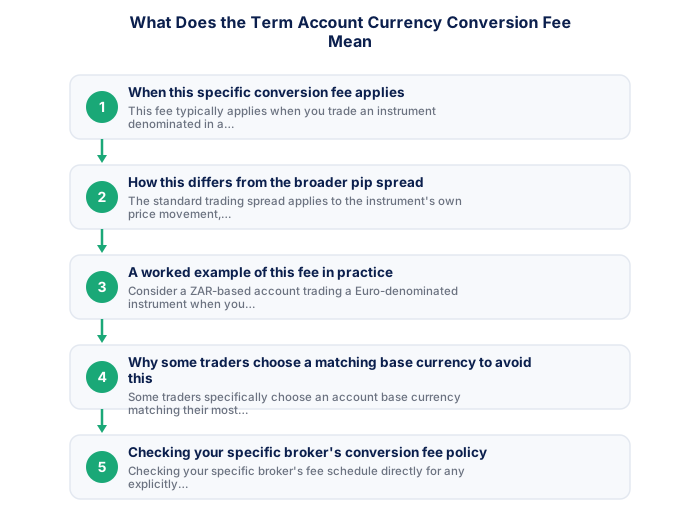
1. When this specific conversion fee applies
An account currency conversion fee applies when you trade an instrument denominated in a different currency from your account's base currency, or when you deposit or withdraw funds in a different currency. When you close the position, your profit or loss is first calculated in the instrument's native currency and then converted to your account currency, and that conversion typically carries a fee.
The fee isn't always a separately itemised charge that appears in your account statement. Often it's embedded in the exchange rate applied to the conversion, the broker applies a slightly less favourable rate than the mid-market rate, with the difference representing their fee for the conversion service. This makes it harder to identify and track than an explicit commission charge.
For South African traders with ZAR-denominated accounts who trade USD-priced instruments, which describes a large proportion of the global CFD and forex market, this fee is present on effectively every trade. Over time, at any meaningful trading frequency, it represents a non-trivial component of total trading costs.
The R2.50 gap is the embedded conversion fee, easy to miss since it's built into the rate rather than shown as a separate line item.
2. How this differs from the broader pip spread
The spread is the difference between the buy and sell price on the instrument you're trading, and it compensates the broker for making a market in that instrument. The currency conversion fee is a separate layer applied when the P&L from that instrument needs translating into a different currency, your account currency.
Both are real costs, but they're distinct mechanisms. The spread applies regardless of whether any currency conversion is needed. The conversion fee only applies when the instrument and account currencies differ. A trader whose account currency matches the instrument they're trading pays the spread but not the conversion fee, a relevant difference when comparing accounts or brokers.
- South African ID or valid passport
- Proof of residential address dated within 3 months
- Proof of bank account ownership
- Selfie or photo for biometric verification (some brokers)
- Source of funds declaration if depositing above threshold
- Predictable cost per trade
- Widens less during news
- Better for news traders
- Slightly wider average
- Very low in calm markets
- Widens during high-impact news
- Lower average cost
- Better for swing traders
Understanding both costs as distinct line items helps you calculate the true all-in cost of trading a particular instrument from a particular account type. Adding spread cost plus conversion fee cost (where applicable) plus any overnight financing gives you the complete picture that the headline spread figure alone doesn't provide.
3. A worked example of this fee in practice
Consider a ZAR-denominated account trading a USD-denominated instrument. When you close the trade, your P&L in USD, say a $50 profit, needs converting to ZAR. The broker applies a conversion rate of, for example, 18.45 USD/ZAR rather than the mid-market rate of 18.50, and your R50 profit becomes R922.50 rather than R925. The R2.50 difference is the conversion fee in practice.
Per trade, this amount is modest. Across a hundred trades, it compounds into a meaningful total. Across a year of active trading, currency conversion fees can represent a percentage of your total trading capital that you've paid purely for the currency translation step, money that would compound for you if it were reduced by choosing an appropriately denominated account.
The magnitude of the fee depends on two factors: the size of the trade and the conversion margin the broker applies. Brokers with tighter conversion margins are genuinely cheaper for cross-currency trading. Checking this specifically in a broker's fee schedule, not just their spread, is part of a complete cost comparison.
4. Why some traders choose a matching base currency to avoid this
Some traders specifically choose an account base currency that matches their most frequently traded instruments to minimise currency conversion costs. A trader primarily trading USD-priced forex pairs and CFDs who opens a USD-denominated account pays the spread on each trade but avoids the conversion step on every P&L calculation.
For South African traders, this involves a practical trade-off. A USD account reduces conversion costs on trading, but depositing and withdrawing in USD from a South African bank involves SARB exchange control steps and currency conversion at the bank level, costs that may offset the savings depending on deposit and withdrawal frequency.
| Rejection reason | Fix |
|---|---|
| Address proof older than 3 months | Get a recent utility bill or bank statement |
| Name mismatch between documents | Use documents with exactly matching full name |
| Poor quality scan | Retake with good lighting, all corners visible |
| PO Box address | Brokers require physical residential address only |
The optimal choice depends on your specific trading profile: frequency of trading, proportion of positions in instruments that require conversion, and deposit/withdrawal patterns. Running the numbers on your own activity produces a more reliable answer than any general rule.
5. Checking your specific broker's conversion fee policy
Your broker's fee schedule should state their currency conversion fee or margin explicitly. Look for terms like 'currency conversion charge', 'FX conversion fee', or a stated percentage or pip margin applied to conversions. If this information requires a support inquiry to locate rather than being published clearly, that's itself a transparency concern worth noting.
Some brokers publish a fixed conversion margin (e.g. 0.5% above mid-market). Others embed it in their standard spread without separating it out, making it harder to evaluate in isolation. When comparing brokers, asking specifically about their conversion margin for your account currency and the instruments you trade produces the clearest cost comparison.
FSCA-regulated brokers are required to disclose their fee structures clearly. If a broker's published fee information doesn't address conversion costs, asking their support team for the specific rate applied and requesting a written confirmation creates a record that's useful for your own cost tracking.
6. How this connects to overall trading cost comparison
Currency conversion fee is one component of the total trading cost picture. A complete comparison between brokers should include spread, conversion margin, overnight financing rates, any explicit commissions, and withdrawal fees, not just the headline spread that most marketing emphasises.
For South African retail traders, the interaction between conversion fees, SARB exchange control requirements, and the ZAR's volatility creates a more complex cost picture than the same trader in a currency that doesn't involve exchange controls. Factoring all of these into your broker selection at account opening is more efficient than discovering them after capital is deployed.
Worth calculating for your own situation: estimate your monthly trading volume, apply your broker's stated conversion margin to the proportion of trades that require conversion, and see what annual total emerges. Comparing that figure across two or three brokers often reveals differences that make broker selection a meaningful cost management decision.
✕ Common mistakes
- Ignoring this fee when calculating overall trading costs. It can meaningfully add up across a month's worth of trades.
- Trading USD instruments on a ZAR account without checking the conversion cost. This mismatch creates ongoing, avoidable friction.
- Assuming this fee is identical across all brokers. Conversion fees and spreads vary meaningfully between providers.
- Not considering account currency choice in light of your typical traded instruments. Matching currencies where possible reduces unnecessary cost.
Key Takeaways
- This fee applies when a trade or deposit involves a currency different from your account's base currency, requiring an automatic conversion step.
- Some brokers apply a small additional charge or spread to this.
- When this specific conversion fee applies.
- How this differs from the broader pip spread.
- A worked example of this fee in practice.
Frequently asked follow-up questions
Does this fee apply to ZAR-to-ZAR trading entirely?
No, this specific fee only applies when genuine currency conversion is actually required, not for trades and transactions remaining entirely within your account's base currency.
Is this fee typically a fixed amount or a percentage?
This commonly applies as a small percentage or spread adjustment on the converted amount rather than a fixed monetary fee, though specific structures vary by broker.
Can I negotiate this fee with my broker?
This is generally a standard, published fee rather than something typically negotiated individually, though checking whether higher account tiers offer reduced rates is worth exploring.
Does every broker charge this kind of conversion fee?
Not necessarily uniformly. Checking your specific broker's fee schedule directly confirms whether and how this specific charge applies to your particular account.
Does this fee affect deposits and withdrawals the same way it affects trades?
Yes, the same underlying conversion principle applies whenever currency conversion is genuinely required, whether for trading profit, deposits, or withdrawals specifically.
