i Short answer
Your account base currency determines the denomination of your balance, profit, loss, and statements, for example ZAR or USD.
This is generally fixed at account opening and typically can't be changed afterward on the same account.
📋 ON THIS PAGE
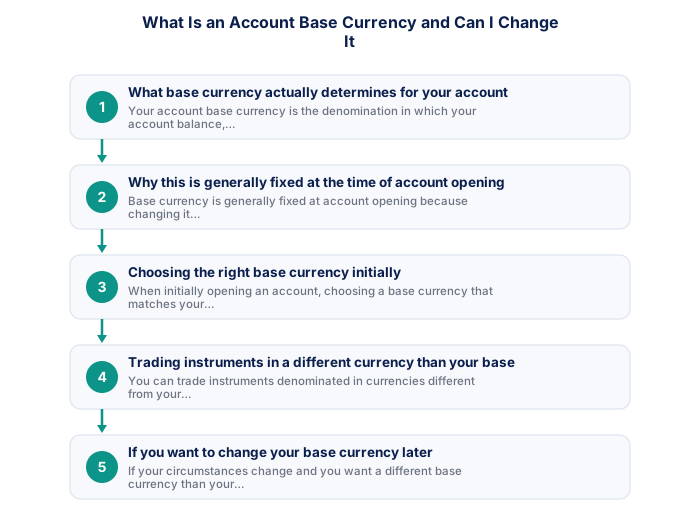
- What base currency actually determines for your account
- Why this is generally fixed at the time of account opening
- Choosing the right base currency initially
- Trading instruments in a different currency than your base
- If you want to change your base currency later
- Considerations specific to South African traders
1. What base currency actually determines for your account
Your account base currency is the denomination in which your account balance, realised profit and loss, and account statements are all expressed, regardless of which specific instruments or currency pairs you actually trade. This differs from the currencies involved in any specific trade itself, which depend on the particular instrument's own currency pair notation.
It's worth appreciating why this single setting has such wide-reaching influence, every figure you see throughout your trading experience, balance, profit and loss, margin requirements, ultimately gets expressed in this one chosen currency, worth understanding it as a genuinely foundational account setting rather than a minor detail.
2. Why this is generally fixed at the time of account opening
Base currency is generally fixed at account opening because changing it afterward would require recalculating your entire account history and balance in a different currency, introducing the kind of complexity and potential for error that most brokers avoid by simply not offering this kind of mid-account change, instead requiring a fresh account if you want a different base currency.
It's worth treating this choice with the same care you'd give any other significant account setup decision, since reversing it later, discussed elsewhere on this site regarding changing base currency, effectively means opening an entirely new account rather than adjusting a simple preference.
- South African ID or valid passport
- Proof of residential address dated within 3 months
- Proof of bank account ownership
- Selfie or photo for biometric verification (some brokers)
- Source of funds declaration if depositing above threshold
Choose FSCA-regulated broker
Verify the FSP number is current at fsca.co.za.
Submit FICA documents
SA ID, proof of address within 3 months, bank account proof.
Fund via EFT
Make the initial deposit from your SA bank account in ZAR.
Open demo account first
Practice on demo before activating your live account.
Start with minimum capital
Begin with an amount you can afford to lose while learning.
3. Choosing the right base currency initially
When initially opening an account, choosing a base currency that matches your own personal financial context, typically ZAR for South African traders funding and eventually withdrawing in Rand, generally simplifies your overall financial management, avoiding unnecessary currency conversion friction at the deposit and withdrawal stages specifically.
It's worth thinking specifically about which currency you actually think and budget in day to day, rather than any other consideration, an account denominated in the currency you're most naturally comfortable reasoning about tends to support clearer risk management thinking overall.
4. Trading instruments in a different currency than your base
You can trade instruments denominated in currencies different from your account base currency, for example, trading EUR/USD with a ZAR base currency account, with your broker's platform automatically handling the necessary conversion when calculating your realised profit, loss, and pip value in your actual base currency.
It's worth understanding that your platform handles this conversion automatically and smoothly, discussed elsewhere on this site regarding trading global markets while holding a ZAR balance, you don't need to manually convert figures yourself when trading instruments priced in a currency different from your account base.
| Rejection reason | Fix |
|---|---|
| Address proof older than 3 months | Get a recent utility bill or bank statement |
| Name mismatch between documents | Use documents with exactly matching full name |
| Poor quality scan | Retake with good lighting, all corners visible |
| PO Box address | Brokers require physical residential address only |
5. If you want to change your base currency later
If your circumstances change and you want a different base currency than your existing account uses, the typical path involves opening a new account with your chosen base currency (most brokers support multiple account types and currencies, then gradually transitioning your trading activity toward this new account rather than expecting an in-place currency change on your existing one.
It's worth reading the detailed process for this specifically, discussed elsewhere on this site regarding changing account base currency, before assuming any particular outcome, since the exact mechanics genuinely matter if you're considering this change.
6. Considerations specific to South African traders
South African traders should weigh the genuine trade-offs between ZAR versus foreign-currency-denominated accounts when initially choosing base currency, considering factors like simplified local banking integration for ZAR accounts versus potential currency exposure management benefits some traders specifically seek through a foreign-currency base instead.
Your account base currency is locked in at opening and generally can't be changed directly. Opening a new account in the desired currency is the practical solution, with the currency conversion occurring on fund transfer.
★ Why It Matters
Worth deciding deliberately at account opening rather than defaulting: if you earn in ZAR but plan to trade mostly USD-denominated instruments, consider explicitly whether a USD-base account (if your broker offers ZAR funding into it) might reduce the conversion friction you'd otherwise face on every single trade.
✕ Common mistakes
- Choosing account currency without considering which instruments you'll mostly trade. A mismatch creates ongoing, avoidable conversion friction.
- Assuming this setting is easily changeable after account opening. Most brokers treat it as fixed once set.
- Not comparing ZAR versus USD account options before committing. The right choice depends on your specific trading plans.
- Ignoring how base currency affects your reported P&L figures. The same trade can show different absolute profit or loss depending on denomination.
Key Takeaways
- Your account base currency determines the denomination of your balance and statements, and is generally fixed at account opening, requiring a new account to change.
- Your account base currency determines the denomination of your balance, profit, loss, and statements, for example ZAR or USD.
- This is generally fixed at account opening and typically can't be changed afterward on the same account.
- What base currency actually determines for your account.
- Why this is generally fixed at the time of account opening.
Frequently asked follow-up questions
Does my base currency affect which instruments I can trade?
No, base currency affects how your results are denominated, not which specific instruments are available for you to trade on the platform.
Can I have accounts with different base currencies at the same broker?
Yes, many brokers support this through separate accounts opened specifically for that purpose.
Does changing base currency affect my tax reporting?
Your tax reporting should reflect your actual trading results regardless of base currency, though consulting a tax practitioner about the specific practical reporting implications is advisable.
Can my account's base currency differ from the pairs I trade?
Yes, this is common. You can hold a ZAR-denominated account while trading pairs involving entirely different currencies, with conversion applied automatically.
Does changing my account's base currency require opening a new account?
Generally yes, most brokers treat this setting as fixed once your account is opened.
Is there a standard default base currency most South African traders use?
ZAR is commonly chosen by South African traders, though USD and other options are sometimes also available depending on your specific broker.
Does this apply to JSE shares too?
Several local brokers offer CFDs on larger JSE shares, with the spread and overnight financing that come with any CFD. Trading JSE shares through a forex broker covers the detail.
Does my historical trading record transfer to the new currency account?
Generally not automatically in the new currency; your original account's historical record remains in its original denomination, separate from the new account.
Is there a fee for opening an additional account in a different currency?
This varies by broker; checking your specific broker's account opening terms clarifies whether any fee applies to this kind of additional account.
Can I close my original account after switching to a new currency account?
Yes, once funds are successfully transferred and you no longer need the original account, you can typically proceed with closing it following your broker's standard closure process.
Will I lose my trading history if I switch to a new currency account?
Your original account's history stays fully accessible within that account, as covered above, it just won't automatically merge into your new, differently-denominated one.
Does this limitation apply to all brokers equally?
Policies do vary somewhat by broker, checking directly with your particular provider confirms exactly what's possible in your situation.
Can I close my old account immediately after opening the new one?
Generally yes, once funds are successfully transferred and you've confirmed you no longer need the original account, just follow your broker's standard closure process.
Is there a fee for this kind of account transition?
This varies by broker, checking your specific provider's fee schedule clarifies whether opening an additional account or transferring funds carries any charge.
