i Short answer
EFT deposits generally work like any other electronic bank transfer: you send funds from your personal bank account to the broker's designated account, using a reference number the broker provides, with funds typically reflecting the same business day if sent within normal banking hours.
Processing speed varies mainly by which bank you use and what time of day you initiate the transfer, since most major banks batch EFT payments at specific cutoff times rather than processing instantly around the clock.
📋 ON THIS PAGE
1. The basic mechanics of an EFT deposit
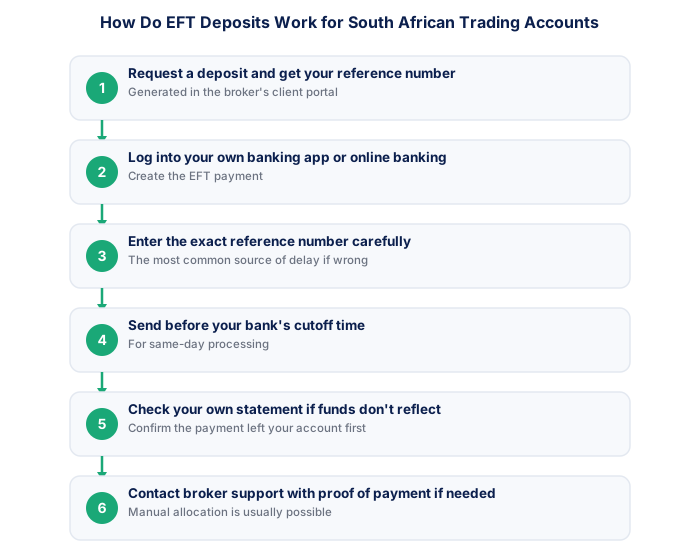
After logging into your trading account's client portal, you typically request a deposit and select EFT as the method, which generates the broker's banking details along with a unique reference number specific to your account. This reference number is critical, it is how the broker's system matches an incoming payment to your specific account.
You then log into your own online banking or banking app and create a new beneficiary or once-off payment using the broker's provided details, entering the exact reference number given, then complete the transfer as you would any other EFT payment.
| Payment Type | Typical Processing Time |
|---|---|
| Standard EFT, before cutoff | Same business day |
| Standard EFT, after cutoff | Next business day |
| Instant EFT/PayShap | Within minutes |
2. Typical processing times by major bank
FNB, Standard Bank, Absa, and Nedbank all support standard EFT payments that generally clear same business day if sent before the receiving bank's cutoff time, commonly mid-afternoon, though this varies. Payments sent after cutoff, or over a weekend, typically only reflect on the next business day.
Some brokers also support Instant EFT or PayShap-style rapid payment options through supported banks, which can reflect within minutes rather than requiring a full business day, though not all brokers and banks support these faster rails equally.
- SARB economic calendar checked for the week
- Next Eskom load shedding schedule reviewed
- GNU stability news reviewed
- Stats SA data releases noted
- Credit agency review dates checked
- US/global events that move EM risk noted
Choose FSCA-regulated broker
Verify the FSP number is current at fsca.co.za.
Submit FICA documents
SA ID, proof of address within 3 months, bank account proof.
Fund via EFT
Make the initial deposit from your SA bank account in ZAR.
Open demo account first
Practice on demo before activating your live account.
Start with minimum capital
Begin with an amount you can afford to lose while learning.
3. Why the reference number matters so much
Omitting or mistyping the broker-provided reference number is the single most common cause of a delayed or "missing" deposit, since without it the broker's system cannot automatically match your payment to your trading account trading account, requiring manual reconciliation that can add a meaningful delay.
Double-checking the reference number character by character before confirming the payment, rather than assuming autocomplete or a copied field is correct, is a small habit that avoids a common and entirely avoidable delay.
| Event | Frequency | ZAR impact | Source |
|---|---|---|---|
| SARB MPC | 6x per year | High | resbank.co.za |
| Budget Speech | Annual (February) | Very high | treasury.gov.za |
| Credit reviews | Annual each agency | Very high | Agency sites |
| Stats SA CPI | Monthly | Medium | statssa.gov.za |
| Eskom stage | As needed | Low-medium | eskomsepush.com |
- SA context provides genuine informational edge
- ZAR pairs accessible via FSCA brokers in ZAR accounts
- Rand volatility creates larger intraday ranges
- 6 SARB meetings/year create regular macro setups
- Higher geopolitical risk than G10 pairs
- Load shedding creates unique operational disruptions
- SA rand liquidity thinner than major G10 pairs
- SA-specific news requires constant local monitoring
4. What to do if a deposit does not reflect as expected
If a deposit has not reflected within the broker's stated typical timeframe, first confirm the payment actually left your account successfully by checking your own bank statement or app, since a failed or pending payment on your side is a common and easily checked first explanation.
If the payment did leave your account successfully, contact the broker's support team directly with your proof of payment and reference number, since most brokers can manually locate and allocate a misreferenced payment once provided with these specific details.
5. Fees and limits worth knowing about
Standard EFT deposits are typically free on the broker's side, though your own bank may charge a standard EFT transaction fee depending on your account type and banking package, so check with your bank directly rather than assuming it is always free.
Some brokers apply a minimum deposit amount for EFT specifically, and larger deposits may occasionally require additional source-of-funds documentation as part of standard financial crime compliance, particularly for a first-time large deposit that is notably larger than your account's typical pattern.
6. Instant EFT and third-party payment services
Some brokers integrate third-party instant payment services that initiate the EFT on your behalf after you log into your banking app through their secure interface, often reflecting faster than a standard manually entered EFT. These services are generally reputable when integrated directly by a regulated broker, though always confirm you are on the broker's own verified deposit page before entering banking credentials anywhere.
Regardless of which method you use, keeping your own proof of payment, whether a bank confirmation screenshot or reference number, for at least the transaction in question is good practice in case any reconciliation query arises later.
★ Why It Matters
Worth saving the broker's deposit reference number and banking details as a saved beneficiary in your own banking app after your first deposit, since this both speeds up future transfers and reduces the chance of a manual entry error on a subsequent deposit.
✕ Common mistakes
- Omitting or mistyping the broker's reference number. This is the most common cause of a delayed or unmatched deposit.
- Assuming all EFTs reflect instantly regardless of time sent. Standard EFT is generally batch-processed at specific bank cutoff times, not instant around the clock.
- Not checking your own bank statement first when a deposit seems delayed. Confirming the payment actually left your account is the fastest first troubleshooting step.
- Entering banking credentials on a page you haven't confirmed is the broker's own verified deposit interface. Always confirm you're on the legitimate, secure page before entering sensitive details.
How long does verification take?
A working day is normal. Complete it when you open the account rather than when you want money out, which is when the delay hurts. Switching brokers covers it in full.
Key Takeaways
- EFT deposits into a South African trading account generally work like any other electronic bank transfer: you send funds from your personal bank account to the broker's designated account, using a reference number the broker provides, with funds typically reflecting the same business day if sent within normal banking hours.
- The basic mechanics of an EFT deposit.
- Typical processing times by major bank.
- Why the reference number matters so much.
- What to do if a deposit does not reflect as expected.
Frequently asked follow-up questions
Is Instant EFT safe to use for a trading account deposit?
Generally yes when accessed directly through the broker's own verified deposit page, since these services are widely used and regulated in their own right, though always confirm you're on a legitimate page before entering banking credentials.
Can I deposit from someone else's bank account into my trading account?
Most brokers require deposits to originate from an account in your own name for compliance reasons, and third-party deposits are commonly rejected or flagged for additional verification.
Why did my broker ask for proof of the source of a large deposit?
This is a standard financial crime compliance requirement for unusually large or pattern-inconsistent deposits, applied by regulated brokers generally rather than specific to any one company.
